
First reactions.
What twelve courses on the human body taught me about yours
I finished the full Postural Restoration curriculum. Here's the map — and one honest correction to the story I used to tell about it.
Plug your right nostril and breathe through your left. Now switch. One side is almost certainly easier than the other — probably noticeably so.
Originally sent to AER members as an email. The exact send date wasn’t recovered — the date shown reflects publication order, not a precise record.
Hold onto that for a minute. I want to come back to it at the end, and I want to be careful about what it does and doesn’t mean — because the version of this story I used to tell was more confident than the evidence deserves.
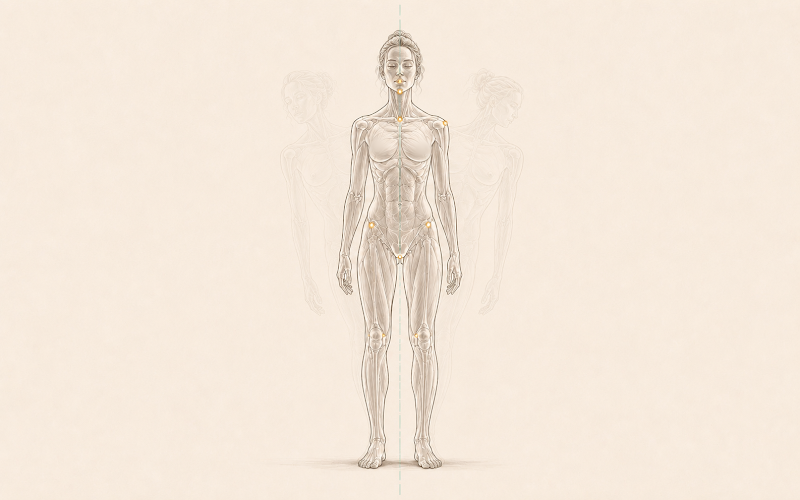
I just finished the Postural Restoration Institute’s full twelve-course curriculum. What follows isn’t a comprehensive analysis. It’s a map: what twelve courses actually cover, why they’re sequenced the way they are, and what that has to do with the symptom you’ve been managing for years.
Start here, not here
If you want the mechanism — why the body organizes itself asymmetrically, and what “restoration” actually restores — that’s a separate letter, and it’s the one to read first: What PRI actually restores. This one assumes you’ve got the gist and goes wide instead of deep. Twelve courses, one pattern, four movements.
The architecture
Foundation — pelvis and breath
The first three courses are about the two things everything else stands on: where your pelvis sits, and whether you can finish a breath.
Myokinematic Restoration. You bend to pick up groceries and your back seizes. The imaging finds something. The exercises help. Three months later it’s back. Repeat for years. PRI’s read is that the pelvis has rotated — not catastrophically, just enough that one hip sits differently in its socket, and everything downstream follows from that one shift.†
One honest note, and it matters: the idea that static pelvic asymmetry directly causes low back pain is genuinely contested in the research literature, and I’m not going to pretend otherwise.1 What has better support is the broader principle — that a problem at one region is often driven by the region above or below it, which is why treating the painful spot keeps failing.2 PRI’s specific pattern is a clinical model built on that principle. It is not a proven causal chain, and you should hear it that way.
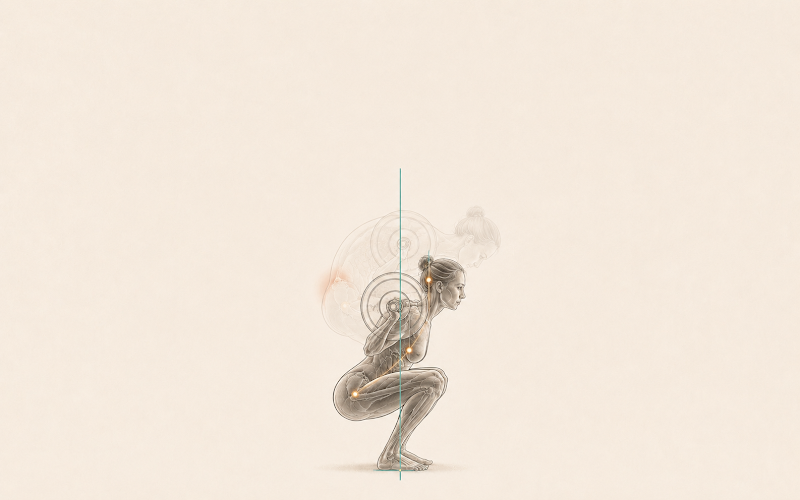
Postural Respiration. You yawn through meetings. You sigh without noticing. You feel short of breath and your lungs are fine. At night your mind races and you can’t say why.
Here’s the mechanism, and it’s a real one. Your diaphragm doesn’t float in your chest — a section of it lies flat against the inside of your lower ribs, pressed up against them. That contact strip is called the zone of apposition, and it’s what gives the muscle something to pull against. When it contracts from a good position, it drives air in and stabilizes your spine, because it’s also a postural muscle — and its position and function measurably track with low back pain.3
Now flatten the diaphragm and park the ribs high, and that contact strip shrinks. Less contact, less leverage. The muscle is still working, but it’s pulling from a position that can’t do the job — so breathing migrates upward into the neck and chest, where it doesn’t belong. This isn’t hand-waving: in chronic hyperinflation, the zone of apposition collapses to roughly half its normal area, and the diaphragm’s mechanical disadvantage is severe enough that clinicians can detect it at the bedside.3
The honest boundary: that evidence comes from pathological hyperinflation — lungs stuck full, as in COPD — not from the everyday rib flare I see in a Boston professional who’s been breathing badly at a desk for a decade. Reading the same mechanism at a smaller scale in an otherwise healthy body is PRI’s inference, and it’s the one I’ve bet my practice on — but it’s an inference, and you’re entitled to know that.† The mechanism is solid. The extrapolation is the framework.
And rib position really is wired to autonomic state: hands-on work that changes rib mechanics produces measurable shifts in autonomic activity.4 That’s the piece I keep coming back to. The anxiety wasn’t only in your head. Some of it was in your ribs.
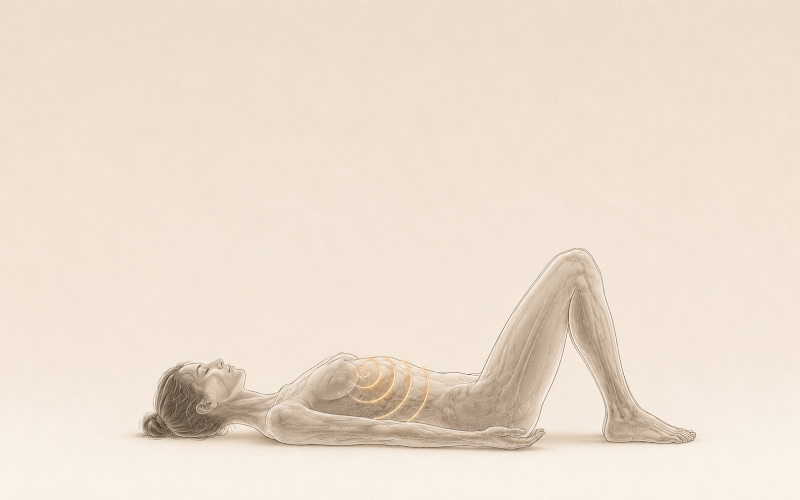
Pelvis Restoration. With every step, your pelvis should shift — left, right, alternating, endlessly. When it loses that ability, you effectively live on one leg. The SI joint someone keeps resetting for you may never have been the problem. The lost alternation is.†
Structure — thorax and cervical
Cervical Revolution. You crack your neck every morning and it’s better for twenty minutes. By 3 p.m. your head is out in front of your shoulders and you don’t notice until you catch your reflection.
Forward head posture and neck pain do travel together5 — though that’s an association, not a verdict on which caused which. PRI’s position is that the neck is rarely the author of its own problem: it’s stabilizing a head that the structure underneath it can’t support.†
Impingement & Instability. Your shoulder got fixed. You did the rotator cuff work. Six months later it flares. More exercises. It flares again. You start to believe it’s just your shoulder.
Beyond the shoulder, this course gets at something most training never touches: the difference between actually feeling a part of your body and merely thinking about it. In PRI’s language that’s the corporeal/incorporeal distinction, and it’s a clinical concept, not a lab finding.† But it changes everything about how I coach. A lot of people who “can’t feel” a muscle are not weak. The muscle is right there. The brain has lost contact with it.
Integration — cranium, gait, autonomics
Cranial Resolution. A car horn honks and you flinch like you’ve been shot. You’re awake at 2 a.m., wired and exhausted. Bloodwork’s fine. Nobody has looked at your autonomic nervous system.
PRI’s model is that the system is meant to oscillate — activation and rest, left and right — and that when the rhythm stalls, it locks in one gear.† I want to be precise that this is the framework talking, not a trial. What is well established is that the nervous system runs lateralized, alternating rhythms at all — the nasal cycle you tested at the top is one of them.6
Forward Locomotor Movement. You used to run 5Ks; now a quarter-mile and your knee has opinions. Gait isn’t just legs. Here’s my favorite fact from twelve courses: when your heel strikes the ground, it moves your jaw. That coupling is measured and real.7 Walking is a whole-body event, and it recruits systems you’d never file under “walking.”
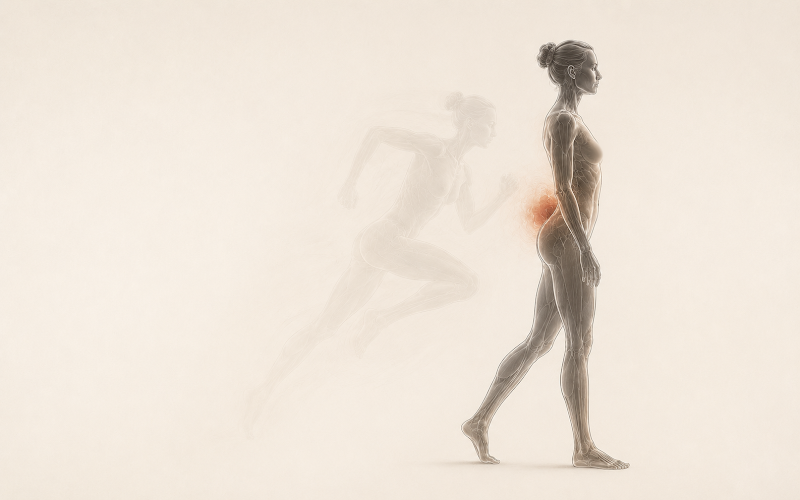
Advanced Integration is where the layers stop being separate regions and get treated as one architecture.
Interdisciplinary — voice, vision, occlusion
The last stretch of the curriculum leaves the musculoskeletal lane entirely, and this is the part that changed how I see the body.
Voice Box Resonation — your airway is shaped by how your neck sits and how your ribs move. Visual Vestibular Refinement — you get carsick as a passenger but never as a driver; you misjudge curbs; your eyes and inner ear are doing quiet work to compensate for a body underneath them, and vision has a dedicated stream devoted to guiding action rather than conscious seeing.8 Occlusal Cervical Restoration — you’ve ground through two night guards and your TMJ clicks, and nobody has looked below your chin.
That last one deserves the honest version. The ligaments around your teeth and the ligaments around your ankles are doing a similar job: telling your brain where you are in space. The heel-strike-moves-your-jaw coupling is documented.7 The clinical leap — that your bite and your feet should be assessed as one system — is PRI’s framework, and I find it persuasive after twelve courses.† But it’s a framework, not a finding, and I’d rather tell you that than oversell it.
How we deploy it
Rough diamonds and heavy weights
Diamonds form over millions of years under chronic pressure. The result is a shape determined by circumstance rather than intention.
Your body has done something similar. Years of asymmetrical loading — standing on one leg, turning one direction more than the other, breathing half a breath for a decade — produced a shape. That shape is your pattern. (It’s a metaphor, and an imperfect one: bodies can be reorganized. Diamonds can’t. That’s the whole advantage.)
What we do at AER is reshape it. We use PRI to restore the conditions — respiratory position, pelvic alternation, cervical independence — and then we load the reorganized body under controlled, progressive demand. Squat, hinge, push, pull, rotate. The movements are conventional. The context is not.
The rationale for loading it: motor learning is what makes a new pattern stick, and resistance training drives real adaptation in the nervous system, not just in muscle.9,10 The claim that heavy loading specifically consolidates a restored postural pattern is my applied method — the Pneuma protocol — built on that literature by analogy.† It is not a conclusion from a trial, and I’m not going to dress it up as one.
Before you go — 2 minutes
Change what you just felt
Remember which nostril was more restricted? Lie down on the side of your open nostril for about two minutes. Breathe normally through your nose.
Now recheck. Plug one side, breathe through the other. Switch.
The previously restricted side should be more open. That’s not a trick — lying on one side reliably shifts nasal airflow toward the upper nostril, an autonomically driven change you just produced with nothing but position.6
You changed an autonomic function by changing where your body was. That’s the smallest possible version of the whole idea.
One honest caveat
Be careful what you conclude from that. A blocked nostril does not tell you which side of your body is “sympathetically dominant,” and it does not map onto your pelvis, your thorax, or your cranium. The nasal cycle is a normal feature of most healthy noses: congestion alternates from side to side on its own, roughly every few hours, all day, in people with nothing wrong with them at all.6 The side that’s blocked right now will likely be the open one this afternoon. Your nose is not a diagnostic instrument, and you’ll hear it described that way by people who should know better.
What the demo does show is the thing actually worth showing: position changes autonomic state, quickly, and you can feel it happen in your own body in two minutes. That’s real, it’s measurable, and it’s the reason a practice built on breathing and position can reach systems that “just exercise more” never touches.
To you
Building neurological resilience. Restoring mobility that got lost somewhere between the playground and adulthood. Getting some of you the strongest and most physically resilient you’ve been.
Gratitude, respect, and a real desire to keep pushing this forward.
Peter Jang, MFA CSCS PRT
The fine print
-
Levangie PK. The association between static pelvic asymmetry and low back pain. Spine. 1999;24(12):1234–1242. Limitation — and this one runs against us: this literature does not establish that static pelvic asymmetry causes low back pain, and measured associations have been weak or inconsistent. It is cited here to be honest that PRI’s pelvic model is a clinical framework, not a demonstrated causal chain.
-
Wainner RS, Whitman JM, Cleland JA, Flynn TW. Regional interdependence: a musculoskeletal examination model whose time has come. J Orthop Sports Phys Ther. 2007;37(11):658–660; and Sueki DG, Cleland JA, Wainner RS. A regional interdependence model of musculoskeletal dysfunction. J Man Manip Ther. 2013;21(2):90–102. Limitation: these are conceptual/clinical-reasoning papers proposing a model, not trials. They support the general principle that a symptom’s driver is often elsewhere — they do not validate PRI specifically.
-
Two separate things, and they deserve separate handling. (a) The diaphragm as a postural muscle: Kolar P, Sulc J, Kyncl M, et al. Postural function of the diaphragm in persons with and without chronic low back pain. J Orthop Sports Phys Ther. 2012;42(4):352–362. Limitation: a small dynamic-MRI study showing an association between diaphragm position/excursion and low back pain. Associational and cross-sectional — it does not show that restoring diaphragm position resolves pain. (b) The zone of apposition: that the diaphragm’s apposed area governs its mechanical effectiveness is established respiratory mechanics — in chronic hyperinflation the apposed surface is reduced to about 54% of normal (Cassart M, Pettiaux N, Gevenois PA, Paiva M, Estenne M. Effect of chronic hyperinflation on diaphragm length and surface area. Am J Respir Crit Care Med. 1997;156(2 Pt 1):504–508 — 10 patients with severe COPD vs 10 controls), and the resulting mechanical disadvantage is clinically detectable (Hoover’s sign). The underlying mechanics are laid out in De Troyer A, Boriek AM. Mechanics of the respiratory muscles. Compr Physiol. 2011;1(3):1273–1300. Two limitations, and both matter. First, this literature is about pathological hyperinflation — COPD lungs stuck at high volume — not about rib flare in an otherwise healthy person at a desk. Applying the same mechanics at a much smaller scale to a healthy population is PRI’s clinical inference, not a demonstrated finding, and it is marked † in the text accordingly. Second, read the 54% correctly: Cassart found that at equivalent lung volumes the diaphragm was comparable between groups. The lost apposition is a consequence of the chest being held inflated — it is not the muscle wasting away. Position, not damage. That distinction is the entire reason the position is worth training.
-
Henderson AT, Fisher JF, Blair J, et al. Effects of rib raising on the autonomic nervous system: a pilot study using noninvasive biomarkers. J Am Osteopath Assoc. 2010;110(10):601–607. Limitation: a small pilot study of an osteopathic technique — not a PRI technique — measuring short-term autonomic markers. It supports the general link between rib mechanics and autonomic state; it does not measure any lasting effect, and it is not a study of our method.
-
Fernández-de-las-Peñas C, Alonso-Blanco C, Cuadrado ML, Pareja JA. Forward head posture and neck mobility in chronic tension-type headache. J Manipulative Physiol Ther. 2006;29(2):151–155. Limitation: cross-sectional and associational. Posture and pain travel together here; direction of causation is not established.
-
The nasal cycle — spontaneous, alternating congestion between the nostrils, driven by autonomic control of nasal blood vessels, and shifted by body position (lying on one side tends to open the upper nostril) — is well established in the ENT literature. Reviewed in Eccles R. Nasal airflow in health and disease. Acta Otolaryngol. 2000;120(5):580–595; lateralized autonomic rhythms discussed in Shannahoff-Khalsa D. Lateralized rhythms of the central and autonomic nervous systems. Int J Psychophysiol. 1991;11(3):225–251. Limitation, stated plainly: the existence of the cycle and its responsiveness to posture are solid. The further claim — that the currently blocked nostril indicates systemic or postural asymmetry elsewhere in the body — is not supported, and the broader ultradian-rhythm interpretations in this area remain contested. We use the demo to show that position changes autonomic state, and for nothing more than that.
-
Miles TS, Flavel SC, Nordstrom MA. Control of human mandibular posture during locomotion. J Physiol. 2004;554(Pt 1):216–226. Limitation: a small laboratory study in healthy adults documenting that jaw muscle activity is modulated in time with the gait cycle. It establishes the coupling. It does not show that gait causes TMJ disorders, or that treating the feet treats the jaw.
-
Goodale MA, Milner AD. Separate visual pathways for perception and action. Trends Neurosci. 1992;15(1):20–25. Limitation: a foundational neuroscience model distinguishing vision-for-action from vision-for-perception. Cited only for that distinction. It says nothing about postural restoration, and I’m not implying it does.
-
Carroll TJ, Riek S, Carson RG. The sites of neural adaptation induced by resistance training in humans. J Physiol. 2002;544(2):641–652. Limitation: establishes that resistance training produces adaptation within the nervous system, not only in muscle. It does not study postural patterns.
-
Kleim JA, Jones TA. Principles of experience-dependent neural plasticity: implications for rehabilitation after brain damage. J Speech Lang Hear Res. 2008;51(1):S225–S239. Limitation: a principles review, largely drawn from rehabilitation and animal-model literature. Applying “use it and improve it / specificity / repetition” to consolidating a restored breathing and postural pattern is a well-motivated analogy — not a study of that application.
If any of this changed how you think about your own body, an assessment is where that conversation starts.