
Your head isn't the problem.
It's the evidence
The pattern that pushes your head forward is also taxing your rotation, your focus, and how you age. Here's a 20-second test that shows you the tip of it.
Everyone has been told to pull their head back. Nobody has been told what is pushing it forward. That’s the whole letter — and there’s a twenty-second test that makes the point better than I can.
Originally sent to AER members as an email. The exact send date wasn’t recovered — the date shown reflects publication order, not a precise record.
Do this first — 20 seconds
The wall
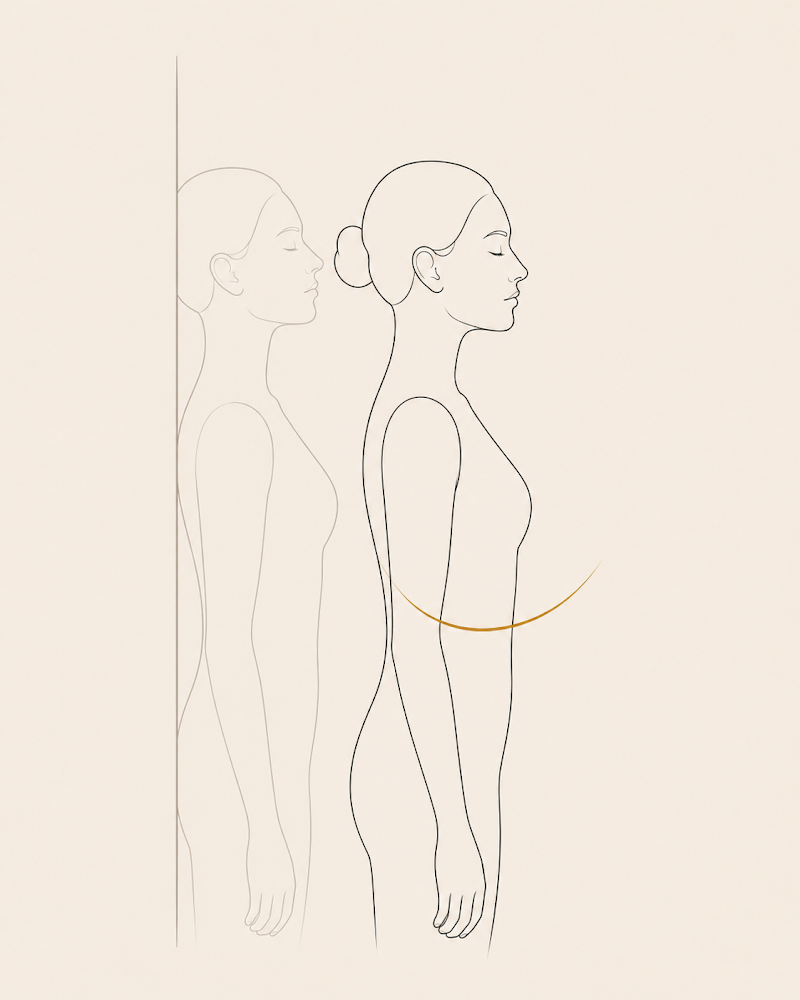
- Heels, backside, and upper back to a wall. Without lifting your chin, let your head fall back toward it. Note the gap — and note the effort.
- Step away. Exhale everything — slowly, completely — until your ribs drop and your low back softens. Pause at empty. Three or four breaths like that. Feel your feet.
- Back to the wall. For most people, the head now settles closer, with less strain, and feels lighter to hold.
You didn’t stretch your neck. You didn’t pull your shoulders back. You let the rest of you out of the position that was carrying your head forward — and the head came with it.
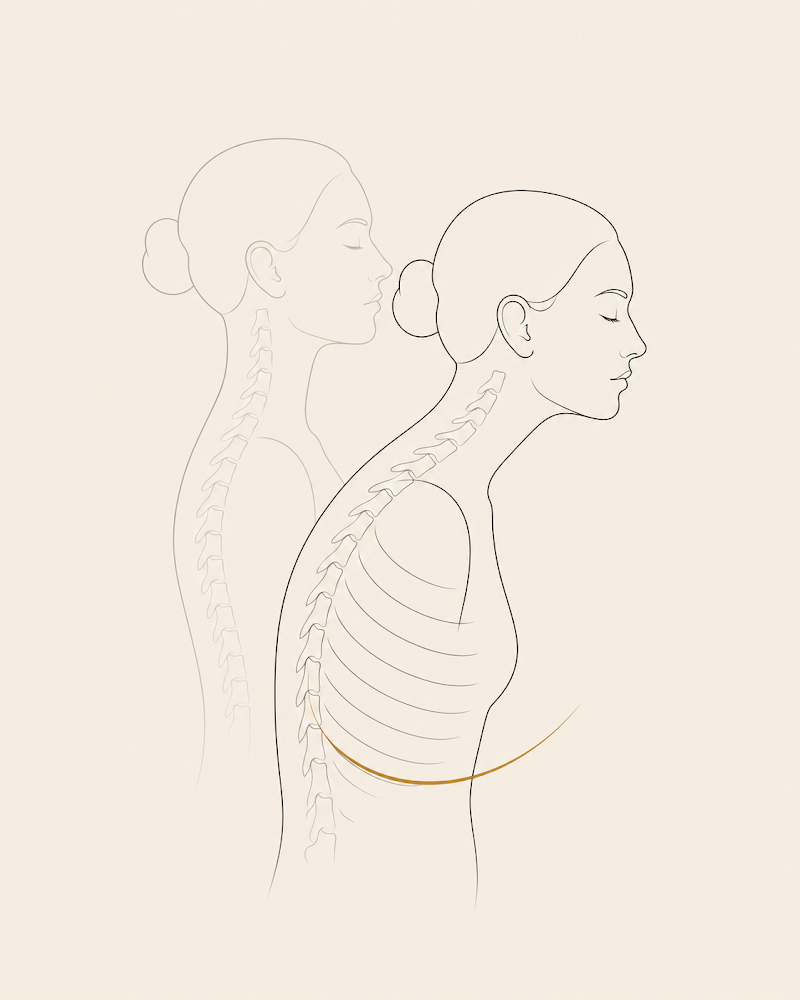
The neck doesn’t choose to go forward. It gets sent there.
Your head is not an independent object balanced on top of you. It’s the last link in a chain, and it goes wherever the chain leaves it. A rib cage held open, a pelvis tipped forward, a breath stuck high in the chest — that shape has to end somewhere, and where it ends is your head, out in front of you, held up by muscles that were never meant to be postural.†
Which is why chin tucks, neck stretches, and “sit up straight” never hold. They all work on the head. None of them touch what’s sending it there. Twenty seconds of a real exhale did more than a month of chin tucks, and it did it by changing the thing underneath.
It was never only your neck
Once you see the pattern, you see it everywhere — and it quietly taxes three things you actually care about.
Your rotation. A golf swing, a tennis serve, a clean reach across a desk — they all run on your ability to rotate one side of you against the other. In older adults with neck pain, more thoracic rounding tracked with less rotation available at the neck, and forward head posture was the link between the two.1 That’s measured at the neck in one specific population — but the principle scales, and rotation is one of the first things this pattern takes. (It’s also the subject of the next letter.)
Your focus and your nervous system. Stuck breathing high and shallow, you idle in a low hum of alert all day. Free the breath and the whole system downshifts — steadier, clearer, quicker to recover. That isn’t a mood. It’s wiring, and there’s more below.
How you age. How you breathe, how your airway works, how well your system regulates itself day after day — these are the quiet inputs to your energy, your sleep, and how capable your body stays across decades. I’m describing how the systems work, not promising you an outcome. But posture isn’t vanity. It’s infrastructure.
Three things about your neck that aren’t about your neck
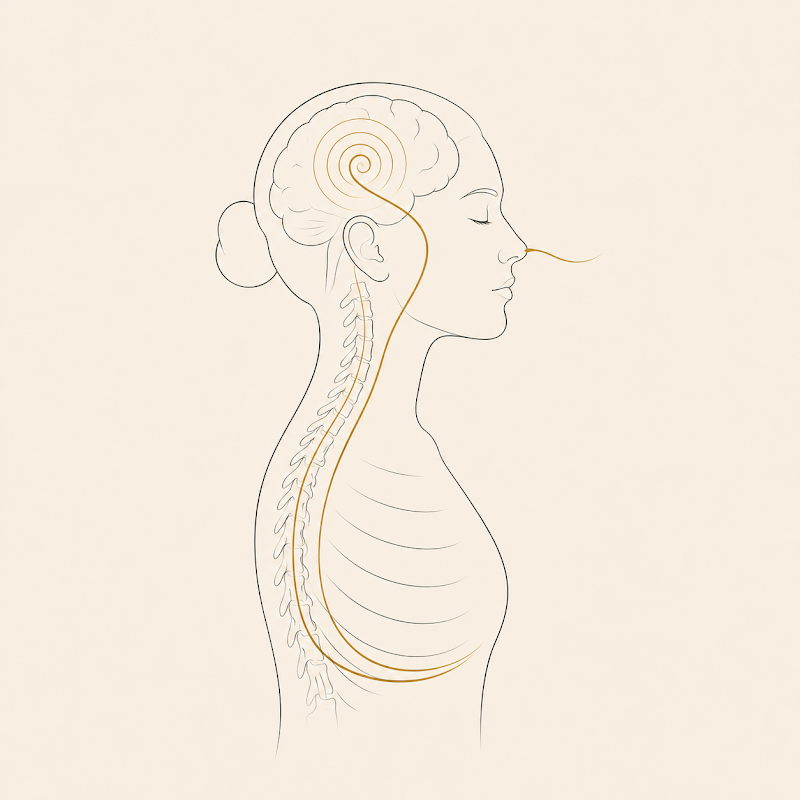
1. Nasal breathing does something to your brain that mouth breathing doesn’t. Recording from electrodes inside the human brain, researchers found that breathing through the nose entrains rhythms in the amygdala and hippocampus, with measurable effects on memory and fear processing — effects that disappeared when the same people breathed through their mouths.2 Nasal breathing isn’t a preference. It’s a different input to the brain.
Here’s where I’ll be more careful than the version of this you’ve read elsewhere: mouth breathing and forward head posture reliably show up together, but which one drives which is genuinely not settled — the airway literature mostly runs the arrow the other way, from chronic mouth breathing toward a head that drifts forward. I treat them as one coupled system rather than claiming your neck caused your mouth to open.†
2. Your breathing is wired directly to your brain’s arousal center. In mice, a small cluster of neurons in the brainstem’s breathing pacemaker projects straight into the locus coeruleus — the brain’s noradrenaline hub for alertness and alarm. Silence that cluster and breathing carries on unchanged, but the animals become calmer and spend less time aroused.3 Breathing isn’t only a readout of how calm you are. It’s an input. And how you breathe is dictated by how your ribs, diaphragm, and head are stacked.
3. “Just posture” shows up in autonomic measurements. People with forward head posture measured differently in autonomic function — and in the neck’s own sense of where it is in space — than people without it.4 Head-forward isn’t cosmetic. It tracks with how the body regulates and senses itself.
None of these have quick answers, and I’m not going to pretend they do. They’re the kind of thing that separates running a protocol from understanding a system — and they’re my favorite conversations. Bring the one that grabs you to your next session.
One honest caveat
The wall test is an illustration, not a treatment, and what you felt may not be what the person next to you feels. Everything above about focus, performance, and healthy aging describes how the underlying systems work — it is not a promise of a specific result or an athletic outcome.
Two of the four studies below are cross-sectional: they show that forward head posture travels with altered autonomic function and reduced rotation. They do not show it causes them, and I’m not going to imply otherwise. The third is in mice. Read them for mechanism, not for proof.
This isn’t medical or dental advice, and nothing here diagnoses or treats sleep apnea, TMJ disorders, or any other condition. Where the visual or dental system is clearly part of someone’s picture, I refer out and co-manage with the optometrist or dentist. “Tech neck” is just the everyday name for forward head posture.
Why this is different work
This isn’t posture correction, and it isn’t a stretch routine. It’s reading how a whole system is built to move, breathe, and hold itself — reorganizing it, then testing the change against your own body before you leave the room. If it doesn’t hold, it doesn’t count.
AER on Newbury is a Certified Postural Restoration Center. I’ve completed the Postural Restoration Institute’s full twelve-course curriculum and hold the PRT credential, which is carried by roughly seventy practitioners in the country. That depth is the entire point: it’s what lets one system serve the desk worker’s neck, the golfer’s rotation, the executive’s focus, and the body that intends to stay capable for another forty years. It’s also why this is a one-person practice — the work doesn’t delegate well.
Next letter: your golf swing is a rotation problem, and rotation is a breathing problem. A thirty-second living-room test finds the turn you didn’t know you were guarding.
— Peter Jang, MFA CSCS PRT AER on Newbury · Certified Postural Restoration Center
The fine print
-
Quek J, Pua YH, Clark RA, Bryant AL. Effects of thoracic kyphosis and forward head posture on cervical range of motion in older adults. Man Ther. 2013;18(1):65–71 — in 51 older adults with cervical spine dysfunction, forward head posture mediated the relationship between thoracic kyphosis and reduced cervical rotation and flexion. Limitation: cross-sectional mediation analysis in a small, older, symptomatic sample, measured at the neck. It supports “rounder thorax, less rotation available”; it does not prove causation, and its extension to trunk or golf rotation is my inference, not the study’s finding.
-
Zelano C, Jiang H, Zhou G, et al. Nasal respiration entrains human limbic oscillations and modulates cognitive function. J Neurosci. 2016;36(49):12448–12467. Limitation: a small intracranial sample (7 epilepsy patients with electrodes already implanted for clinical reasons). The cognitive effects were modest and specific. It supports breathing through your nose; it does not make nasal breathing a treatment.
-
Yackle K, Schwarz LA, Kam K, et al. Breathing control center neurons that promote arousal in mice. Science. 2017;355(6332):1411–1415 — ablating ~175 neurons in the preBötzinger complex left breathing intact but made mice calmer. Limitation: this is mice, and it is a genetic ablation, not a breathing exercise. It is foundational evidence that breathing circuitry feeds arousal circuitry — nothing more, and nothing less.
-
Moustafa IM, Youssef A, Ahbouch A, Tamim M, Harrison DE. Is forward head posture relevant to autonomic nervous system function and cervical sensorimotor control? Cross-sectional study. Gait Posture. 2020;77:29–35. Limitation: cross-sectional. People with forward head posture differed on autonomic and sensorimotor measures from people without it. Association, not causation — and correcting posture was not tested here.
If any of this changed how you think about your own body, an assessment is where that conversation starts.