
We do one thing. We do it well.
Why we chose depth
The industry rewards breadth. We went the other way — one framework, followed all the way down. Here's the case for that, and the honest limits of it.
Most people who walk through our door have already tried everything. And most of it helped — a little, for a while.
Originally sent to AER members as an email. The exact send date wasn’t recovered — the date shown reflects publication order, not a precise record.
If you’ve been at this a while, you know the cycle. The chiropractor who cracked your back and sent you home with stretches. The physical therapist who gave you band work for your shoulder. The trainer who said your core was weak. The massage therapist. The acupuncturist. The YouTube mobility routine.
Each one did something. Each provided some measure of relief. And then the symptoms came back — or you hit a ceiling you couldn’t explain.
Not because any of them failed. Because no one followed a single thread deep enough to find where it actually leads.
The sushi chef doesn’t switch to Italian halfway through
If you wanted to become a great chef, you wouldn’t spend six months on Italian, then switch to sushi, then move to Northern Chinese. On paper you’d look increasingly complete. In practice you’d end up unable to make anything extraordinary.
The story goes that sushi apprentices spend years on the rice alone before they’re allowed near the fish. Whether or not that’s literally true of every kitchen, the point it’s making is: mastery demands a kind of sustained attention that breadth makes structurally impossible.
The movement and wellness industry rewards breadth. Practitioners collect certifications and stack a dozen acronyms on the website. It’s possible to learn the vocabulary of everything and the depth of nothing.
We went the other direction.
We chose depth
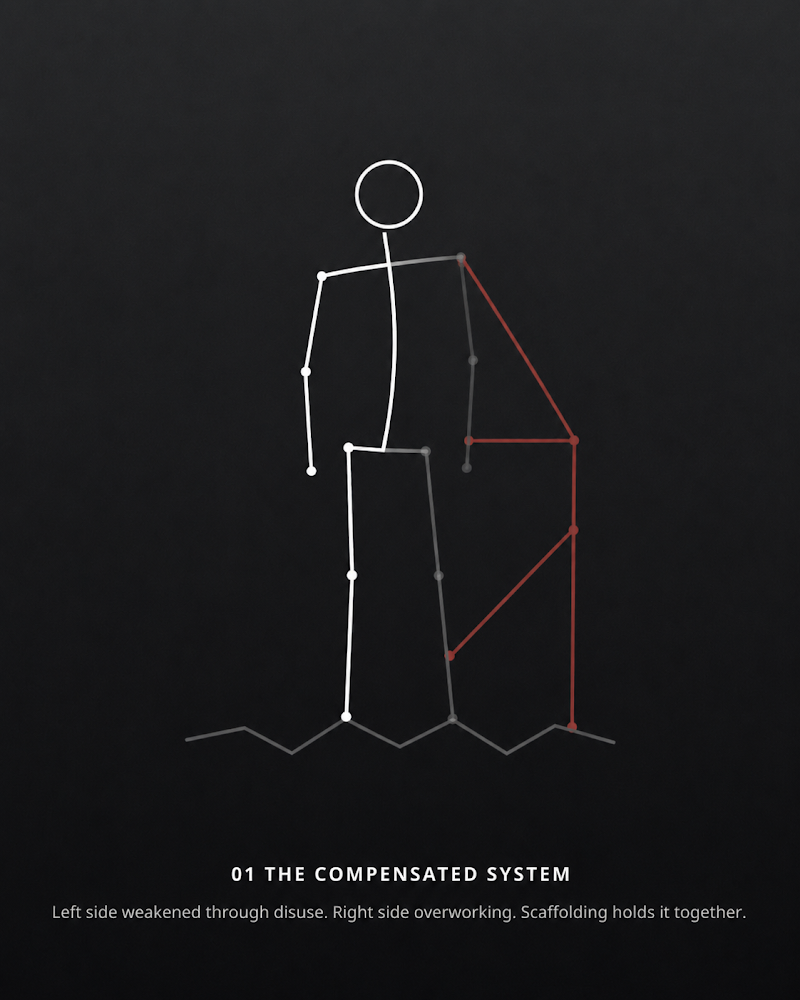
AER is a PRI studio. We use one system — the Postural Restoration Institute framework — and we’ve spent years going down into it rather than out across the field. It integrates musculoskeletal, respiratory, neurological, visual, and autonomic function inside one coherent model, which is exactly why it rewards depth: the pieces only pay off once you can hold them together.† I’ve written properly about what the framework actually restores — that’s here — so I won’t rebuild it from scratch.
The goal is what PRI calls neutrality: a system that is autonomically regulated and orthopedically neutral at the same time, rather than trading one for the other.†
Two honest notes on that paragraph, since this letter is about not overselling.
First, I’m not going to tell you PRI is the only framework in the world with a complete architecture from assessment to resolution. I don’t know that, nobody does, and it isn’t the sort of claim you can support. What I can tell you is that it’s the framework we chose, that we’ve followed it further than most, and why: it’s the one we’ve found that treats breathing, position, and the nervous system as a single problem instead of three departments.
Second: this is a one-person practice. Just me. That’s not a limitation I’m apologizing for — it’s the same choice, viewed from the other side. Depth is what you get instead of breadth, and one person going deep is what that actually looks like on the ground.
The credential I hold, PRT — Postural Restoration Trained — is held by roughly seventy people in the United States. That number is the whole argument in miniature. Not a boast: a description of what happens when you refuse to spread out.
We read everything. We practice PRI.
The method
Three phases. One thread.
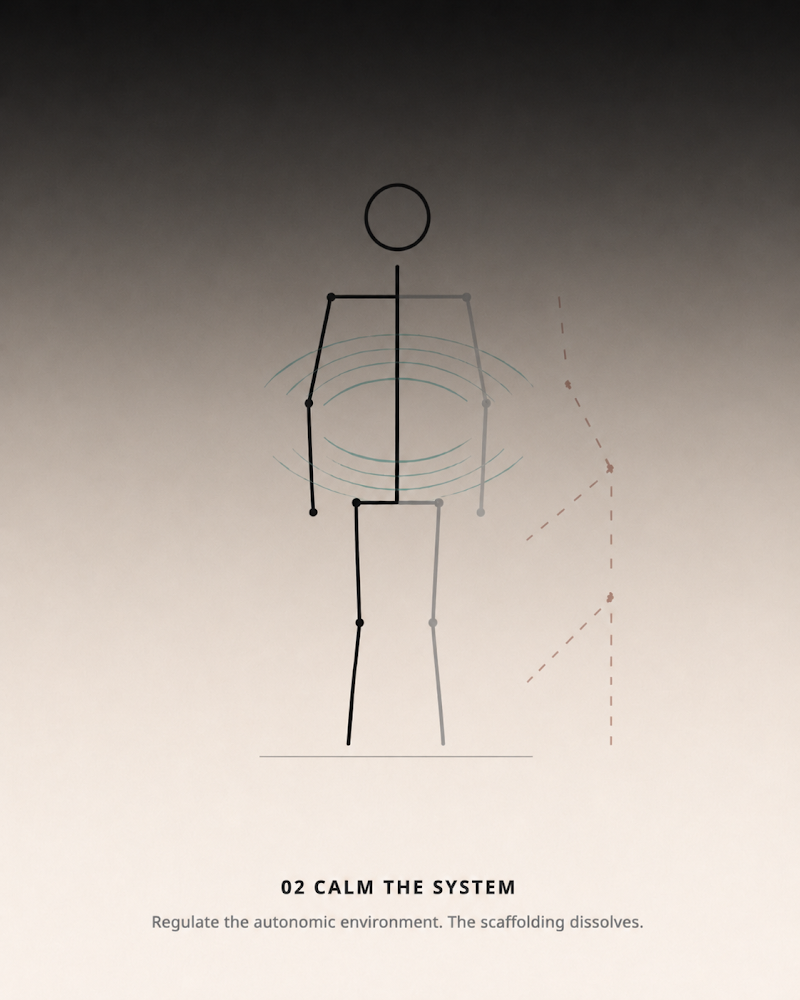
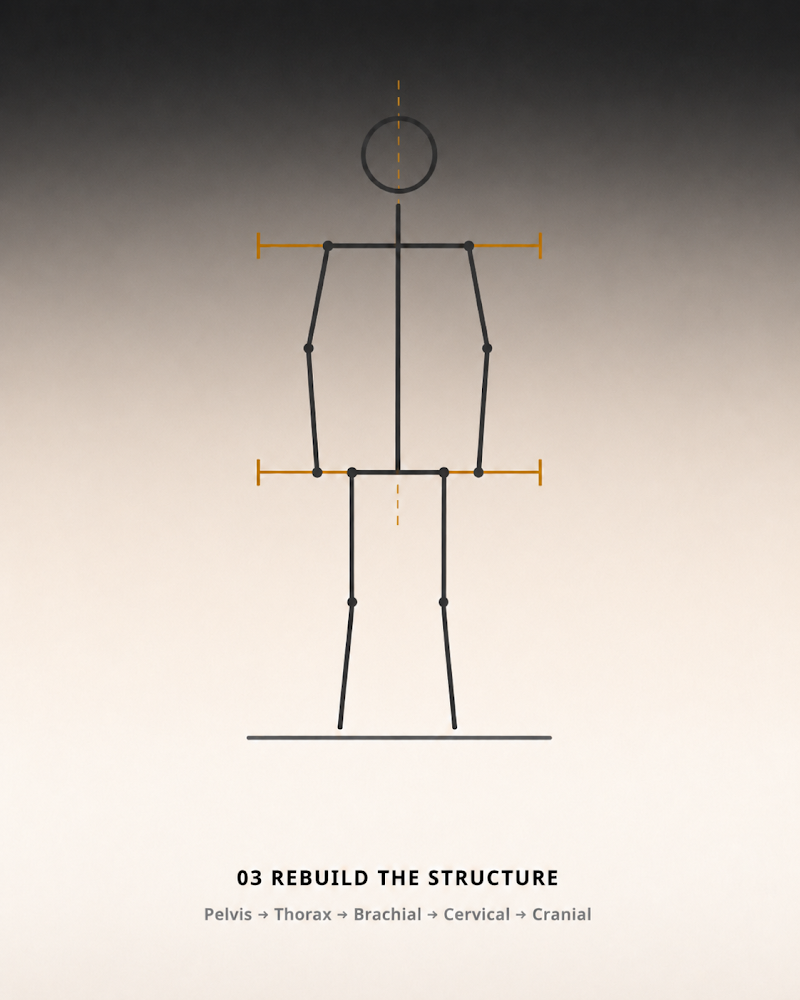
1. Find neutral We address the autonomic environment first — a nervous system locked in a stress response will resist every structural change you attempt.† Then we align the orthopedic components: pelvis, ribcage, scapulae, cervical spine. Together these produce what our testing battery calls neutral — not a position so much as a capacity. The capacity to move in any direction without compensating.†
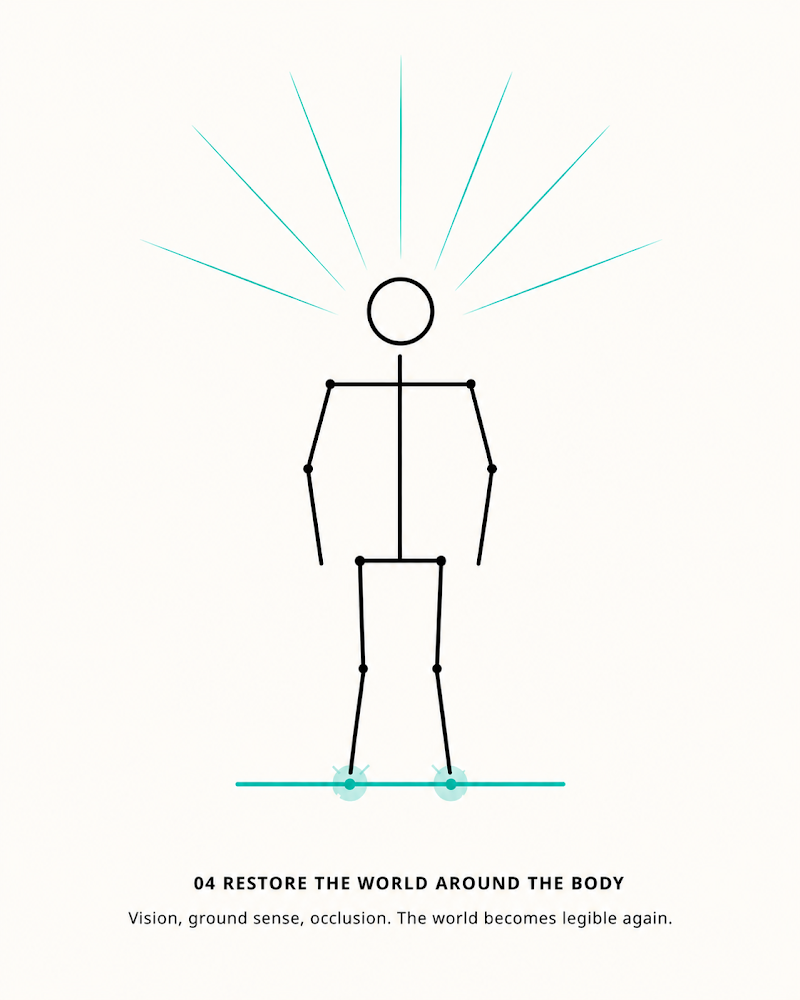
2. Pattern it upright The neurology of human movement changes the moment you stand up. The vestibular system, the visual system, and ground-reaction forces all come online. A body that found neutral on the table has to learn to hold it against gravity, and that’s a separate skill.† Standing integration is the bridge — training the pattern to hold in the conditions where you actually live.
3. Build Once the system is organized, we load it. Deadlifts, bench, split squats — with the Pneuma protocol running between reps, so the nervous system encodes the organized pattern rather than the old compensatory one.† This is the part people don’t expect from a studio that talks this much about breathing. You’re no longer building strength on top of a compensation. You’re building on something organized — and that changes how far the building can go.
The deeper outcome
Forget the pain for a minute. Let’s talk about what this is actually for.
Physical demand and psychological demand share a great deal of machinery — the same stress axis, much of the same autonomic hardware. A heavy deadlift and a high-stakes meeting are not processed in separate buildings.
The line I cut from this letter
The earlier version of this said: “your brain does not discern between physical stress and psychological stress.” It’s a great line. It’s also not true, and I’d rather lose the line than keep something false in a letter about intellectual honesty.
Your brain absolutely can tell the difference — a barbell and a hard conversation don’t run through identical circuitry, and the pathways that handle immediate physical challenge aren’t the same ones that handle anticipated social threat. What’s true is the weaker, more useful claim: they overlap substantially. Enough shared machinery that what you train in one context has a plausible route into the other.
That’s a smaller claim. It’s the one I can actually stand behind.
Here’s what we’re reaching for. Most nervous systems have been trained by decades of low-grade stress — sitting still, breathing shallowly, converging on screens — to associate all intensity with dysregulation. The body braces. The breath holds. The system locks.
So we train the opposite association: high-output effort produced in a state of regulation. Organized breath, sensory awareness, a nervous system that’s oscillating rather than locked. The intended encoding is:
Intensity does not require dysregulation. I can be under load and still be regulated.
And here’s the honest limit of that
The claim that this encoding follows you out of the gym — into your work, your relationships, your sleep — is our method’s central premise. It is not a demonstrated transfer effect, and I’m not going to dress it up as one.†
What the literature does support is narrower and still worth something: slow, controlled breathing is associated with lower arousal while alertness is maintained,1 training that raises heart-rate variability reliably reduces self-reported stress and anxiety,2 and higher resting HRV tends to travel with better executive control — though that link is associational, not a lever you pull.3
Between those findings and “training under load rewires how you meet a hard week” there is a real gap. We think the bridge is sound. We’re telling you it’s a bridge.
What clients tend to describe
“I just don’t get as rattled by things anymore. I can’t explain it exactly — I’m just… steadier.” — an AER member
And the physical version, which is more concrete:
The quads that felt permanently tight and wouldn’t let you sink into a squat? Often that isn’t structural — it’s a nervous system bracing around a pelvis it can’t stabilize. When the pattern resolves, range tends to appear that stretching never produced.†
The back that’s all you can feel during a plank? Often not a weak core — lumbar extensors working overtime for a pelvis that’s tipped anteriorly. Reposition the pelvis and the back tends to quiet down.†
The shoulder that feels unstable overhead? Often not a weak rotator cuff — a scapula sitting on a ribcage that’s rotated underneath it. Address the ribcage and the shoulder frequently settles.†
I’ve hedged every one of those with “often” and “tends to,” and the hedges are doing real work. These are the patterns we see and the explanations our framework gives for them. They’re not universal laws, and an assessment is what tells you whether any of it is true of you.
The pain was never the destination. It was the signal that the system was limited.
A case in point
A representative composite — not one identifiable person. Details are generalized from presentations we see often.†
She arrives with years of chronic back tightness and a shoulder that feels like it’s slipping. She’s seen other providers. She’s been told her core is weak and her rotator cuff needs strengthening. She’s done the work — diligently. It didn’t hold.
The assessment points to one pattern producing both complaints. So we follow that single thread: pelvis first, then ribcage, then the shoulder girdle riding on top of it.†
The back quiets first — usually earlier than people expect, which is its own kind of disorienting when you’ve been managing it for years. The shoulder takes longer; it’s further down the chain. And then, once the system holds its own position under load, we start building on it — which is the part she never got to before, because everything previous had been maintenance.
She didn’t need a stronger core. She didn’t need band work. She needed someone to follow one thread to completion, and then build on top of it.
I want to be careful here: that arc is typical, not guaranteed, and I’ve deliberately stripped the timeline down to a shape rather than a schedule. Anyone selling you session four and session eight as a promise is selling you a schedule they can’t keep.
Is this you?
You’ve been managing symptoms and you’re ready for them to actually resolve. You want to know what your body does when it isn’t fighting itself.
You’re an athlete who suspects there’s another level available — not through more volume, but through a foundation that isn’t quietly compensating.
You’re a professional who wants to show up sharper and steadier, and you’ve started to suspect that’s a physiological question and not a willpower one.
We’re not the most comprehensive studio in Boston. We never tried to be. We picked one thread and followed it further than is probably reasonable — and for the person who wants to go past adequate, that’s the trade we’d make again.
Neutrality first. Then build.
The fine print
-
Zaccaro A, et al. How breath-control can change your life: a systematic review on psycho-physiological correlates of slow breathing. Front Hum Neurosci. 2018;12:353. Slow breathing is associated with increased vagally-mediated HRV and with greater alertness alongside reduced arousal. Limitation: despite the title, this functions as a narrative review rather than a meta-analysis — roughly 15 studies, none of them randomized controlled trials, healthy participants only. Effects are largely acute rather than demonstrated durable shifts in resting baseline, and outcomes are self-report-heavy.
-
Goessl VC, Curtiss J, Hofmann SG. The effect of heart rate variability biofeedback training on stress and anxiety: a meta-analysis. Psychol Med. 2017;47(15):2578–2586 — across 24 studies (484 participants), slow-breathing HRV biofeedback produced a large reduction in self-reported stress and anxiety. Limitation: the outcome is how stressed people reported feeling — a symptom effect — not a measured rise in resting autonomic baseline. Total sample is small, protocols vary widely, and reporting is self-report-heavy.
-
Thayer JF, Hansen AL, Saus-Rose E, Johnsen BH. Heart rate variability, prefrontal neural function, and cognitive performance. Ann Behav Med. 2009;37(2):141–153; model stated in Thayer JF, Lane RD. J Affect Disord. 2000;61(3):201–216. Higher resting HRV tracks better executive-function performance. Limitation: this is an associational link, not a demonstrated causal lever — in at least one large sample the association attenuated after controlling for age, sex, and education. Treat HRV as an index of prefrontal regulation, not a dial you turn for guaranteed focus.
On the PRT number. “Roughly seventy” is an approximate count of currently credentialed Postural Restoration Trained professionals in the United States. PRI is the sole issuer of the credential. The figure moves as practitioners credential and lapse — treat it as an order of magnitude, not a census, and not as a claim of ranking or superiority among them.
On the client story. The case above is a representative composite assembled from presentations we see frequently. It is not a single identifiable client, and no real person’s timeline, provider history, or identifying details are reproduced. The member quote is a real remark from an AER member, reproduced without initials or any identifying detail. Individual results vary — the arc described is a common shape, not a promise.
What we removed from the original. This letter as originally sent claimed that NFL and NBA strength coaches use PRI as their primary framework. We could not substantiate that with any credible public source, so it’s gone. It also claimed PRI is the only system offering a complete architecture from assessment to resolution — an unsupportable superlative, now stated as what it always really was: our choice, and our reasons for it.
If any of this changed how you think about your own body, an assessment is where that conversation starts.