
The Breath — Part 1
Why you crash at 3 o'clock.
The unfinished exhale
It's not sleep or caffeine — it's the breath you haven't finished since morning.
It’s the middle of the afternoon and the lights dim. Words come slower, email takes three reads, and you’re somehow wired and foggy at the same time. You blame sleep, or lunch, or the second coffee. But there’s a quieter suspect: you haven’t finished a breath since this morning.
The unfinished exhale
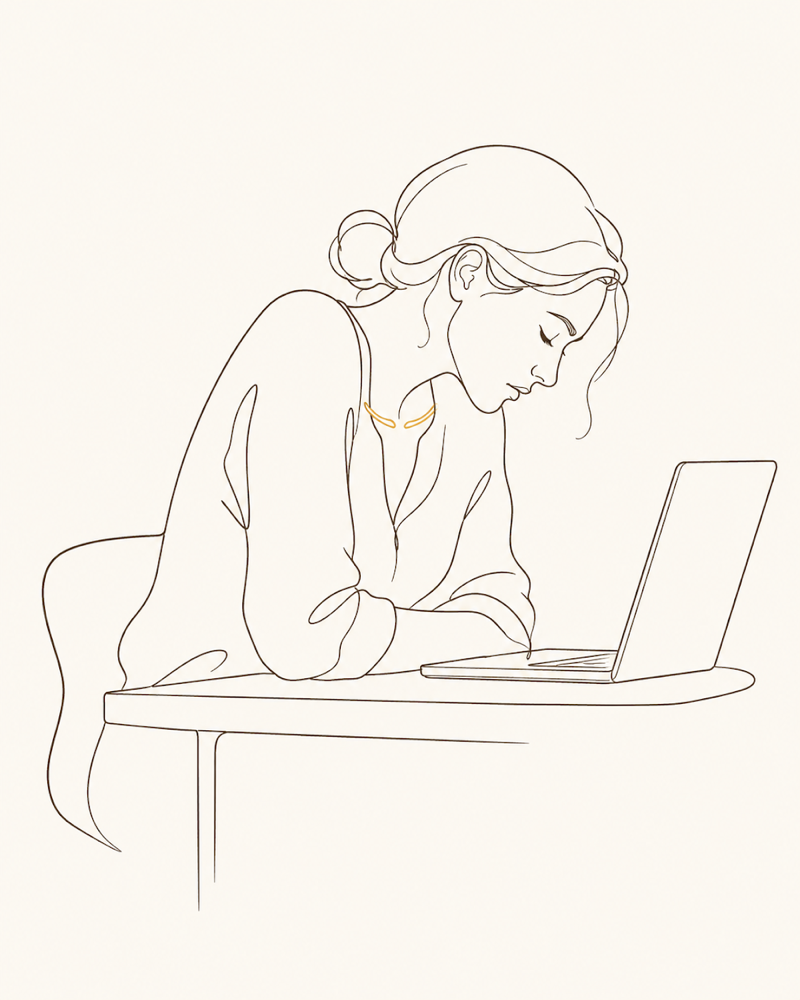
Notice how you’re breathing right now. For a lot of people deep in a workday, the answer is: high in the chest, fast, shallow — shoulders faintly lifted, the lower ribs barely moving, the breath landing somewhere around the collarbones. Air goes in and out, but it never fully goes out. The exhale gets clipped short, again and again, for hours.
That pattern keeps the nervous system leaning slightly forward on its toes — a low idle of alert that’s useful in a sprint and quietly expensive across a day. By mid-afternoon, you’re not so much running low as stuck on high. The fog isn’t always fatigue. Often it’s the cost of staying revved with no full breath to come down on.
Try this now — 60 seconds
The long exhale
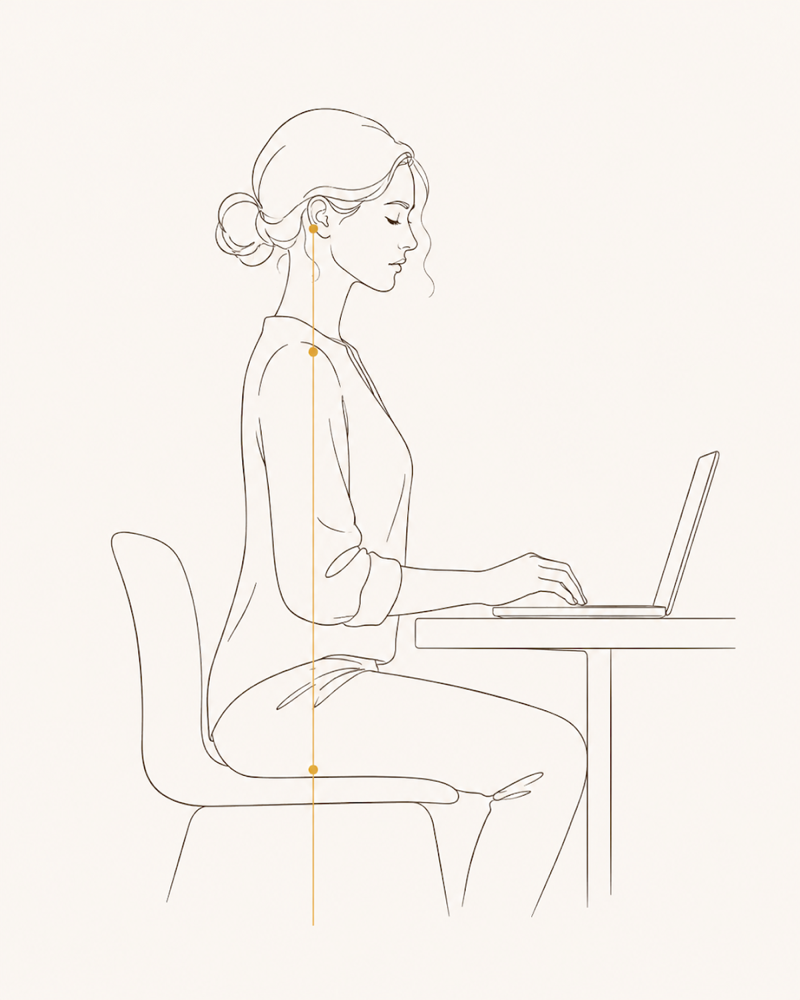
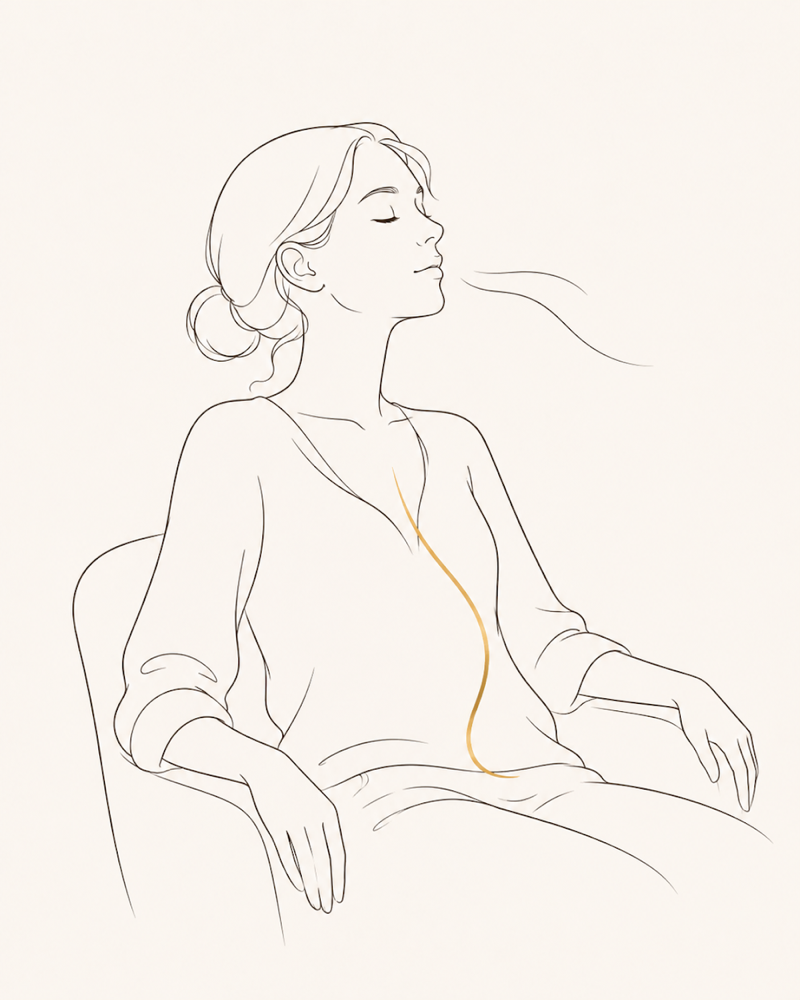
Sit back from whatever you’re staring at. Breathe in through your nose, easily — don’t gulp. Then breathe out through your nose slowly and all the way, letting the exhale run about twice as long as the inhale, until your lower front ribs settle down and in. Pause for a beat at the bottom, fully empty. Then let the next breath arrive on its own, without pulling for it.
Repeat for about six breaths, or one minute. Keep the exhale long, quiet, and complete each time.
You didn’t add energy. You stopped running the engine too hot.
Why it’s all about the exhale
You may notice this whole letter keeps circling one unglamorous thing: the exhale. That isn’t an accident. In a Postural Restoration program — and in the Pneuma protocol we build on it — the exhale is Step One.† It isn’t the flashiest piece, and for any given person it may not even be the single biggest lever. But it is foundational: nothing downstream holds until it’s in place. The calm, the rib position, the strength under load — none of it has anything to stand on until the exhale is real and complete first.
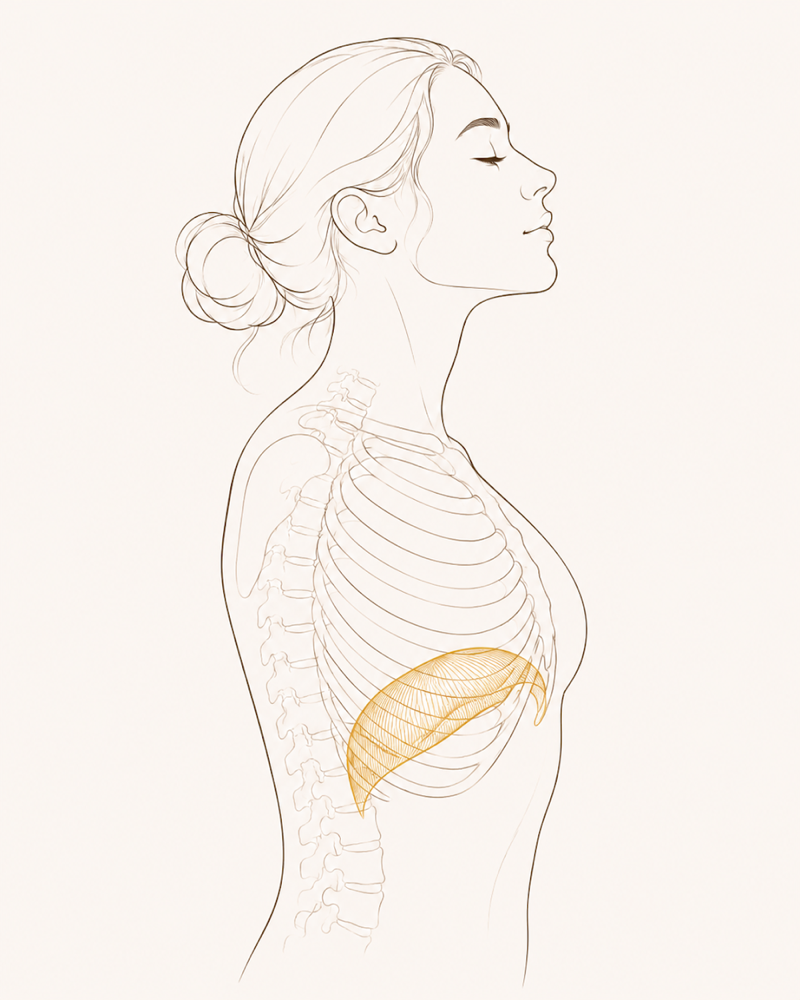
There’s a reason it’s the exhale, specifically, and not the inhale. A full exhale is what restores the zone of apposition — the position where the diaphragm reseats against the lower ribs and can finally do its second job, as the deep stabilizer your spine and rib cage move against.† Pulling air in is easy; almost anyone can do it. Finishing the exhale — getting the ribs all the way down — is the skill, and it’s the one most people have quietly lost.
It’s also why the training can look strange from the outside. The balloons, the kazoos, the humming, the tempo breaths, the frequency work — it reads like a grab-bag of odd drills, but every one of them is aimed at the same target: restoring a real, complete exhale, and teaching a body to find it without thinking about it. Get that, and everything after it finally has a floor to stand on.†
The science
Foggy isn’t always tired. Often it’s over-aroused.
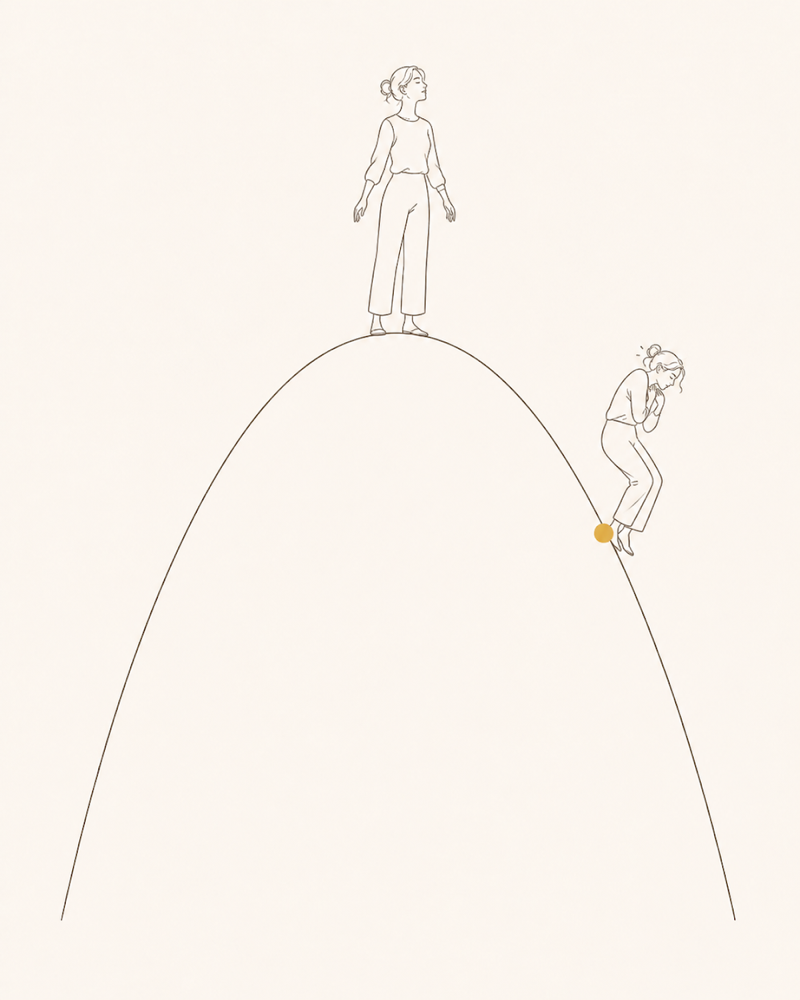
Attention doesn’t just rise with alertness — it follows an inverted U. There’s a band where focus is sharp, and a far side where too much activation makes it worse, not better: scattered, twitchy, hard to hold a thought.1 A morning of shallow, chest-high breathing nudges you up and over that peak, so by afternoon you’re past the point of useful arousal and into the foggy, over-revved end of the curve.
Breathing sits unusually close to the dial that sets that arousal. A small brainstem hub called the locus coeruleus releases noradrenaline and helps tune how alert and attentive you are. It’s sensitive to carbon dioxide, and its activity appears to rise and fall with the phase of your breath — which has led researchers to propose it as a coupling point between how you breathe and how well you can hold attention.2 Slow the breath down and you’re nudging that dial back toward the band where thinking is clean.
There’s a second, smaller contributor worth naming honestly. When you over-breathe — moving more air than your body is producing CO₂ to match — you blow off carbon dioxide faster than you should. Low CO₂ narrows the blood vessels feeding the brain, modestly trimming blood flow.3 This is real physiology, but it’s a contributing piece, not the whole story of an afternoon crash — and a slower, fuller breath is exactly what reverses it.
That’s why the long exhale earns its minute. The exhale is the phase that leans on the vagus nerve — the parasympathetic brake — and slowing the whole breath down is reliably what lifts heart-rate variability, the body’s recovery signal.4 Whether the exhale specifically needs to be the long one, on top of that, is honestly still an open question: it’s a well-motivated model,9 and several studies find a vagal advantage for a longer exhale — but the largest and longest trial run so far found the ratio added nothing beyond simply going slower.10 I work the exhale anyway, and I want to be straight about why: the reason is mechanical, not autonomic. It’s about where your ribs end up.† As a regular practice, slow nasal breathing is associated with steadier alertness sitting alongside lower arousal — calm and clear at once, rather than calm and dull.5 Even the nose earns its place: nasal breathing in particular entrains rhythms in brain regions tied to attention and memory.6
The executive-function link
Heart-rate variability isn’t only a calm-meter. In a well-supported model, the same vagal tone it reflects also indexes how well your prefrontal cortex is regulating attention and emotion. Lower variability tends to travel with rumination and weaker executive control; higher with steadier, more flexible focus.7 So a breath that raises it isn’t just relaxing — it’s pointed straight at the machinery you do your hardest thinking with.
One honest caveat
A slow breath can take the edge off an ordinary afternoon dip. It can’t diagnose or fix a medical one. Persistent brain fog and crashes can also come from things breathing won’t touch — poor or apnea-disrupted sleep, blood-sugar swings, thyroid issues, anemia, medication effects, or depression and anxiety, among others. If your fog is persistent, worsening, or new, treat breath work as a complement to a proper medical workup, not a substitute for one. This letter isn’t medical advice.
Where this meets the method
The minute you just spent is a borrowed state. It shows you the clear-headed setting is available — but it fades, because the moment you stop paying attention your body drifts back to the chest-high, half-exhaled pattern it has been rehearsing all day.† The work at AER is turning that borrowed minute into how you breathe by default, even under a full inbox.
That’s not a breathing tip you white-knuckle through twice a day. It’s a sequence that changes the resting pattern itself. Here’s what it looks like on a real person.
A case in point
A founder comes in certain her 3 p.m. collapse is a sleep problem. She has tried everything around it — earlier bedtime, no caffeine after noon, a cleaner lunch — and still, most afternoons, the wall. Words slow down. A short email takes three passes. By four she’s wired and useless at the same time.†
On assessment, she’s a textbook upper-chest breather: shoulders held up, ribs flared and parked high, breath quick and shallow, and a noticeably short comfortable breath-hold — the picture of a system that over-breathes and rarely fully exhales.† She isn’t short on sleep so much as stuck in overdrive. So we don’t add stimulation. We teach her body how to come down — and how to stay down while she works — in four steps.
| Step | What we do |
|---|---|
| 1. Restore the exhale | First we get the ribs to come down. A long, full exhale — often from a supported position, sometimes with a gentle reach — lets the rib cage settle out of its locked-open posture and restores the deep contact that makes a real, complete exhale possible.† This is the 60-second reset, made deliberate. |
| 2. Own it with the deep abdominals | A position she can’t hold isn’t hers yet. The deep abdominals — the internal obliques and transversus abdominis — are what keep the ribs settled once the exhale ends, and how they fire is wired directly to the breath.8 We teach her to feel them hold the low, quiet position without gripping or bracing the whole torso. |
| 3. Integrate it into the day | A minute of good breathing doesn’t help much if the other nine hours undo it. So we carry the pattern off the mat and into her actual day — at the desk, on calls, walking between meetings — until the low, complete breath is simply how she sits and works, not a thing she remembers to do.† |
| 4. Load it | Finally we build the pattern under demand — our Pneuma protocol — so the calm, clear setting holds when the day gets loud, not only when she’s sitting still. A body can be reorganized this way; the new default gets stronger the more it’s loaded.† |
She didn’t need more sleep or less coffee. She needed to finish the exhale — and then keep finishing it after she left.
Why it matters past 3 o’clock
Not more energy. A lower idle.
The afternoon crash just makes this visible, because that’s when the bill comes due. But the same over-revved idle runs underneath the things you’d never connect to your breath — the short fuse on a long call, the third reread of a paragraph, the wired flatness that follows you home. Change the resting breath and you’re not buying one good hour. You’re lowering the idle the whole day runs on.
One more thing, said plainly: the Pneuma protocol behind all of this isn’t finished — and it isn’t meant to be. It’s a method I’m actively developing, right now in collaboration with a psychologist, working it through and setting it down in writing, so that every step is deliberate and every claim earns its place. What you’d meet in the studio is a living method, still being sharpened.

The fine print
-
The inverted-U between arousal and thinking rests on the catecholamine literature: norepinephrine and dopamine each exert an inverted-U influence on prefrontal-cortex function — too little (fatigue, low arousal) or too much (uncontrollable stress) degrades it, while a moderate level is where the PFC works best. Arnsten AFT. Stress signalling pathways that impair prefrontal cortex structure and function. Nat Rev Neurosci. 2009;10:410–422. The underlying locus-coeruleus firing modes (tonic vs. phasic) are described in Aston-Jones G, Cohen JD. Annu Rev Neurosci. 2005;28:403–450. Limitation: this idea is popularly traced to Yerkes & Dodson (1908), but that original was a small habit-formation study in mice — groups as small as two, no statistics, and the U-shape in only one of the tasks — so it’s the modern noradrenergic work, not the 1908 paper, that actually carries this claim.
-
Melnychuk MC, et al. Coupling of respiration and attention via the locus coeruleus. Psychophysiology. 2018;55(9):e13091. The locus coeruleus is CO₂-sensitive and its activity tracks the respiratory cycle. Limitation: this is a proposed coupling mechanism (with original fMRI/pupillometry showing breath and attention are linked) — not proof that one exhale clears mental fog.
-
Established physiology: over-breathing lowers arterial CO₂ (hypocapnia), which constricts cerebral vessels and modestly reduces cerebral blood flow (roughly 2–4% per mmHg CO₂). Presented here as a secondary, additive contributor — not the sole cause of any given crash.
-
Russo MA, Santarelli DM, O’Rourke D. The physiological effects of slow breathing in the healthy human. Breathe. 2017;13(4):298–309 — a review: slow breathing raises HRV and shifts sympathovagal balance toward parasympathetic. Limitation: the authors note the evidence base still needs strengthening.
-
Zaccaro A, et al. How breath-control can change your life: a systematic review of slow breathing. Front Hum Neurosci. 2018;12:353 — slow breathing is associated with increased HRV and alpha EEG, and with greater alertness alongside lower arousal/anxiety. Limitation: the underlying studies are heterogeneous.
-
Zelano C, et al. Nasal respiration entrains human limbic oscillations and modulates cognitive function. J Neurosci. 2016;36(49):12448–12467. Nasal (not oral) breathing entrained rhythms in attention/memory-related regions. Limitation: small intracranial sample (7 patients) and primarily about nasal inhalation and memory; cited here only to support breathing through the nose.
-
Thayer JF, Lane RD. A model of neurovisceral integration in emotion regulation and dysregulation. J Affect Disord. 2000;61(3):201–216 (the model); and Thayer JF, et al. Heart rate variability, prefrontal neural function, and cognitive performance. Ann Behav Med. 2009;37(2):141–153, which reported that higher resting HRV tracks better executive-function performance. Limitation: this is an associational link — one large sample (MIDUS) found it attenuated after controlling for age, sex, and education — so treat HRV as an index of prefrontal regulation, not a lever you pull for guaranteed focus.
-
Hodges PW, Gandevia SC, Richardson CA. Contractions of specific abdominal muscles in postural tasks are affected by respiratory maneuvers. J Appl Physiol. 1997;83(3):753–760 — deep-abdominal postural activity, including transversus abdominis, is modulated by breathing.
-
Gerritsen RJS, Band GPH. Breath of Life: the respiratory vagal stimulation model of contemplative activity. Front Hum Neurosci. 2018;12:397. A theoretical review proposing that slower breathing and, in particular, longer exhalations phasically and tonically stimulate the vagus nerve (the parasympathetic “brake”). Limitation: it synthesizes existing work into a model rather than reporting one controlled trial. It is cited here as the origin of the “long exhale” idea — a well-motivated model, not a demonstrated result. See citation 10 for the trial evidence, which is genuinely mixed.
-
On whether the exhale must specifically be the longer phase, the evidence is split, and this letter has been updated to say so. For: Van Diest I, et al. Inhalation/exhalation ratio modulates the effect of slow breathing on heart rate variability and relaxation. Appl Psychophysiol Biofeedback. 2014;39(3–4):171–180 — a longer exhale raised high-frequency HRV, but only at a slow rate. Also Laborde S, et al. Sustainability. 2021;13(14):7775 — longer exhalation raised RMSSD in 64 athletes at 6 cycles/min. Against: Birdee G, et al. Slow breathing for reducing stress: the effect of extending exhale. Complement Ther Med. 2023;73:102937 — a 12-week randomized controlled trial, n=100, with HRV and PROMIS Anxiety as co-primary outcomes, found that extending the exhale did not outperform an even inhale:exhale ratio. This is the largest and longest trial on the question, and it is null. What is not in dispute is the slow rate itself: roughly six breaths a minute reliably raises vagally-mediated HRV. That is the part this letter’s minute is built on — the 2:1 count is a practical way to get you there, not a claim that the ratio is the active ingredient.
The Letter
The writing here is the why. The letter is where the what to do lives — the protocol, the drill, the case behind each piece.
If any of this changed how you think about your own body, an assessment is where that conversation starts.