
The Breath — Part 2
Breathe in. Not like that.
The breath you've been missing
Sighing all afternoon? Yawning at your desk? It's not how much air — it's where it goes. A companion to Monday's letter on the exhale.
Ever take a deep breath — the kind someone tells you to take — and not quite feel like you got one?
Or catch yourself sighing through the afternoon. Yawning at your desk after a full night’s sleep. Noticing, mid-sentence, that your shoulders have crept up toward your ears again — and wondering how long they’ve been there.
None of that is a diagnosis, and none of it means something is wrong with you.3 But it is a tell, and it usually means the same thing: you’re moving plenty of air. You’re just sending it to the wrong place.
I don’t usually send two of these in a week — but Monday’s letter was only half the story. That one was the exhale: letting all the air out, the brake. This is the other half — breathing in — and it’s the half almost everyone has backwards.
Give me sixty seconds and I’ll show you on your own ribs — because where a breath goes turns out to sit under more than you’d guess: how settled you feel, what you’ve got left at the end of a day, whether you feel like you’re in your body or just steering it from the outside.
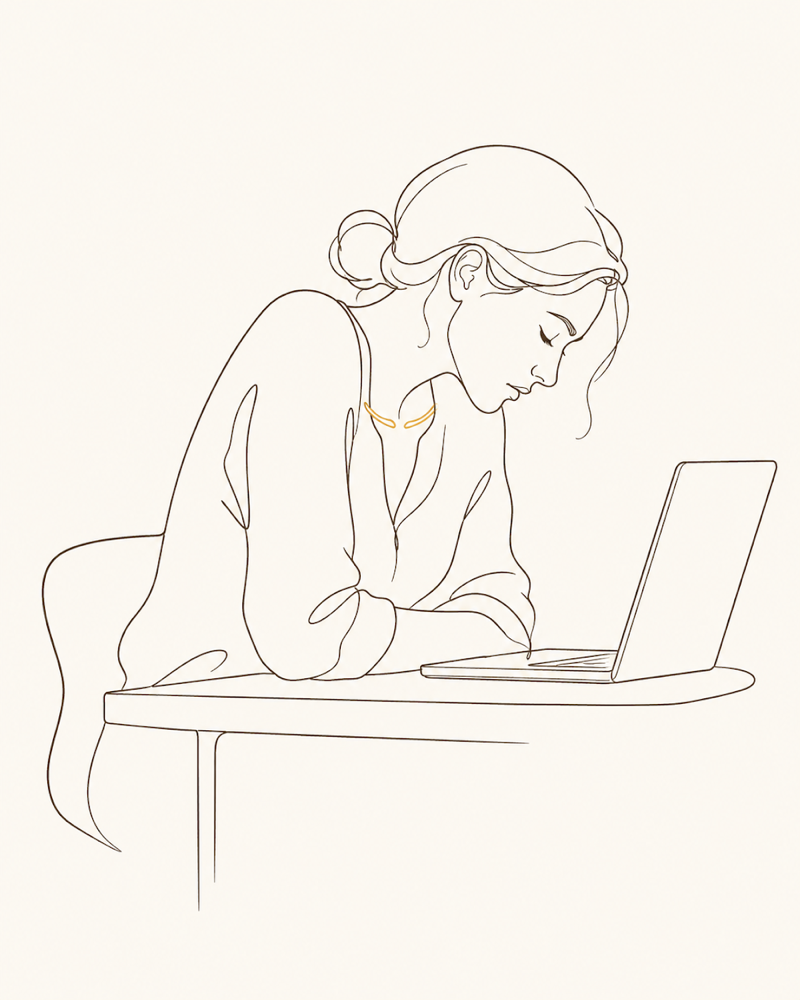
The common mistake
You breathe up. You’re built to breathe wide.
Watch yourself take a big breath — the kind you take when someone says “take a deep breath.” Odds are your shoulders climbed, your chest lifted, and the air piled into the top of you. That’s breathing up. It takes effort, so your brain logs it as a big one. It isn’t. It’s a small breath wearing a costume.
So try the opposite. That quiet, hard-to-reach space at the bottom and back of you is exactly where the air is supposed to go.
Try this now — 60 seconds
Send your breath into your back.
- Hands on your lowest back ribs — not your belly.
- Breathe in slowly through your nose.
- Aim the air at your hands. Think wide, not big.
- Shoulders quiet. If they lift, you’ve gone back to breathing up.
- Five or six breaths. About a minute.
You’re not chasing a huge inhale — you’re sending an ordinary one somewhere it doesn’t usually go. After a few, most people notice their shoulders have quietly dropped and their back feels wide and almost heavy. That’s the tell that the breath finally landed low, instead of hauling itself up into your neck.
You didn’t breathe more. You just sent it somewhere new — and it probably felt like more anyway.
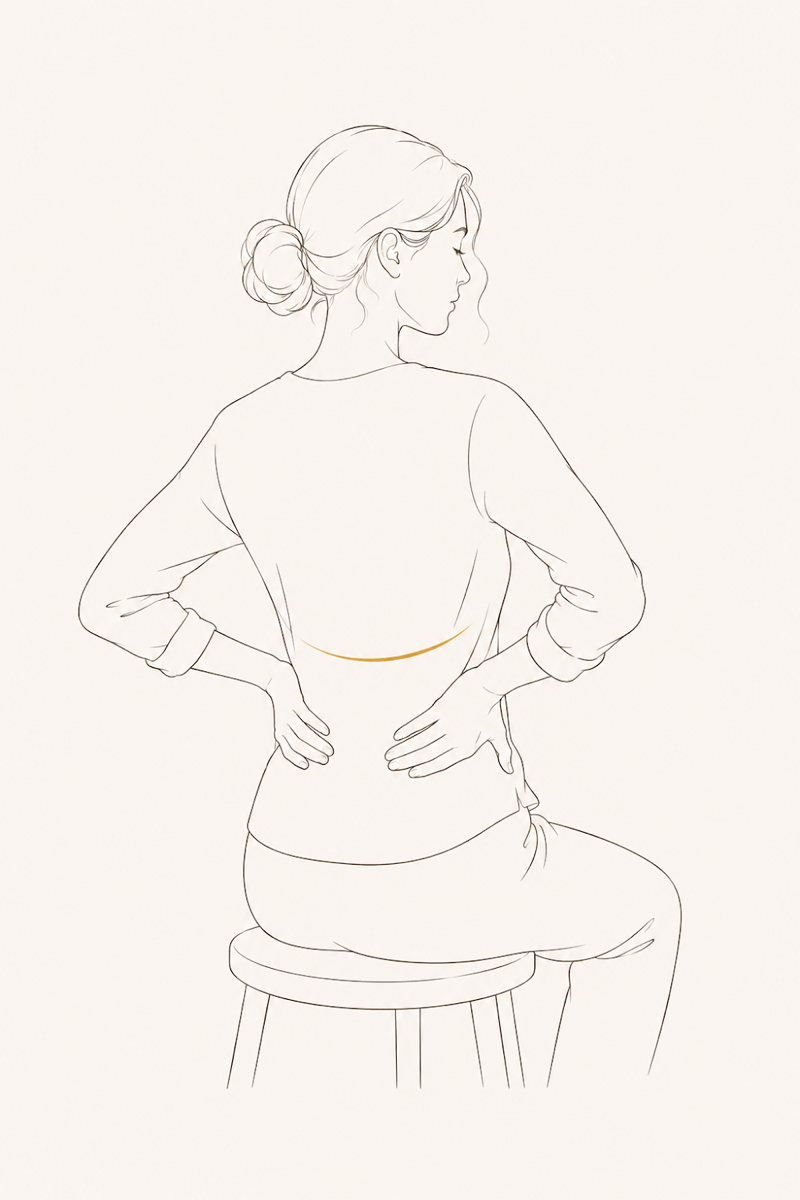
“It’s not how much air. It’s where it goes.”
Nobody needs to learn to inhale more — if anything, plenty of us already move too much air. The skill is direction: getting an ordinary breath to fill the low, wide, back part of you instead of climbing into your neck and chest.
And here’s where Monday comes back. You can’t fill a space that’s already jammed open. A chest that never fully exhaled is stuck a little inflated all the time — so there’s nowhere for a real inhale to go. That’s why the exhale came first: letting the air out, ribs settling down, is what re-seats your diaphragm — restoring its zone of apposition — and makes room for the next breath to land somewhere useful.† An inhale is only ever as good as the exhale before it.
So everything that looks a little strange in our studio is really one idea: teaching a breath to go where it quietly stopped going. Into the back. Into the low ribs. And — for reasons that deserve their own letter — especially into the right side.†
The science
Your lungs don’t fill evenly.
| Region | What happens |
|---|---|
| Top | the apex takes in the least — and it’s exactly where most of us send the air. |
| Bottom | about half again as much air, every single breath.1 |
Gravity leaves those lower, deeper regions primed and waiting to expand. Lie down and the busiest region shifts to whatever’s lowest now: your back. Which means most of us spend our lives breathing hardest into the part of the lung that does the least. So “breathe low, into your back” isn’t yoga-teacher poetry — it’s aiming your breath at the part of you that was built to do the work.
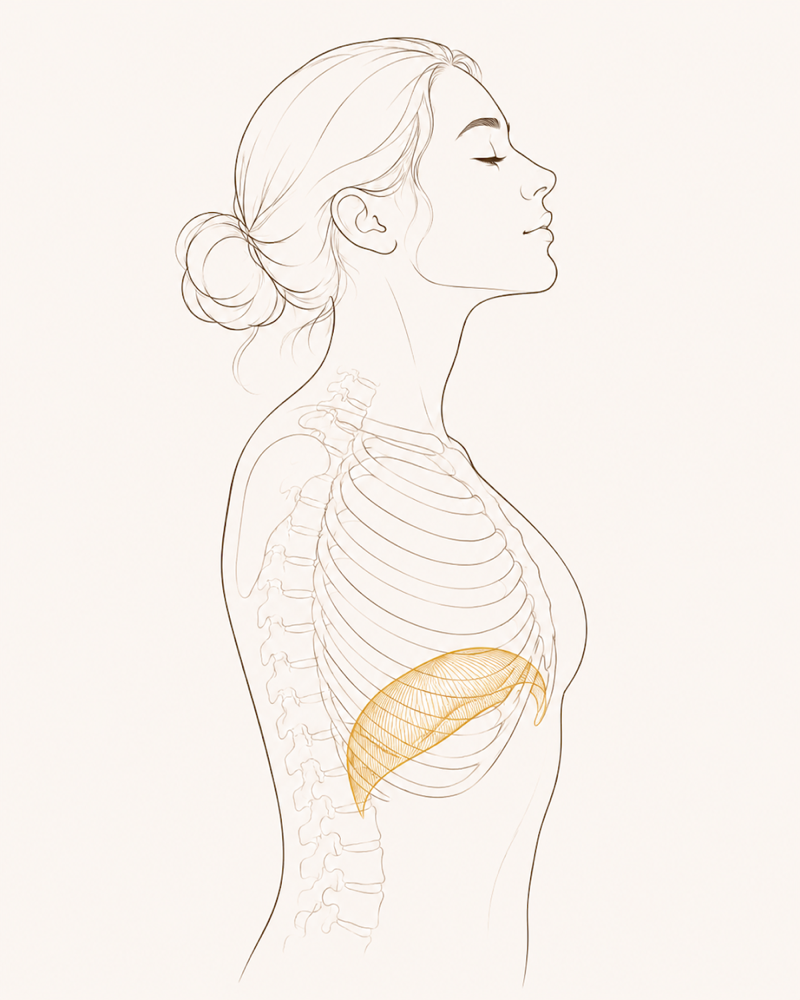
The engine for that is your diaphragm — a dome under your lungs that drops when it contracts and draws air down and wide. When it’s working, you barely feel your upper body move. When it isn’t, you make up the difference with the muscles of your neck and upper chest, hauling air in from the top.2 That’s the shoulders-up breath. It works, but it’s the backup generator running while the main engine idles. (Fair warning, because we don’t do fear-marketing: “you’re breathing wrong” is a useful nudge, not a diagnosis — there’s no clean line where a breathing pattern becomes a disease.3)
One more thing worth knowing: the inhale is your body’s gentle gas pedal. Within a single breath, breathing in nudges your heart rate up and breathing out brings it back down — a real, measurable rhythm.4 That’s the quiet symmetry of these two letters: Monday’s long exhale is how you settle, and a slow, low, wide inhale is how you take in fuel and a little lift — without winding yourself up.
And yes — through the nose
The nose isn’t just a hole air passes through. Those ridged structures inside warm, humidify, and filter every breath, and they’re your first immune checkpoint for what you inhale.5 A nasal inhale also carries a little nitric oxide toward your lungs, and its timing even syncs with brain rhythms tied to attention.6
Straight talk, though — the popular claim that nose-breathing floods you with oxygen or supercharges performance is overstated: you’re already near 98%, with almost no room to climb.6 Its real job is quieter and more useful — better-conditioned air, and a breath that lands low.
One honest caveat
Gentle is the whole point. This is about where the breath goes, not how big or how fast — don’t force huge inhales or stack them quickly, which just moves too much air and can leave you lightheaded. And a breathing skill isn’t a medical fix: if you’re often short of breath, can’t get a satisfying breath, or feel breathless at rest, that deserves a real workup, not a newsletter. Nothing here is medical advice.
Where this meets the method
The minute you just spent shows you a breath can go into your back. Finding out why yours doesn’t — and which corners it’s skipping — is what an assessment is for. From there the work is unglamorous and specific: a reach that opens one part of your rib cage, a hand cueing another, the balloon that teaches your ribs to move air where they’d stopped.† Not “take deeper breaths.” A map of where your air isn’t going, and a way to send it there until it goes on its own.
A case in point
A guy comes in who, in his words, “can’t ever get a full breath.” He yawns constantly, sighs all day, always feels like he needs one more inhale that never quite satisfies. He’s convinced he isn’t getting enough air.†
On the table it’s the opposite problem. He’s moving too much air, all of it up high — fast little chest breaths, ribs already flared and parked open, shoulders doing the lifting. There’s no room left to fill, so no breath ever feels complete, so he chases it with another. The harder he tries to breathe in, the worse it gets.†
So we don’t teach him to breathe more. We teach him to breathe down — with one specific exercise, and it has a gloriously unglamorous name: the 90-90 Hip Lift with Right Arm Reach and Balloon.†
1. Finish the exhale — against a balloon. He lies on his back, feet flat on a wall, knees and hips at ninety degrees, a small ball squeezed between his knees. He tucks his tailbone until his low back flattens into the mat — that’s what draws the ribs down and re-seats the diaphragm.† Then he blows into a balloon. The balloon isn’t a gimmick: it gives the exhale something to push against, so he can’t quit halfway.7
2. Reach — and the next breath goes somewhere new. As he blows out, his right arm reaches for the ceiling. Tongue on the roof of his mouth, hold three seconds, don’t let the balloon empty. Then he inhales through his nose again — and this is the whole trick. His chest is already full and the balloon is holding pressure, so the air has nowhere to go but into his back and the right side of his ribs. Exactly where it had stopped going.†
3. Four breaths, five times — then make it ordinary. That’s the set: four breaths, repeated five times. Weeks later he doesn’t need the wall or the balloon — the ribs come down on their own.† Which technique, and which arm reaches, is decided by an assessment — not by a newsletter. His pattern called for the right.
He wasn’t starved for air. He was drowning in it, high in his chest, with nowhere for a real breath to land. The fix wasn’t more. It was lower.
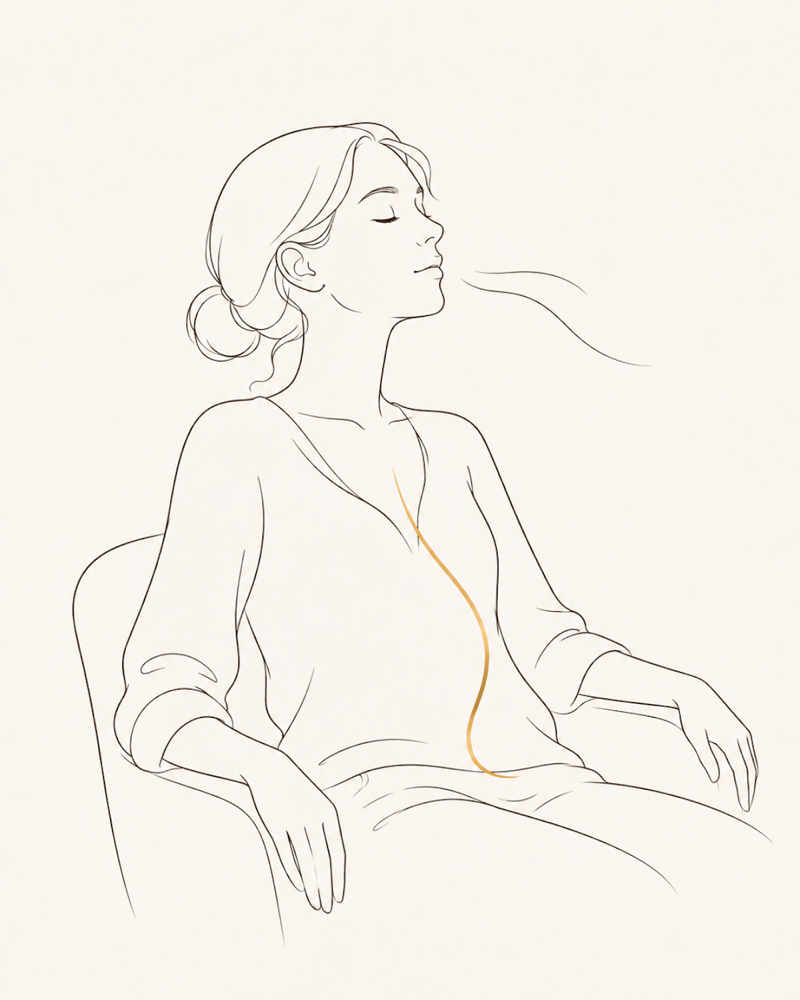
The whole breath
Not a bigger breath. A complete one.
Put the two letters together and you’ve got the whole cycle. The exhale makes the room; the inhale fills it — low, wide, into the back. A “full breath” was never a bigger breath. It’s a complete one, going where it’s built to go, both directions.
And it’s the same lever no matter what brought you here. If you can never quite land a satisfying breath, this is where that starts. If you’re chasing the last few percent of what your body can do, this is the floor all the fancier work stands on — none of it holds if the breath underneath it doesn’t. Same plumbing, different questions.
It’s also the quietest version of what we’re really after in here: actually being in your body, not just steering it around from the neck up. That’s not a big mystical idea — it starts this low, and this plain: one honest breath, going the right way.
Same note as Monday, said plainly: the Pneuma protocol under all of this is a method I’m still actively building — right now with a psychologist — writing it down so every step earns its place. What you’d meet in the studio is that method, still being sharpened.
The fine print
-
Regional ventilation is gravity-dependent: in an upright person the lung base is ventilated roughly 1.5× more per unit volume than the apex. West JB, Luks AM. West’s Respiratory Physiology: The Essentials. 11th ed. Wolters Kluwer; 2021. Limitation: it’s position-relative — “dependent” means whatever is lowest — and the gradient reverses near a full exhale. “Low and into the back” is a fair rule for normal upright/reclined breathing, not an absolute law.
-
The diaphragm is the primary muscle of inspiration; the scalenes, sternocleidomastoid and upper trapezius are accessory muscles, normally recruited as demand rises or when the diaphragm is compromised. De Troyer A, Boriek AM. Mechanics of the respiratory muscles. Compr Physiol. 2011;1(3):1273–1300.
-
The idea of a habitual upper-chest / over-breathing “breathing pattern disorder” is a clinical framework, not a validated diagnosis: CliftonSmith T, Rowley J. Phys Ther Rev. 2011;16(1):75–86; Courtney R. Int J Osteopath Med. 2009;12(3):78–85. Limitation: expert/observational models with no agreed objective cutoff — useful for framing, not proof that “most people breathe wrong.”
-
Within a breath, inhalation transiently withdraws vagal input and speeds the heart, while exhalation restores it and slows the heart — respiratory sinus arrhythmia. Eckberg DL. The human respiratory gate. J Physiol. 2003;548(2):339–352. Limitation: the direction is solid; the per-breath swing is small, and its size isn’t a clean readout of overall “vagal tone.”
-
The nasal turbinates warm, humidify and filter inspired air and act as an early immune interface. Georgakopoulos B, Le PH. Anatomy, Head and Neck, Nose Interior Nasal Concha. In: StatPearls [Internet]. StatPearls Publishing; 2023.
-
Nitric oxide is produced continuously in the paranasal sinuses and carried toward the lungs on a nasal inhale (Lundberg JON. Anat Rec. 2008;291(11):1479–1484); nasal-inhalation timing entrains limbic brain rhythms and modestly sharpens some attention/memory tasks (Zelano C, et al. J Neurosci. 2016;36(49):12448–12467, intracranial recordings in 7 patients). The debunk: the effect of nasal NO on actual blood-oxygen is small and was shown mainly in intubated patients who were NO-deprived; in a healthy person at ~97–99% saturation there’s essentially no oxygen headroom, so “nose-breathing boosts your oxygen/performance” is overstated.
-
Blowing into a balloon supplies resistance to the exhale, which helps restore the diaphragm’s dome position (its “zone of apposition”). Boyle KL, Olinick J, Lewis C. The value of blowing up a balloon. N Am J Sports Phys Ther. 2010;5(3):179–188. Limitation: that paper is a case report — a clinical demonstration, not a controlled trial.
The Letter
The writing here is the why. The letter is where the what to do lives — the protocol, the drill, the case behind each piece.
If any of this changed how you think about your own body, an assessment is where that conversation starts.