
Deep breaths won't save you.
What actually makes a breathing protocol work — and what doesn't.
The instruction to 'take a deep breath' usually misses the autonomic target. The nervous system responds to specific parameters — rate, ratio, position, environment — and getting even one wrong can maintain the state you're trying to shift.
“Take a deep breath.”
Count how many times you’ve heard that. In a doctor’s office. Before a presentation. From someone who meant well and had nothing more specific to offer. So you did it. You pulled in a big lungful of air, probably through your mouth, chest lifting, shoulders climbing, maybe a little noise. It felt like something happened.
Then nothing did. Heart rate didn’t come down. The jaw tightened back up inside a minute. Whatever state you were in before the breath, you were still in it. And you were left with the vague impression that you must be doing it wrong, or that breathing exercises are just one of those things that works for other people.
Neither is true. The problem is more specific than that, and once you see it, you can’t unsee it.
“Deep” is the wrong word.
Watch what happens when someone is told to breathe deeply. Almost every time, they do the same thing: they inhale harder. The chest lifts. The neck recruits. The upper trapezius gets involved. And the rate actually increases — they’re trying to get more air in, so they speed the whole cycle up. A forced, effortful inhale is the nearly universal response to the word “deep.”
Every piece of that response points the wrong direction.
The systematic review by Zaccaro and colleagues looked across the slow-breathing literature and found a consistent pattern: the physiological changes associated with an autonomic shift — increased heart rate variability, decreased sympathetic markers, increased parasympathetic output — track with slow breathing, not deep breathing.1 “Deep” isn’t a parameter the autonomic system recognizes. Rate is. Ratio is. The size of the inhale isn’t.
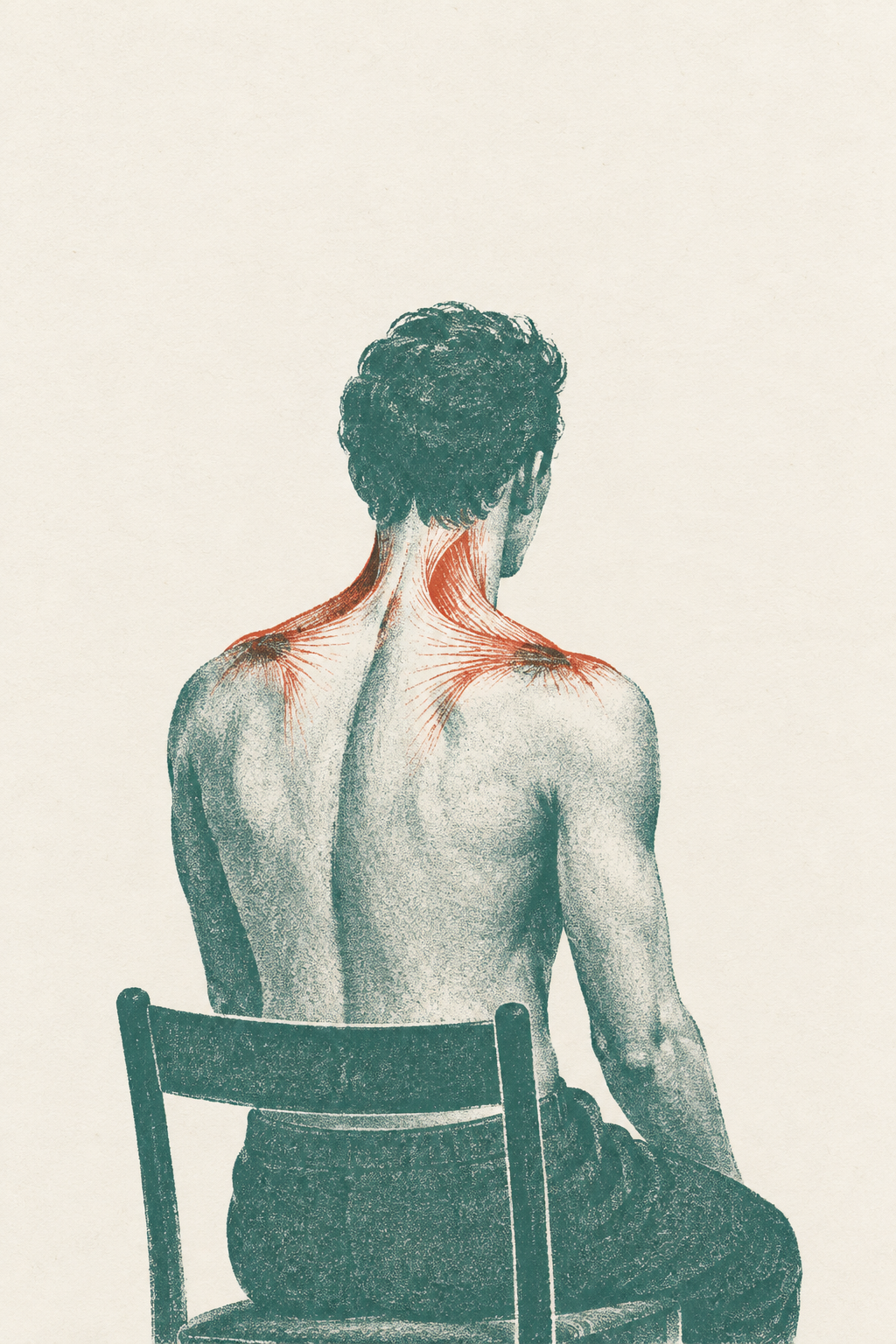
So the forced deep breath that most people take when instructed involves a bigger inhale (which briefly lifts the vagal brake), more upper-chest recruitment (associated with effort and alarm, not recovery), and often a faster rate (the opposite of every protocol shown to work). You just performed a breathing exercise that, on every axis the autonomic system cares about, maintained or intensified the state you were trying to leave.
Rate.
Here’s where it gets specific.
Laborde and colleagues published a systematic review and meta-analysis in 2022, pulling together the evidence on voluntary slow breathing and heart rate variability. The finding that held across studies: breathing at six breaths per minute or slower produced consistent increases in HRV — the best available marker of parasympathetic tone.3
Six breaths per minute means a ten-second cycle. Five in, five out, roughly. If you’ve never timed it, that feels absurdly slow. Most people at rest breathe somewhere between twelve and twenty times a minute. Cutting that by more than half isn’t a subtle adjustment. It’s a different gear.
And the evidence suggests a threshold, not a gradient. Breathing at ten breaths a minute isn’t half as effective as breathing at five. The autonomic shift shows up clearly at six and under, and it doesn’t track linearly above that.3 Whether there’s a floor — a rate so slow that the benefit plateaus — is less clear. But the ceiling is well established: faster than six, and you’re above the range where the consistent evidence lives.

Ratio.
Your heart rate fluctuates with every breath. It speeds up slightly on the inhale and slows on the exhale. That’s respiratory sinus arrhythmia, and the driver is the vagus nerve. During exhalation, vagal efferent output to the heart increases, actively slowing it. During inhalation, that output is briefly withdrawn — the parasympathetic brake lifts, and the heart speeds up.2
This is not the same as “inhaling activates your fight-or-flight.” Sympathetic signaling is far too slow for a beat-to-beat effect. What happens on the inhale is that the brake eases off. What happens on the exhale is that it comes back on. The exhale is when the system is being steered toward recovery.
An exhale-dominant breathing pattern gives that brake more time to work within each cycle. An inhale-dominant pattern — short exhale, long or effortful inhale, holding at the top — gives it less.†
The honest status: the RSA mechanism is well-established physiology. The question of whether deliberately extending the exhale beyond what you’d get by simply slowing the rate adds meaningful benefit is genuinely unsettled. I covered this in detail in No. 8 — the largest trial found no difference between an extended exhale and an even ratio at the same slow rate, while other studies found a difference.3 It’s a split verdict, and I’d rather hand you that than a slogan.
I still build the work around the exhale. Not because the autonomic evidence demands it, but because of the mechanical argument — which is the next parameter and the one that ties the breathing to a specific position.
Position.
The diaphragm doesn’t work in a vacuum. It works against the ribcage, and its leverage depends on the zone of apposition — the band where the muscle sits flat against the inner wall of the lower ribs. When that zone is intact, the diaphragm pulls down and expands the lower ribcage outward. When it’s compromised — by a chronically inflated, extended rib cage — the diaphragm is held flat, and the exhale never fully happens because the apparatus that performs it can’t get purchase.†
This is why position matters. Supine, knees bent, feet flat. That position changes the mechanical relationship of the diaphragm to the ribcage and the pelvis. Gravity helps the ribs settle. The flexed hips reduce the extension bias in the lumbar spine. The diaphragm returns to a position where it can actually dome on the exhale, restoring the leverage that makes quiet breathing possible.†
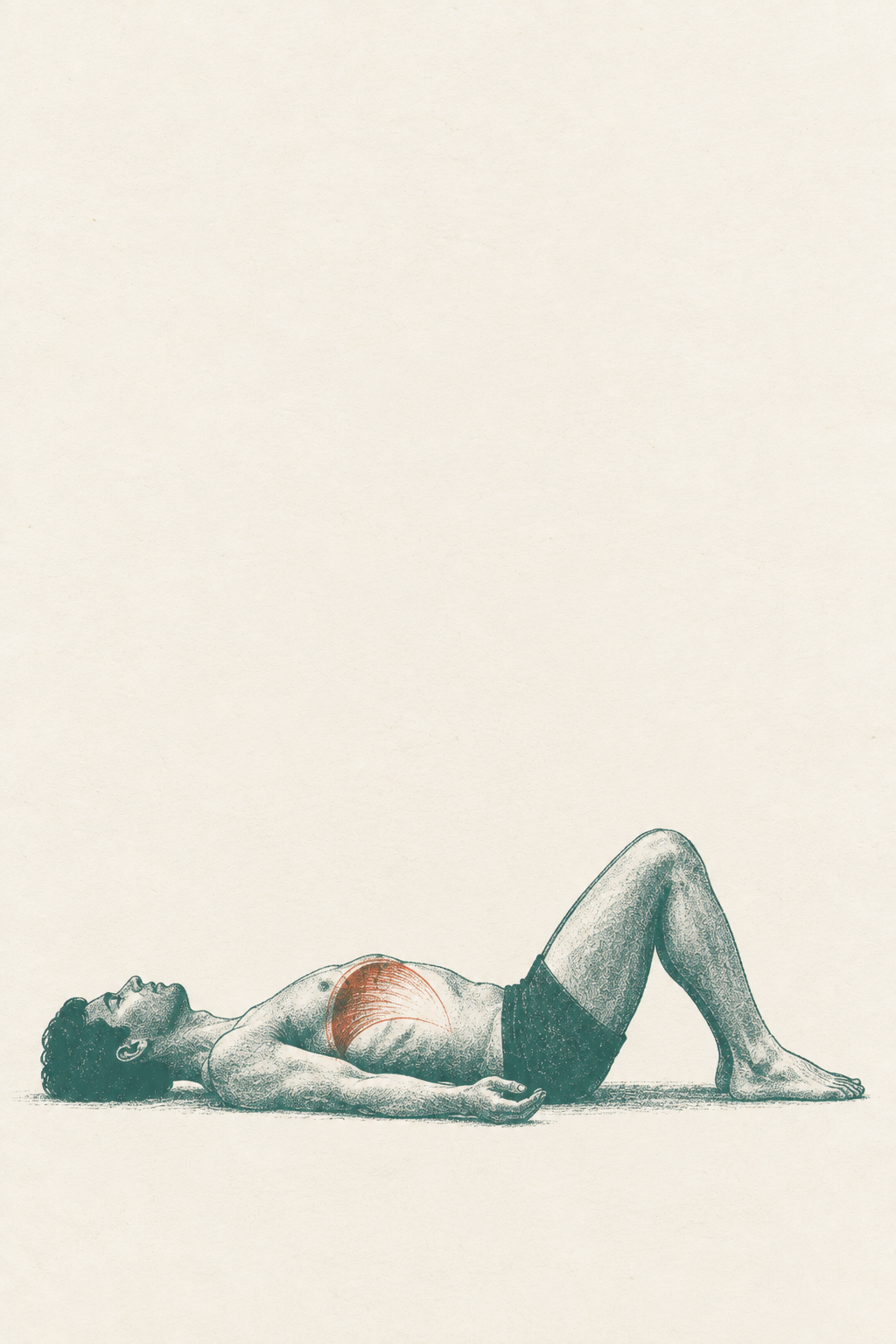
Try to do the same exhale sitting upright in a desk chair with your ribs flared and your back arched. The mechanics are different. The muscles that should be quiet are working. The diaphragm can’t dome. The exhale that would shift the state can’t fully happen because the body is in a shape that doesn’t allow it.†
The position isn’t a comfort preference. It’s a mechanical prerequisite for the exhale to actually do what the physiology says it can.
The room.
The autonomic nervous system doesn’t just read internal signals. It reads the environment.
Thayer and colleagues’ meta-analysis described the circuit: prefrontal cortex, amygdala, brainstem autonomic nuclei, vagal output to the heart. Information flows in both directions.5 The prefrontal cortex modulates the amygdala’s threat assessment, which modulates autonomic output, which modulates cardiac function — and cardiac function feeds back up the chain. The circuit integrates everything. Including the room you’re sitting in.
What that means in practice: a bright, loud, visually complex environment signals the system to stay alert. Dim light, low auditory input, reduced visual complexity signals something closer to safety. The same breathing protocol performed in both settings will produce different results, because the autonomic system is weighting the room as an input alongside the breath.

This doesn’t require a meditation cave. It means the person doing their breathing exercise in a brightly lit gym with music playing and people moving has an extra variable working against the shift they’re trying to make. The parameters interact. Each one alone moves the needle. Together they compound. Working against each other, they cancel.
Thinking still counts.
In No. 19, I made the case that the autonomic system doesn’t take orders — it takes inputs. That’s true. But the clean version of that argument, the one that says top-down is useless and bottom-up is the only game, is tidier than reality.
Cognitive reappraisal — changing the way you interpret a situation — genuinely changes the emotional and physiological response to it. That evidence is robust, not speculation.4 If you feel safe, the same slow exhale in the same dim room produces a stronger parasympathetic shift than if you feel threatened. Context matters. Expectation matters. The story you carry into the exercise is part of the input set the autonomic system is weighing.
What I said in No. 19 stands: for the person whose system has been stuck in sympathetic dominance — tight jaw, shallow breath, poor sleep, chronic holding — starting from the body is more effective than starting from the mind.† But once the body has shifted the state, the cognitive layer can do something with it that it couldn’t do before. The two aren’t competing. They work in sequence. The mistake most people make is trying to skip straight to step two — assuming that thinking about calm is the same thing as being in it.
What made the other pieces work.
The pre-sleep breathing from No. 17. The pain test from No. 18. The reason those produced a shift isn’t that breathing is inherently special. It’s that each one happened to get the parameters right.
A rate at or below six breaths per minute. An exhale-emphasized ratio, giving the vagal brake more time per cycle. A supine or supported position that let the diaphragm actually do its job. A quiet, dim environment with reduced sensory input. And no attempt to force calm — just the mechanics, letting the state follow.
Every one of those parameters is either a well-established physiological variable or a framework-informed clinical variable I’ve marked as such. None of them alone is the answer. Together, they meet the system where it actually listens. That’s what a breathing protocol is. A set of conditions the autonomic system is wired to respond to, delivered at the same time.
If you’ve tried “just breathing” and it didn’t work, there’s a decent chance at least one of those conditions was missing.
If any of this sounds like the pattern you’ve been living in, an assessment starts with where your system is actually sitting — not where you think it should be.
Book an assessment at aerboston.com
The fine print
-
Zaccaro A, Piarulli A, Laurino M, et al. How breath-control can change your life: a systematic review on psycho-physiological correlates of slow breathing. Front Hum Neurosci. 2018;12:353. doi:10.3389/fnhum.2018.00353. Limitation: a systematic review of heterogeneous studies with varying protocols, sample sizes, and outcome measures. The consistent finding — that slow breathing shifts autonomic balance toward parasympathetic dominance — holds across the literature, but the optimal parameters (exact rate, ratio, duration) are not settled. The distinction between “deep” and “slow” is drawn from the pattern in the evidence, not from a head-to-head comparison of deep vs. slow protocols.
-
Russo MA, Santarelli DM, O’Rourke D. The physiological effects of slow breathing in the healthy human. Breathe (Sheff). 2017;13(4):298-309. doi:10.1183/20734735.009817. Limitation: a narrative review, not a systematic review or meta-analysis. The dual voluntary/involuntary control of breathing and the RSA mechanism (vagal output increases during exhalation) are well-established respiratory physiology. The framing of breathing as a unique bridge between voluntary and autonomic control is widely shared but is the authors’ interpretive lens, not an independently tested claim.
-
Laborde S, Allen MS, Borges U, et al. Effects of voluntary slow breathing on heart rate and heart rate variability: a systematic review and a meta-analysis. Neurosci Biobehav Rev. 2022;138:104711. Limitation: the meta-analysis supports slow breathing at six breaths per minute or fewer for increasing HRV during and shortly after the practice. Whether these effects durably shift resting autonomic tone is a thinner evidence base. The meta-analysis supports slow rate but does not establish that a specific exhale-to-inhale ratio adds benefit beyond slowing the rate itself — that question remains genuinely unsettled in the literature.
-
Ochsner KN, Gross JJ. The cognitive control of emotion. Trends Cogn Sci. 2005;9(5):242-249. doi:10.1016/j.tics.2005.03.010. Limitation: a review of the cognitive reappraisal literature as of 2005. The evidence that cognitive strategies modulate emotional and physiological responses is robust for acute laboratory paradigms. Whether those effects are sufficient to shift a chronic, stuck autonomic state — the kind described in this piece — is a different question with a thinner evidence base. The review does not address somatic or bottom-up regulation, which is a separate literature.
-
Thayer JF, Ahs F, Fredrikson M, Sollers JJ 3rd, Wager TD. A meta-analysis of heart rate variability and neuroimaging studies: implications for heart rate variability as a marker of stress and health. Neurosci Biobehav Rev. 2012;36(2):747-756. doi:10.1016/j.neubiorev.2011.11.009. Limitation: a meta-analysis of neuroimaging studies establishing the prefrontal-amygdala-brainstem-vagal circuit and its bidirectional relationship to HRV. The claim that environmental context modulates autonomic responses via this circuit is well-supported by the model but is framework-level inference — the study itself did not manipulate environmental variables like lighting or noise. The specific application to dim/quiet environments facilitating parasympathetic shift is consistent with the model, not directly tested by it.
The Letter
The writing here is the why. The letter is where the what to do lives — the protocol, the drill, the case behind each piece.
If any of this changed how you think about your own body, an assessment is where that conversation starts.