
It's not anxiety.
When your nervous system is reacting to something real.
Your heart races standing up. Your stomach can't handle foods it used to. Every doctor says anxiety. Three conditions — EDS, dysautonomia, and MCAS — share one structural root in connective tissue. Here's the mechanism, and why it matters.
Your heart races when you stand up. Your stomach can’t handle foods it used to tolerate. Your joints ache in ways no scan explains. You’re exhausted but wired.
You’ve seen the doctors. Tests come back normal. And every one of them says the same thing: have you considered that this might be anxiety?
It’s not.
Three conditions. One structural root.
Ehlers-Danlos Syndrome. The hypermobile type — hEDS. It’s a connective tissue disorder. The collagen that holds your body together is too lax. Joints move further than they should. Ligaments don’t hold.1
That sounds like a joint problem.
Connective tissue isn’t just in your joints. It’s the structural material of your blood vessels, your gut wall, the matrix where your immune cells live. When it’s lax, the consequences reach everywhere.
Two conditions show up alongside hEDS with striking regularity: dysautonomia — dysfunction of the autonomic nervous system — and mast cell activation syndrome, MCAS. All three share a structural root in connective tissue.2
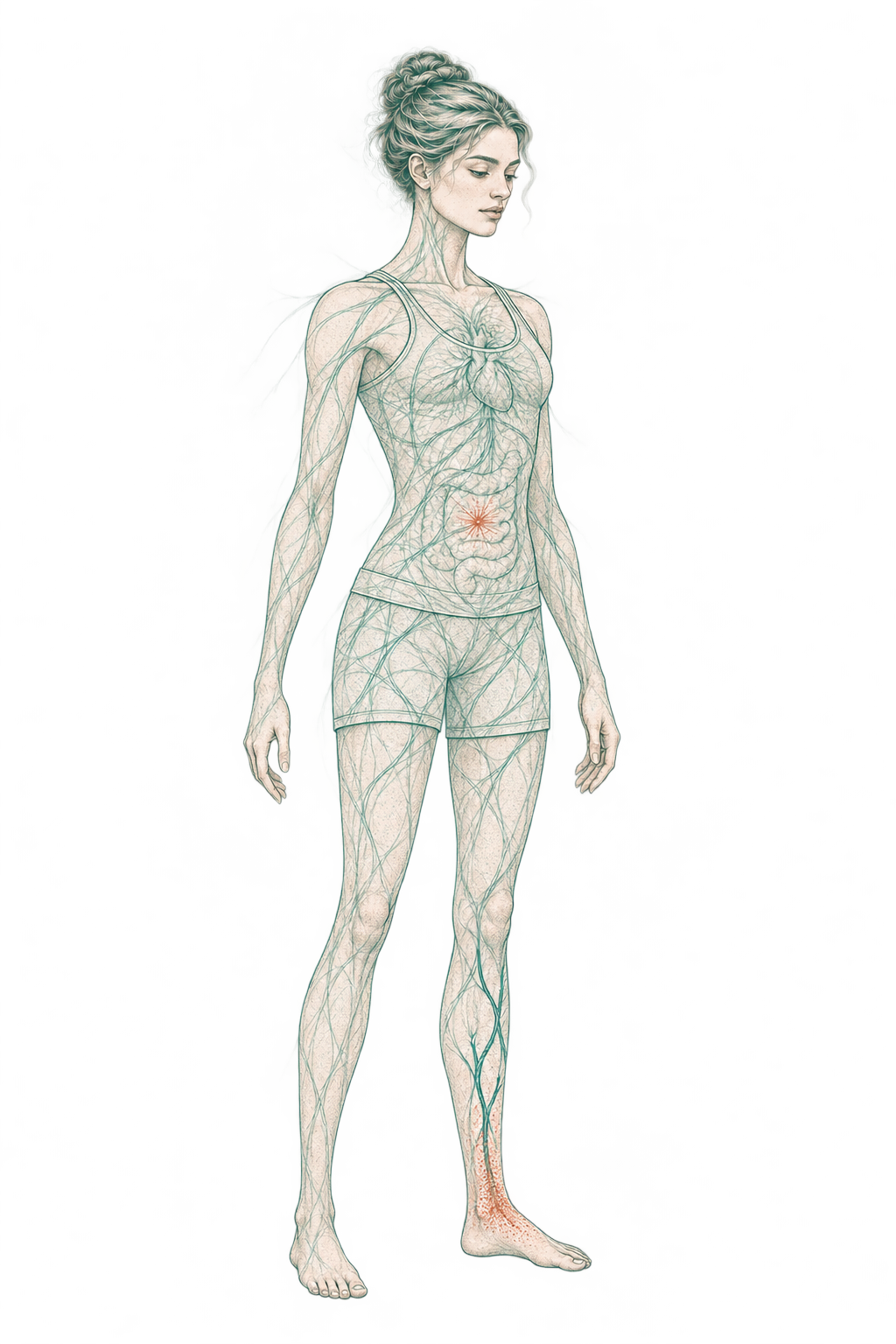
Why your heart races.
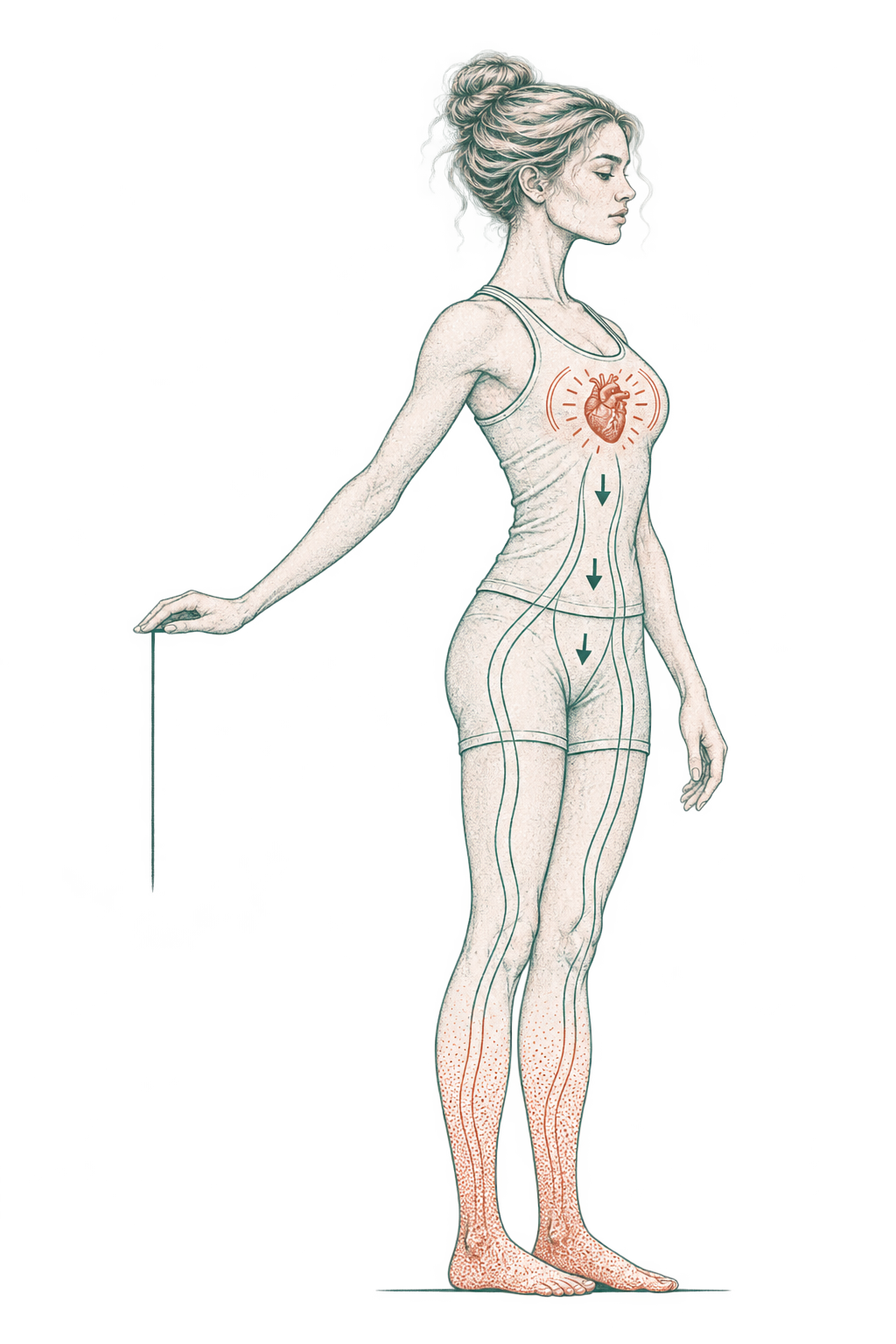
Blood vessels are connective tissue. When that tissue is lax, the vessels in your legs don’t constrict the way they should when you stand up. Blood pools downward. Your brain detects the drop in return flow and fires an emergency signal: speed up the heart.3
That’s postural orthostatic tachycardia syndrome — POTS. Heart rate jumps 30 or more beats per minute just from standing. Studies report it in roughly 20% to over 50% of hEDS patients, depending on the population.4
Your heart is compensating for a structural problem. Anxiety has nothing to do with it.
Why your stomach rebelled.
Mast cells — the immune cells that drive allergic reactions — live in connective tissue. When the structural environment they sit in is abnormal, they can become unstable. They degranulate — release their contents — in response to things that shouldn’t trigger them. Food. Temperature changes. Stress. Exercise.2
That’s MCAS. The flushing, the food intolerances, the hives out of nowhere. Those are immunological. The mechanism linking connective tissue abnormality to mast cell instability is still being mapped — this is the most emerging piece of the science — but the clinical association between hEDS and mast cell dysfunction is documented and taken seriously.2
Why everyone says anxiety.
Here’s the problem.
Tachycardia. GI distress. Flushing. Fatigue. Brain fog. Those are anxiety symptoms. They’re also autonomic dysfunction symptoms. Same output. Completely different input.
Anxiety is top-down. Your nervous system perceives a threat and your body reacts. Dysautonomia is bottom-up. Your body has a structural problem and your nervous system is compensating. The symptoms look identical. The mechanism is completely different.
In a survey of 4,835 POTS patients, 69% had been diagnosed with an anxiety disorder before anyone identified the autonomic dysfunction.5 More than two-thirds. Told it was in their head when it was in their blood vessels.
The cost of being wrong.
The average time from symptom onset to an hEDS diagnosis is over ten years. One study found 10.4 years, an average of 10 incorrect diagnoses, and 15.6 clinicians seen before someone got it right.6
During those years, treatment targets anxiety. SSRIs. Breathing exercises. “Stress management.”
Some of those help. Talk therapy is good for anyone. But they don’t explain why your heart races when you stand up. They don’t address why foods you tolerated last year now wreck you.
And there’s a second cost — a psychological one. Years of being told your symptoms are in your head. Years of doubting your own body. Research on diagnostic delay shows that patients describe emotional harm as the most salient impact — the feeling of being dismissed, lasting damage to trust in healthcare, and the complex grief of validation arriving years too late.7
The irony: the anxiety often IS real by the time someone gets the right diagnosis. It’s just not the cause. It’s the consequence.
Why position matters.
When connective tissue is lax, the body can’t rely on passive structural support. Ligaments don’t hold. Joints don’t lock into stable positions the way they’re supposed to.
So the nervous system compensates. It increases muscle tone. It locks into specific postural strategies — patterns that create stability through tension instead of structure. The system is always “on.”†
That constant compensation is expensive. Studies show that the metabolic cost of walking is significantly higher in people with hypermobility — the musculoskeletal system works harder for basic tasks, and the autonomic system supports that higher workload.8
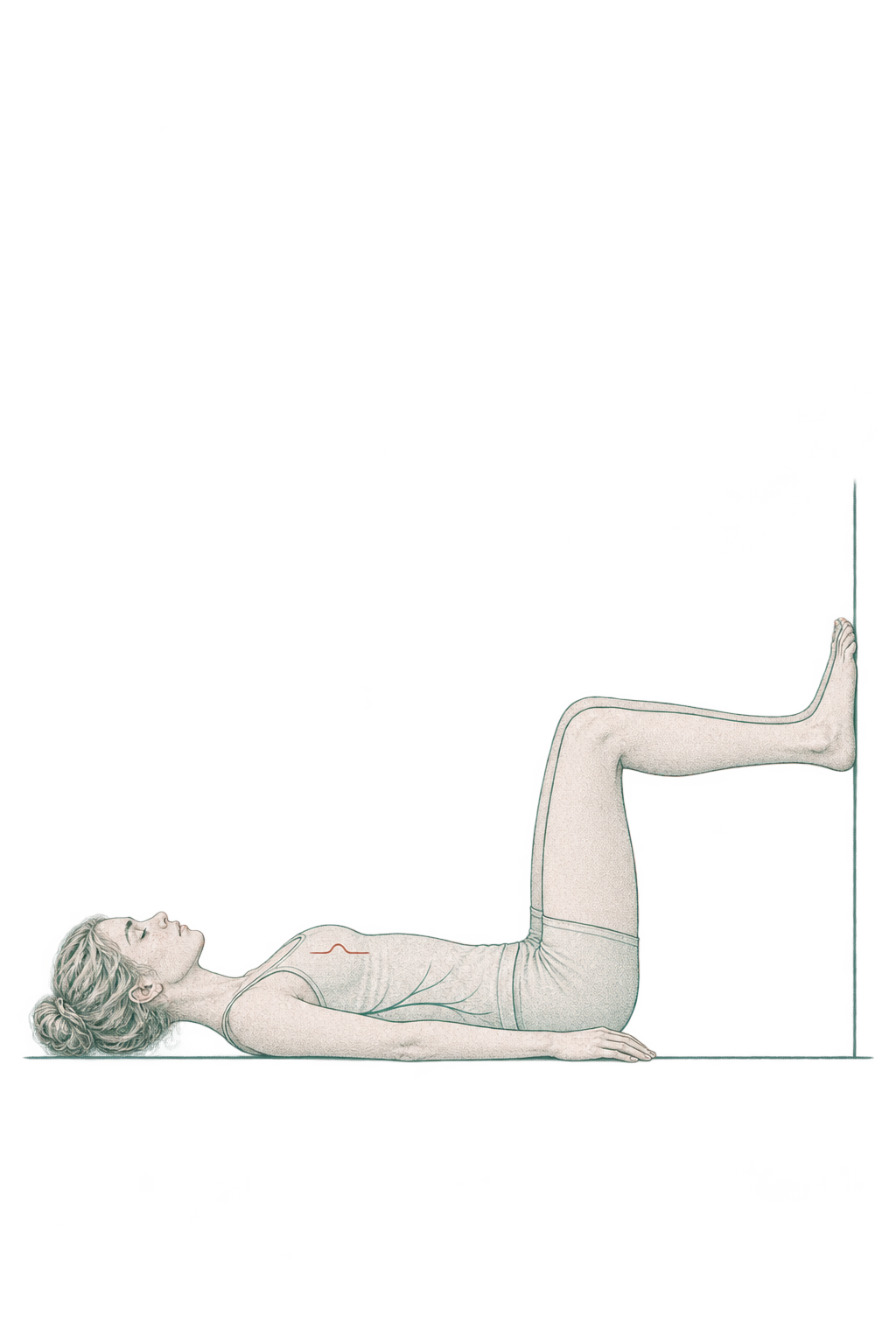
This is where repositioning comes in.† Not to fix the connective tissue — nobody’s claiming that. But to give the nervous system an alternative. A position where stability comes from something other than constant muscular bracing. A position where the system can be less “on.”†
That’s not a cure for EDS. It’s a strategy for reducing what it costs the nervous system to live in a body that doesn’t hold itself together the way textbooks say it should.†
This Thanksgiving, I’m grateful for the patients who didn’t stop looking. Who sat through years of “it’s just anxiety” and kept saying something is wrong until someone listened.
I’m grateful for the practitioners who do listen. Who test for the things that don’t show up on the standard panel. Who take the time to understand that a heart rate of 130 on standing is information, not a panic attack.
And I’m grateful for the body itself. Even when it struggles, it’s adapting. The tachycardia is a solution. The muscle tension is a solution. The nervous system is doing exactly what it should with the hand it was dealt.
Happy Thanksgiving.
If you recognize any of this — in yourself or someone you love — an assessment looks at the structure, not just the symptoms.
Book an assessment at aerboston.com
The fine print
-
Malfait F, Francomano C, Byers P, et al. The 2017 international classification of the Ehlers-Danlos syndromes. Am J Med Genet C Semin Med Genet. 2017;175(1):8-26. doi:10.1002/ajmg.c.31552. Limitation: this is the nosology — the classification system itself. It establishes hEDS as a clinical entity with specific diagnostic criteria but acknowledges that no genetic marker has been identified for the hypermobile type, making diagnosis clinical rather than molecular.
-
Seneviratne SL, Maitland A, Afrin L. Mast cell disorders in Ehlers-Danlos syndrome. Am J Med Genet C Semin Med Genet. 2017;175(1):226-236. doi:10.1002/ajmg.c.31555. Limitation: this is a review of proposed mechanisms, not a confirmatory study. The association between hEDS and mast cell dysfunction is clinically recognized but the specific structural mechanism — how connective tissue abnormality triggers mast cell instability — is a hypothesis, not established fact. MCAS diagnostic criteria themselves are debated. The mast cell link is the most emerging piece of the triad.
-
Rowe PC, Barron DF, Calkins H, Maumenee IH, Tong PY, Geraghty MT. Orthostatic intolerance and chronic fatigue syndrome associated with Ehlers-Danlos syndrome. J Pediatr. 1999;135(4):494-499. doi:10.1016/S0022-3476(99)70173-3. Limitation: landmark paper proposing the vascular compliance mechanism. Alternative or complementary mechanisms — neuropathy, deconditioning, baroreflex dysfunction — also contribute. The specific jump from “lax connective tissue in vessel walls” to “excessive venous pooling” is a leading hypothesis, not a proven pathway.
-
Gazit Y, Nahir AM, Grahame R, Jacob G. Dysautonomia in the joint hypermobility syndrome. Am J Med. 2003;115(1):33-40. doi:10.1016/S0002-9343(03)00235-3. Limitation: foundational study, but n=27. The wide prevalence range across studies (roughly 20–50%+) reflects differences in populations, diagnostic criteria, and ascertainment methods. The 20–50% range stated in the text is a composite from multiple studies, not a single definitive finding.
-
Shaw BH, Stiles LE, Bourne K, et al. The face of postural tachycardia syndrome — insights from a large cross-sectional online community-based survey. J Intern Med. 2019;286(4):438-448. doi:10.1111/joim.12895. Limitation: community-based survey (n=4,835). Self-report and self-selected population — patients in Dysautonomia International may have had worse diagnostic experiences than the broader POTS population. The 69% figure is the proportion who self-reported a prior anxiety diagnosis, not a clinician-confirmed misdiagnosis rate.
-
Halverson CME, Cao S, Perkins SM, Francomano CA. Comorbidity, misdiagnoses, and the diagnostic odyssey in patients with hypermobile Ehlers-Danlos syndrome. Genet Med Open. 2023;1(1):100812. doi:10.1016/j.gimo.2023.100812. Limitation: survey-based with recall bias. The 10.4-year average and 15.6-clinician figures come from patients who self-selected into an EDS research cohort. National electronic health record studies (Demmler et al., BMJ Open 2019) confirm significant diagnostic delays at a population level, but the specific numbers should be read as “patients report” rather than “the population average is.”
-
McCleskey S, Hero J, Berdahl C, Gordon D. Between doubt and diagnosis: patient experiences of emotional harm from diagnostic delays. Patient Educ Couns. 2026;149:109610. doi:10.1016/j.pec.2026.109610. Limitation: qualitative study of patient experiences, not a randomized trial. But the finding — that diagnostic delay causes lasting emotional harm, damages trust in healthcare, and creates a complex grief when validation finally arrives — is consistent across the broader diagnostic-delay literature in EDS, endometriosis, autoimmune conditions, and other delayed-diagnosis populations.
-
Ladell AJM, Golden DW, Oliemans JP, Walls KD, Manocha RHK, Fletcher JR. Perceived quality of life, fatigue and the metabolic cost of walking in generalized hypermobility spectrum disorder and hypermobile Ehlers-Danlos syndrome. Front Rehabil Sci. 2025;6. doi:10.3389/fresc.2025.1706912. Limitation: the study measures metabolic cost of walking (energy expenditure), not autonomic markers specifically (HRV, catecholamines). The jump from “higher metabolic cost” to “higher autonomic cost” in this article is our inference — logically sound (a system working harder for basic tasks demands more autonomic support) but not what the study directly measured. The compensatory joint-work redistribution finding is directly observed.
The Letter
The writing here is the why. The letter is where the what to do lives — the protocol, the drill, the case behind each piece.
If any of this changed how you think about your own body, an assessment is where that conversation starts.