
Why 'just relax' doesn't work.
Your nervous system doesn't take orders. It takes inputs.
Everyone's been told to relax. It doesn't work — and there's a physiological reason. The autonomic nervous system doesn't respond to willpower. It responds to specific inputs.
Everyone’s tried it. A friend, a doctor, a yoga teacher — somebody looked at you and said some version of “you just need to relax.” And you tried. You tried harder. You downloaded the app. You sat in the class. You told yourself to calm down.
And here’s what happened: it didn’t work. Or it worked for about eight minutes and then the jaw tightened back up, the shoulders crept toward the ears, and you were right back where you started.
This isn’t a discipline problem. It’s a wiring problem.
Two systems. One body.
Your nervous system runs on two levels that matter here.
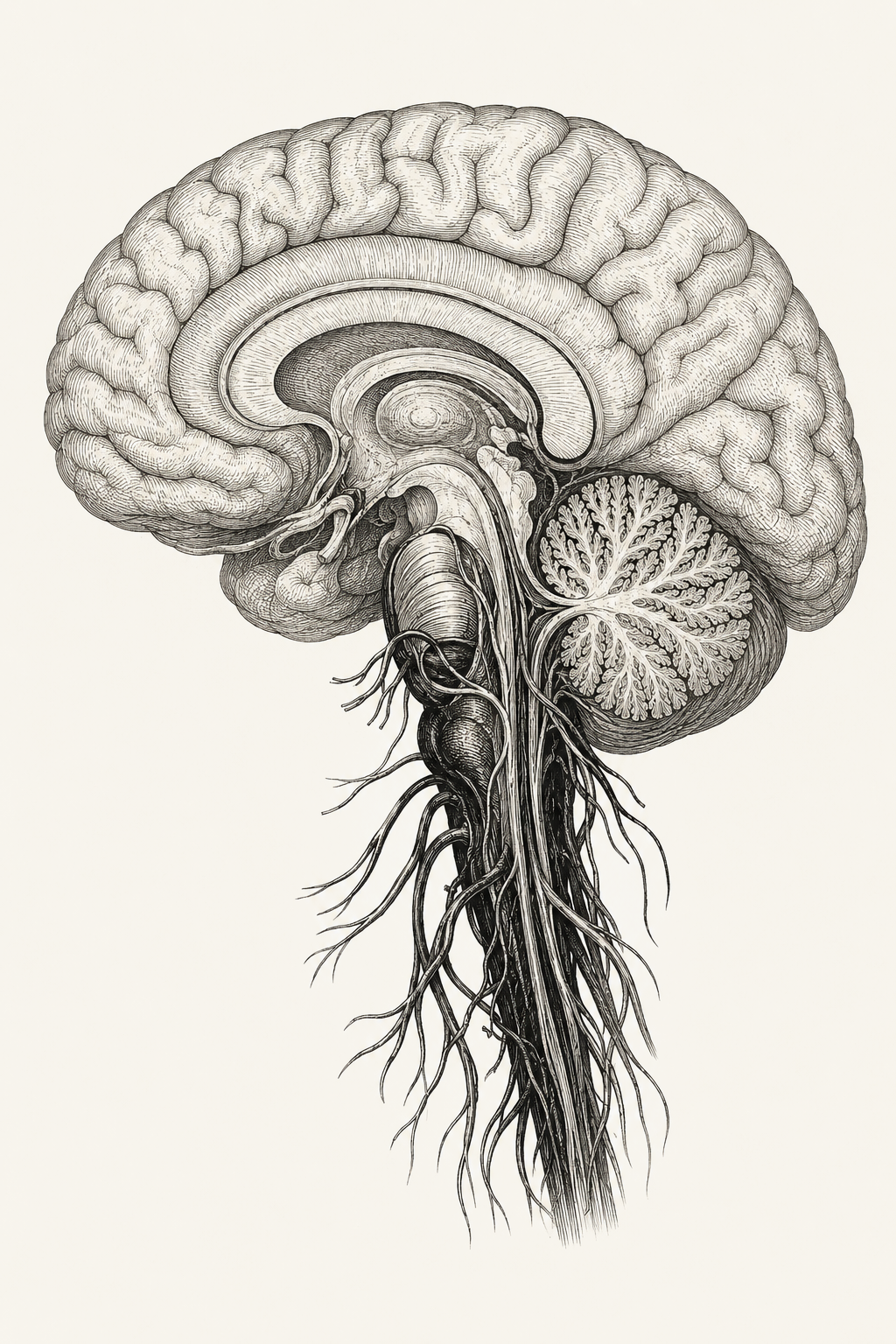
The first is the one you know about — the cortical level. It lets you decide things. Pick up a pen. Say a word. Hold your breath. This is the layer that meditation apps are talking to, and it’s the layer that responds when someone says “just relax.”
The second is the autonomic nervous system. It runs your heart rate, your blood pressure, your digestion, your stress response, your pain thresholds, your sleep onset. And it does not take orders. You cannot decide to lower your heart rate the way you decide to raise your hand. You cannot will your way into a parasympathetic state. The autonomic system responds to input — physiological input — not to intention.1
This is the reason “just relax” doesn’t work. The instruction is aimed at the wrong system.
The bridge.
There is one place where those two systems overlap: breathing.
Breathing is one of the only visceral functions under both involuntary and voluntary control. You breathe without thinking about it — but you can also choose to slow your exhale, extend the pause at the bottom, shift from mouth to nose. That dual control isn’t a design flaw. It’s a bridge.2
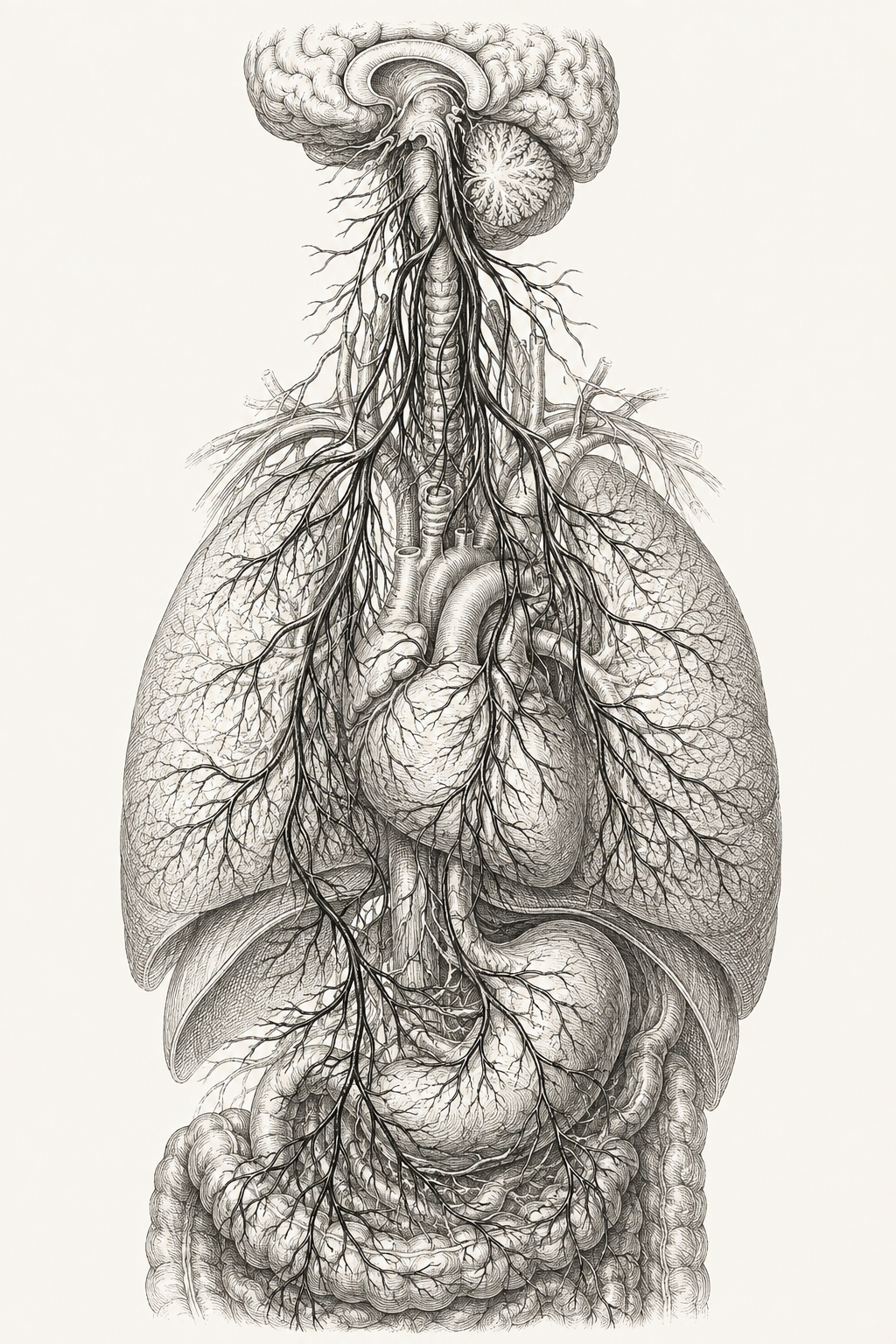
When you deliberately lengthen your exhale, you’re using the voluntary system to send a signal to the autonomic one. The exhale phase activates vagal efferent output to the heart, slowing heart rate and shifting autonomic balance toward the parasympathetic side.3 This is measurable. Heart rate variability increases. Sympathetic markers decrease. The state actually shifts — not because you decided to relax, but because you gave the system an input it knows how to use.
This is why the 90-second breathing test from the last piece worked for pain. It’s why the pre-sleep sequence from No. 17 worked for sleep. Not because breathing is magic. Because it’s the one voluntary input the autonomic system actually listens to.
Why the apps don’t stick.
Meditation. Mindfulness. Cognitive behavioral techniques. Positive self-talk. These are not useless — they work on the narrative layer. The story you’re telling yourself about the stress, the pain, the situation. Changing the interpretation of a sensation can genuinely change the experience of it. That’s well-established.4
But the narrative layer operates on the cortex. And for the person whose autonomic nervous system is stuck in a sympathetically dominant state — the person who’s been braced, tight, wired for months or years — the cortex is not the bottleneck. The state is.†
Here’s the distinction that gets missed: you can change how you think about the tension without changing the state that’s producing it. The jaw still clenches. The shoulders still climb. The sleep is still shallow. Because the autonomic system is still doing what it was doing before you opened the app.
This doesn’t mean you should stop meditating. It means if the meditation isn’t moving the needle on the physical tension, the problem probably isn’t that you’re doing it wrong. The problem is you’re starting from the wrong end.
What actually shifts the state.
If the autonomic system doesn’t respond to intention, what does it respond to?
Specific, reproducible, physiological inputs:†
Respiratory rate. Slow it down. Six breaths per minute or fewer shifts autonomic balance measurably — a systematic review and meta-analysis of the slow-breathing literature found consistent increases in heart rate variability and consistent shifts toward parasympathetic dominance.3
Exhale length. The parasympathetic shift is driven by the exhale phase specifically — during exhalation, vagal output to the heart increases, slowing heart rate via respiratory sinus arrhythmia.3 An inhale-dominant pattern (short exhale, long inhale, or holding at the top) maintains or increases sympathetic tone. An exhale-dominant pattern does the opposite.†
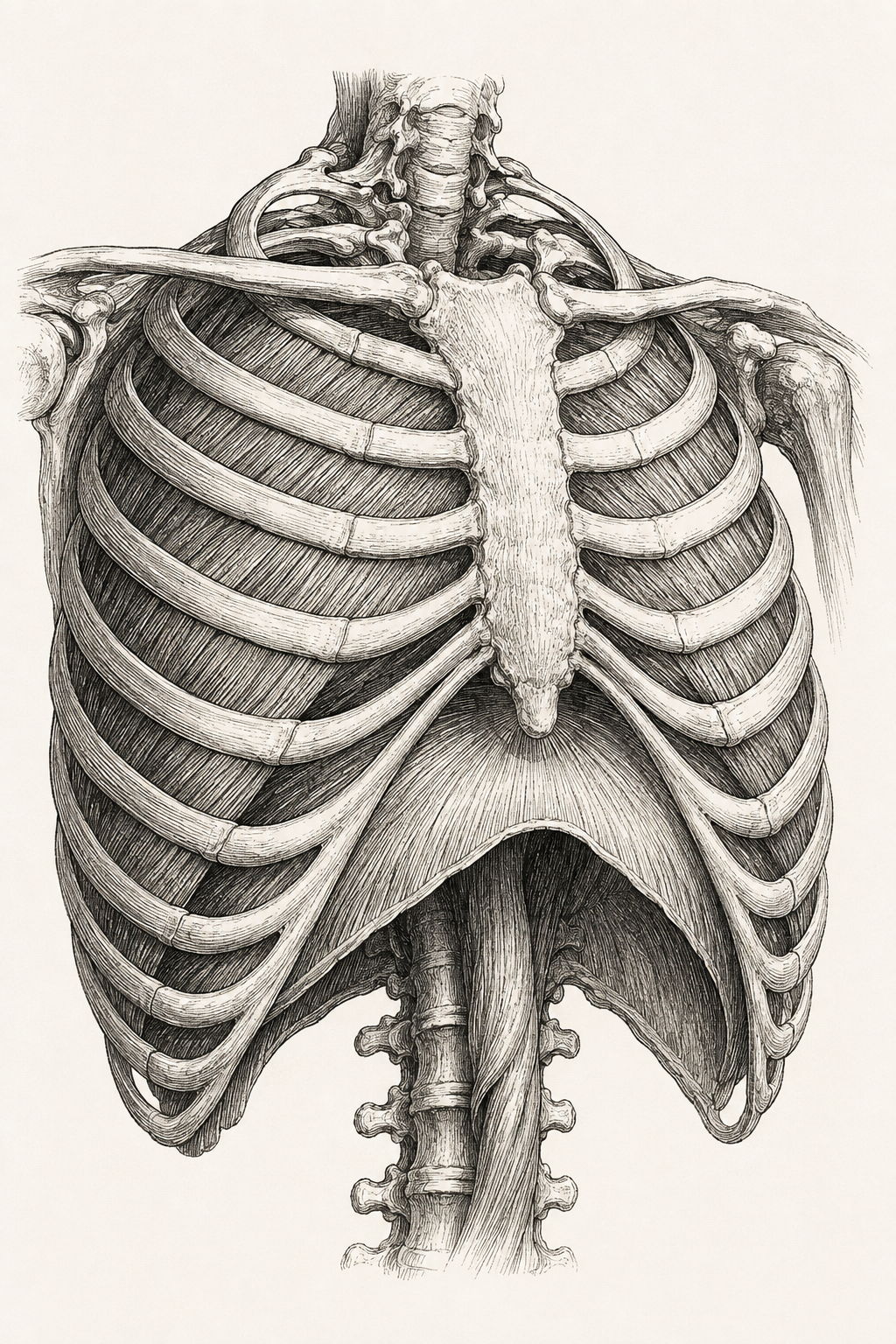
Position. Supine, knees bent, feet flat. This position changes the mechanical relationship of the diaphragm to the ribcage and pelvis, making a full exhale possible in a way that sitting or standing doesn’t always allow.†
Sensory environment. Dim light, low auditory input, reduced visual complexity. The autonomic system doesn’t just read internal signals — it reads the room. An environment that signals safety facilitates a parasympathetic shift. An environment that signals threat maintains sympathetic readiness.5
These are bottom-up inputs. They work from the body to the brain, not the other way around. And they’re what make the protocols across the last several pieces — the breathing test (No. 18), the pre-sleep sequence (No. 17), the recovery reframe (No. 15) — actually work.
The honest version.
The clean distinction — “top-down doesn’t work, bottom-up does” — is tidier on paper than in the body. The reality is they interact. The neurovisceral integration model describes a circuit: prefrontal cortex, amygdala, brainstem autonomic nuclei, vagal output, heart. Information flows in both directions. Cognitive context modulates autonomic responses — if you feel safe, the same slow exhale produces a stronger parasympathetic shift than if you don’t. Attention matters. Expectation matters.5
What I’m saying is not that cognitive strategies are worthless. It’s that for the person whose system is stuck — whose baseline is sympathetic dominance, who has been tight and wired long enough that it’s become the default state — starting from the body is more effective than starting from the mind.† The body shifts the state. The state changes what the mind can do with it.
That’s bottom-up regulation. That’s what we look for in an assessment. And it’s why I keep talking about breathing, position, and environment — not mindset.
If you’ve tried everything from the neck up and the tension hasn’t moved, an assessment looks at what’s happening from the neck down.
Book an assessment at aerboston.com
The fine print
-
Zaccaro A, Piarulli A, Laurino M, et al. How breath-control can change your life: a systematic review on psycho-physiological correlates of slow breathing. Front Hum Neurosci. 2018;12:353. doi:10.3389/fnhum.2018.00353. Limitation: a systematic review of heterogeneous studies with varying protocols, sample sizes, and outcome measures. The overall direction of the evidence (slow breathing shifts autonomic balance toward parasympathetic dominance) is consistent, but the optimal parameters (rate, ratio, duration) are not settled. Generalizability to clinical populations with autonomic dysfunction is limited by the predominance of healthy-subject studies.
-
Russo MA, Santarelli DM, O’Rourke D. The physiological effects of slow breathing in the healthy human. Breathe (Sheff). 2017;13(4):298-309. doi:10.1183/20734735.009817. Limitation: a narrative review, not a systematic review or meta-analysis. It summarizes the physiological mechanisms clearly but does not formally assess study quality or risk of bias. The dual voluntary-involuntary control of breathing is well-established respiratory physiology; the specific claim that this makes breathing a unique autonomic access point is the authors’ framing, widely shared but not independently tested as such.
-
Laborde S, Allen MS, Borges U, et al. Effects of voluntary slow breathing on heart rate and heart rate variability: a systematic review and a meta-analysis. Neurosci Biobehav Rev. 2022;138:104711. Limitation: the vagal effects are clearest during and shortly after the practice; evidence that slow breathing durably shifts resting autonomic tone is thinner and more mixed. Applying slow breathing to an autonomic regulation context specifically is our reasoning based on the mechanism, not a result from a trial designed to test that application.
-
Ochsner KN, Gross JJ. The cognitive control of emotion. Trends Cogn Sci. 2005;9(5):242-249. doi:10.1016/j.tics.2005.03.010. Limitation: a review of the cognitive reappraisal literature as of 2005. The evidence that cognitive strategies can modulate emotional experience is robust for acute laboratory paradigms. Whether those effects translate to chronic, stuck autonomic states — the kind described in this piece — is less clear. The review does not address bottom-up or somatic regulation strategies, which is a separate literature.
-
Thayer JF, Ahs F, Fredrikson M, Sollers JJ 3rd, Wager TD. A meta-analysis of heart rate variability and neuroimaging studies: implications for heart rate variability as a marker of stress and health. Neurosci Biobehav Rev. 2012;36(2):747-756. doi:10.1016/j.neubiorev.2011.11.009. Limitation: a meta-analysis of neuroimaging studies, not a clinical trial. It establishes the anatomical circuit (prefrontal cortex, amygdala, brainstem nuclei, vagal output) and the bidirectional relationship between HRV and prefrontal function. The clinical implication — that low HRV reflects a system stuck in a threat-default state — is the authors’ framework, supported by the data but not a direct finding of the meta-analysis itself.
The Letter
The writing here is the why. The letter is where the what to do lives — the protocol, the drill, the case behind each piece.
If any of this changed how you think about your own body, an assessment is where that conversation starts.