
Do you feel less resilient than you should?
Dysregulation, dysautonomia, and the spectrum between them
Stress hits harder. Energy doesn't recover. Brain fog you can't explain. What if the issue isn't effort — it's regulation?
Have you ever noticed that stress hits you harder than it used to? That your energy doesn’t recover the way it should? That you wake up tired, get dizzy when you stand up too fast, feel a brain fog that isn’t explained by how much sleep you got?
Originally sent to AER members as an email. The exact send date wasn’t recovered — the date shown reflects publication order, not a precise record.
Maybe you’ve chalked it up to being busy. Or getting older. Or not exercising enough.
But what if the issue isn’t effort — it’s regulation?
Your autonomic nervous system runs everything you don’t consciously control: heart rate, blood pressure, digestion, temperature, the constant calibration your body performs to keep you upright and functional. When it’s working, you don’t think about it. When it isn’t, everything feels harder than it should.
That’s dysregulation. Most people experience some degree of it without ever having a name for it.
The spectrum
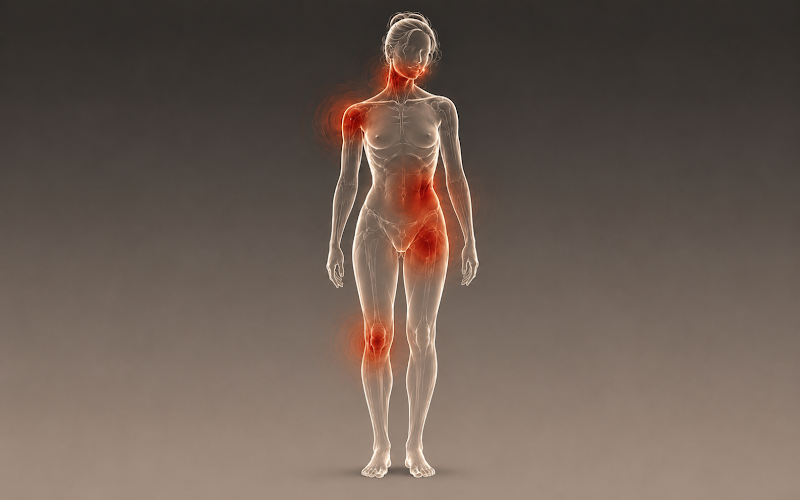
Dysregulation isn’t a yes-or-no. On one end: you’re more reactive to stress than you’d like, your sleep is inconsistent, your digestion is unpredictable, your anxiety feels disproportionate to whatever set it off. You function — you’re just working harder than you should have to.
Further along, the clinical diagnoses start.
Dysautonomia is the umbrella term for dysfunction of the autonomic nervous system. Under it:
POTS — Postural Orthostatic Tachycardia Syndrome. Heart rate spikes abnormally on standing, producing dizziness, fatigue, brain fog, and exercise intolerance.
MCAS — Mast Cell Activation Syndrome. The immune system misfires at stimuli the body should tolerate — inflammation, flushing, GI dysfunction, systemic reactivity.
EDS and hypermobility disorders — connective-tissue laxity that compromises vascular tone and joint stability. Patient-advocacy organizations report that a large share of people with EDS also experience POTS symptoms.1
These overlap constantly. And what ties the whole spectrum together — from “I just don’t feel resilient” to a formal diagnosis — is a nervous system that has lost the ability to scale its response to the demand in front of it.
Is it actually getting more common?
Honestly: probably, but the data is softer than the headlines suggest, and it’s worth being straight about that.
One frequently cited analysis found POTS incidence in the U.S. rising roughly fourfold between 2000 and 2016 — from about 1.6 to 6.0 per 100,000 person-years.2 That’s a real signal, but it comes with a real caveat: a rise in diagnosed incidence is not the same as a rise in true incidence. Awareness of POTS grew enormously over exactly that window. Some of that curve is more people getting recognized, not more people getting sick. The honest read is that it’s likely both, and nobody can currently tell you the split.
The often-repeated “1 in 100 teenagers” figure for POTS traces to patient-advocacy organizations rather than to primary epidemiological literature.1 We’re citing it as what it is — an advocacy-org estimate, not a peer-reviewed prevalence study. Treat it accordingly.
What’s better supported: excessive screen time in children and adolescents is associated with high sympathetic arousal, disrupted sleep architecture, and reduced physiological resilience.3 Association, not proof of cause — kids who are struggling may also be on screens more, and the studies can’t cleanly separate the two.
And the autonomic symptoms — fatigue, brain fog, stress intolerance, gut dysfunction — often ride along with other conditions and get missed, because autonomic disorders are barely taught in medical school.
If you feel less resilient than you think you should, you’re not imagining it. You may just be describing something nobody’s put a name to yet.
The honest boundary
We are not a medical practice. We don’t diagnose POTS, MCAS, EDS, or anything else, and nothing here is medical advice. If you’re experiencing these symptoms, you need an actual workup — dysautonomia is under-recognized, and it is also not the explanation for every tired afternoon.
What we do is work on one contributing layer: the positional and respiratory mechanics that influence how well your autonomic system can regulate. That’s a real layer. It is not the whole picture, and we won’t pretend it is.
Why this matters even if none of those words apply to you
If you read the diagnosis list and thought that’s extreme, that’s not me — consider that the same autonomic nervous system producing POTS symptoms at the clinical end is the one producing your 3 p.m. crash, your inconsistent sleep, and your stress that feels too big for its trigger.
It’s not a different system. It’s the same system, at a different point on the same dial.
Which is why the work that helps at the severe end is, in our experience, the same work that helps at the everyday end — just sequenced with far more care.†
What the work actually is
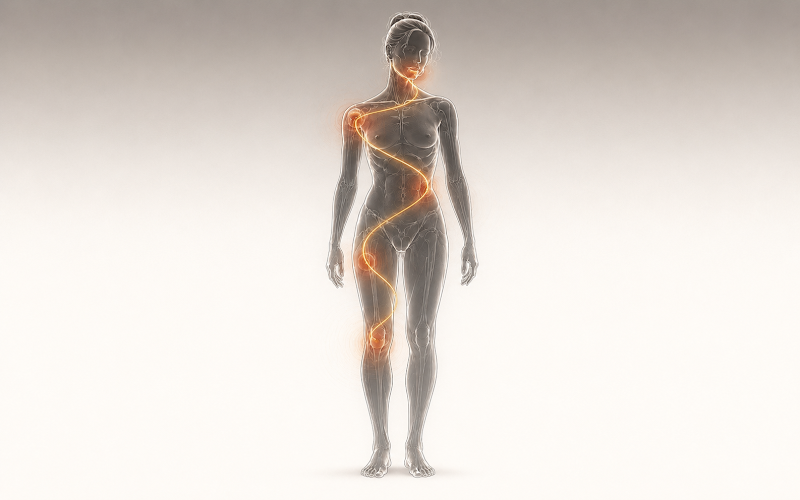
Three things, in order.†
Get to neutral. Before you load a system, it has to be in a position it can organize from. In the Postural Restoration model, that means restoring the positional options a compensating body has lost.† The mechanism is laid out in full here.
Restore respiratory mechanics. Not “breathe deeper.” A complete exhale, which most people organized around compensation genuinely cannot produce.† Here’s the honest version of the physiology, because the popular version is wrong: your heart speeds up as you inhale and slows as you exhale, and that happens because the brainstem briefly withholds vagal input to the heart on the way in and restores it on the way out.4 Inhaling doesn’t “switch on” your sympathetic nervous system — it takes the vagal brake off for a moment. The lever that’s actually well supported is the rate: slowing down toward six breaths a minute reliably raises vagally-mediated HRV, and that one is meta-analytically solid.5 Whether the exhale specifically needs to be the longer phase, on top of that, is contested — not settled. Several studies find a vagal advantage for a longer exhale; the largest and longest trial run so far found the ratio added nothing beyond simply going slower.5 So: slow down first. We work on the exhale for a different reason — a mechanical one, about where your ribs end up, and it’s our framework, not a trial result.† The full mechanism is here.
Then load it — deliberately. This is the part people get wrong in both directions. Exercise is one of the better-supported non-pharmacological interventions for POTS: structured training programs improve symptoms and functional capacity.6 But loading a system that can’t yet organize itself is how people with dysautonomia get flared and set back — which is why so many of them have concluded, reasonably, that exercise makes them worse. The question was never whether to load. It’s what has to be true before you load, and in what order.†
That sequencing is the actual work, and it’s why this isn’t something we can hand you as a set of exercises.
If you take one thing from this
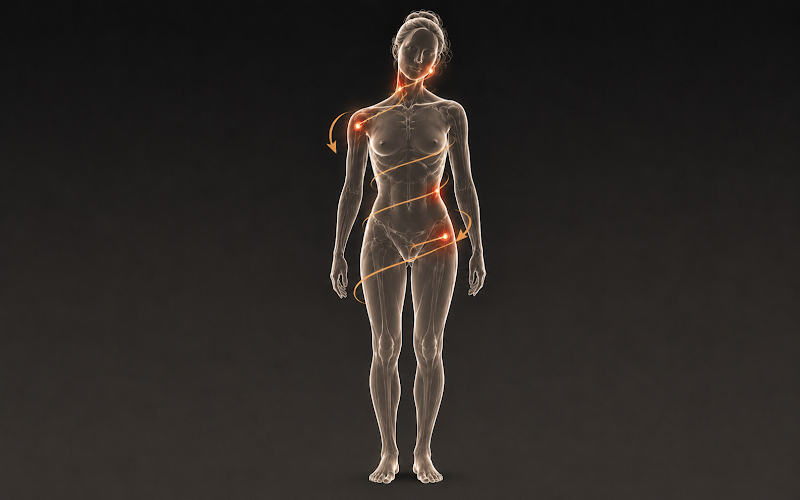
Feeling less resilient than you should is not a character problem and it’s usually not a fitness problem. It’s a regulation problem — and regulation is trainable.
Start where regulation starts: a full exhale.
The fine print
-
Patient-advocacy sources, cited as such: The Dysautonomia Project (“Teens and POTS”; “Teen and Adult Onset Dysautonomias,” thedysautonomiaproject.org) and The EDS Clinic (“Ehlers-Danlos Syndrome and POTS,” eds.clinic). Limitation — and it’s a significant one: these are patient-advocacy organizations, not primary peer-reviewed epidemiology. The widely repeated “1 in 100 teenagers” POTS figure and the “~80% of EDS patients have POTS” figure both originate in this kind of source and we have not been able to trace either to a primary prevalence study. We report them as advocacy-org estimates because that is what they are. Do not treat them as established prevalence.
-
Mayo Clinic. “Epidemiology of Postural Tachycardia Syndrome.” Neurology. 2019;92(15 Suppl):S18.005. Limitation: this is a conference abstract, not a full peer-reviewed paper — it has not been through the same scrutiny. It reflects a defined regional cohort rather than a national sample, and it measures diagnosed incidence. Because clinical awareness of POTS rose sharply across the same period, an unknown share of the fourfold increase is improved recognition rather than more disease. We state the number and the caveat together, because the number without the caveat is misleading.
-
Lissak G. Adverse physiological and psychological effects of screen time on children and adolescents. Environ Res. 2018;164:149–157; and Papadopoulou N, et al. Screen time and its health consequences in children and adolescents. Children (Basel). 2023. Limitation: observational and associational. These studies cannot establish that screen time causes autonomic dysregulation — reverse causation and confounding (sleep, activity, socioeconomic factors, underlying mental health) are all live alternatives.
-
Eckberg DL. The human respiratory gate. J Physiol. 2003;548(Pt 2):339–352. The respiratory cycle gates cardiac vagal outflow: vagal-cardiac motoneurone responsiveness is reduced during inspiration and restored in expiration. Limitation — and it’s the reason we rewrote this paragraph: the popular framing (“inhaling activates your sympathetic nervous system”) is mechanistically wrong. Sympathetic effects on the heart are far too slow to produce beat-to-beat change; the inspiratory heart-rate rise is vagal withdrawal. Eckberg also notes the gate is not binary, and that muscle sympathetic nerve activity is itself respiratory-gated in a way that cuts against the tidy version of this story.
-
Zaccaro A, et al. How breath-control can change your life: a systematic review on psycho-physiological correlates of slow breathing. Front Hum Neurosci. 2018;12:353 — slow breathing (<10 breaths/min) is associated with raised HRV and reduced anxiety. Limitation: a narrative systematic review, not a meta-analysis; only 15 studies survived screening; no RCTs, no longitudinal studies, healthy subjects only. On whether the exhale specifically has to be the long one: that is genuinely unsettled, and we’d rather say so than pick a side. Several studies find a vagal advantage for a longer exhalation (Van Diest I, et al. Appl Psychophysiol Biofeedback. 2014;39(3–4):171–180; Laborde S, et al. Sustainability. 2021;13(14):7775; Bae D, et al. Psychophysiology. 2021;58(11):e13905); the largest and most rigorous trial to date — a 12-week single-blind RCT, n=100, with HRV and PROMIS Anxiety as co-primary outcomes — found none (Birdee G, et al. Complement Ther Med. 2023;73:102937). The slow rate is the part the evidence actually carries. Whether the ratio adds anything on top of it is an open question — and note that in Bae, the exhale:inhale ratios participants actually achieved were 1.08 vs 1.33, so even the supporting studies never tested a true 2:1.
-
Fu Q, Levine BD. Exercise and non-pharmacological treatment of POTS. Auton Neurosci. 2018;215:20–27; and Okamoto LE, et al., on exercise training in POTS. Limitation: exercise is among the better-supported non-pharmacological interventions for POTS, but trials are small, dropout is high (the intervention is hard for exactly the people who need it), and protocols vary widely. “Effective for many” is supportable. “Necessary,” or “works for everyone,” is not — and we’ve removed that stronger claim from an earlier version of this letter.
If any of this changed how you think about your own body, an assessment is where that conversation starts.