
Adaptation — Part 2
Why your recovery isn't working.
Most of what's sold to you as recovery is theater
You own the foam roller, maybe the plunge, and a watch that scores your recovery every morning. Here's why almost none of it touches the system that does the recovering.
You own the foam roller. Probably the massage gun too, maybe the cold plunge, and a watch that hands you a recovery score every morning. And your recovery still isn’t working. I want to be careful here, because recovery is real and it matters enormously. But most of what gets sold to you as recovery is theater. It is built around chasing a number that is a symptom, not something you can actually pull on. This letter is about that difference, and about the handful of boring things that do the recovering while the gadgets take the credit.

Recovery is real. The version they sell you isn’t.
Start with what’s true, because I don’t want to throw the baby out. Getting stronger doesn’t happen while you train. It happens afterward, while you rest, and only if you actually rest enough. The joint consensus statement from the European College of Sport Science and the American College of Sports Medicine puts it about as plainly as those documents ever put anything: training has to involve overload, and it also has to avoid overload piled on top of inadequate recovery.1 So recovery isn’t optional and it isn’t soft. It’s half the job.
Here’s the part the industry skips. That same document went looking for a single reliable test that tells you whether you’ve crossed the line into too much, and concluded there isn’t one.1 Not a hormone, not a blood marker, not a questionnaire. And into that gap walks an entire industry, and what it sells you is a number. Raise the number, the story goes, and you’ve recovered. The number is almost always your heart-rate variability, and this is where it gets interesting.
The number is a warning light, not a lever.
Heart-rate variability is the tiny beat-to-beat variation in your heart’s timing, and as a warning light it is genuinely good. In a study of more than fifty thousand people, the ones with lower HRV were measurably more likely to die over the following years.2 That is not nothing. If your HRV is in the basement, your body is telling you something real.
But watch what happens when you ask the next question, which is the only one that matters if you’re going to spend your life chasing the number. Does raising HRV actually make you healthier, or is it just reporting on health you already have? The same study answered it. They used genetics to isolate the people who are simply built for higher HRV, and across more than four hundred thousand people, that genetically-higher HRV had no association with living longer at all.2 A separate genetic study ran the same test across nine different cardiovascular outcomes and found no benefit anywhere.3
Read those two findings side by side, because together they are the whole game. Low HRV predicts trouble. Raising HRV does not appear to fix it. HRV is a thermometer. A high fever tells you something is wrong, and that is useful. But you don’t treat the fever by holding an ice cube against the thermometer until the number looks better. You’ve changed the reading. You haven’t touched the thing the reading was about.
And if you were still tempted to just crank the number as high as it will go, there is a wrinkle. In one large study, people with naturally higher HRV actually developed more atrial fibrillation, not less, and the genetic analysis pointed the same way.4 It even makes sense: endurance athletes tend to carry both unusually high HRV and an unusually high rate of exactly that arrhythmia. This does not make high HRV bad. It means “maximize the number” was never a coherent goal in the first place.
A wearable can tell you your system is running on empty. That’s worth knowing. It cannot tell you the ice bath filled it back up. And mostly, it didn’t.
Your recovery score can’t grade its own homework
So why does your recovery score climb after a good week? Fair question, and the answer is a little deflating. The score is built out of your HRV. WHOOP lists your resting heart rate and your HRV as the measurements that feed its Recovery score, and hands back the raw HRV in the same breath. Oura’s Readiness is the same story: resting heart rate is the number one contributor and “HRV Balance” is number two.5 Which means a good recovery score can never be independent evidence that your recovery improved, because the score mostly is your HRV, wearing a friendlier outfit. It’s the same measurement grading its own homework.
Two more things worth knowing before you trust the morning number. First, a single night is mostly noise. In a dataset of nine million readings, a night of drinking knocked HRV down about twelve percent, and being a little sick knocked it down about ten.6 Those swings are bigger than almost anything your recovery routine could plausibly add. So the morning after your ice bath, whatever the number did, you genuinely cannot tell whether it was the ice bath, the two drinks on Thursday, the fight you had, or nothing at all. Only the multi-week trend carries a real signal.
Second, whether the number is even accurate depends on the device. Measured against a proper ECG across more than five hundred nights, an Oura ring’s nightly HRV was nearly perfect. A WHOOP’s was acceptable but a good deal noisier, with an error band wide enough to swallow the small changes people obsess over.7 If you are going to watch a trend, at least watch it on something that can see it.
Signal, yes. Scoreboard, no.
If you read the last letter, you might feel like I just contradicted myself. Last week I told you to watch your HRV as a readiness signal, to decide when to train hard and when to back off. I stand by every word of it. Here is the distinction that makes both letters true at once. Watching a gauge and chasing the number are not the same act.
As a dashboard light that tells you what state you’re in this morning, HRV earns its place. It is a decent readout of whether your body is ready to be asked a hard question today. As a score to maximize, or as proof that last night’s gadget worked, it doesn’t. So watch the trend, use it to time your effort, and then put your energy where it actually does something. Which brings us to the part nobody sells, because you can’t put a subscription on it.
Try this now — 3 minutes
An actual downshift
If the score isn’t the lever, what is? The unglamorous answer is that recovery is a state your nervous system drops into, and you have exactly one direct handle on that state. It’s the same one from last time.
Tonight, before bed, sit or lie down. Breathe out slowly and all the way to the end, then wait a beat before the next breath arrives. Keep the whole cycle slow, somewhere around five or six breaths a minute, which will feel almost comically slow the first time. Three minutes. That’s it.
Same honesty as last letter, since the internet is full of magic ratios: it’s the rate doing the work, not some precise proportion of in to out. Slowing the whole cycle down is what reliably shifts the vagal side of your nervous system, during the practice and for a stretch afterward.8 This won’t move a set point you were born with, and it isn’t trying to. It is putting you into the state where the recovering actually happens. For free, tonight, without a single strap.
Why breathing reaches it when the massage gun doesn’t
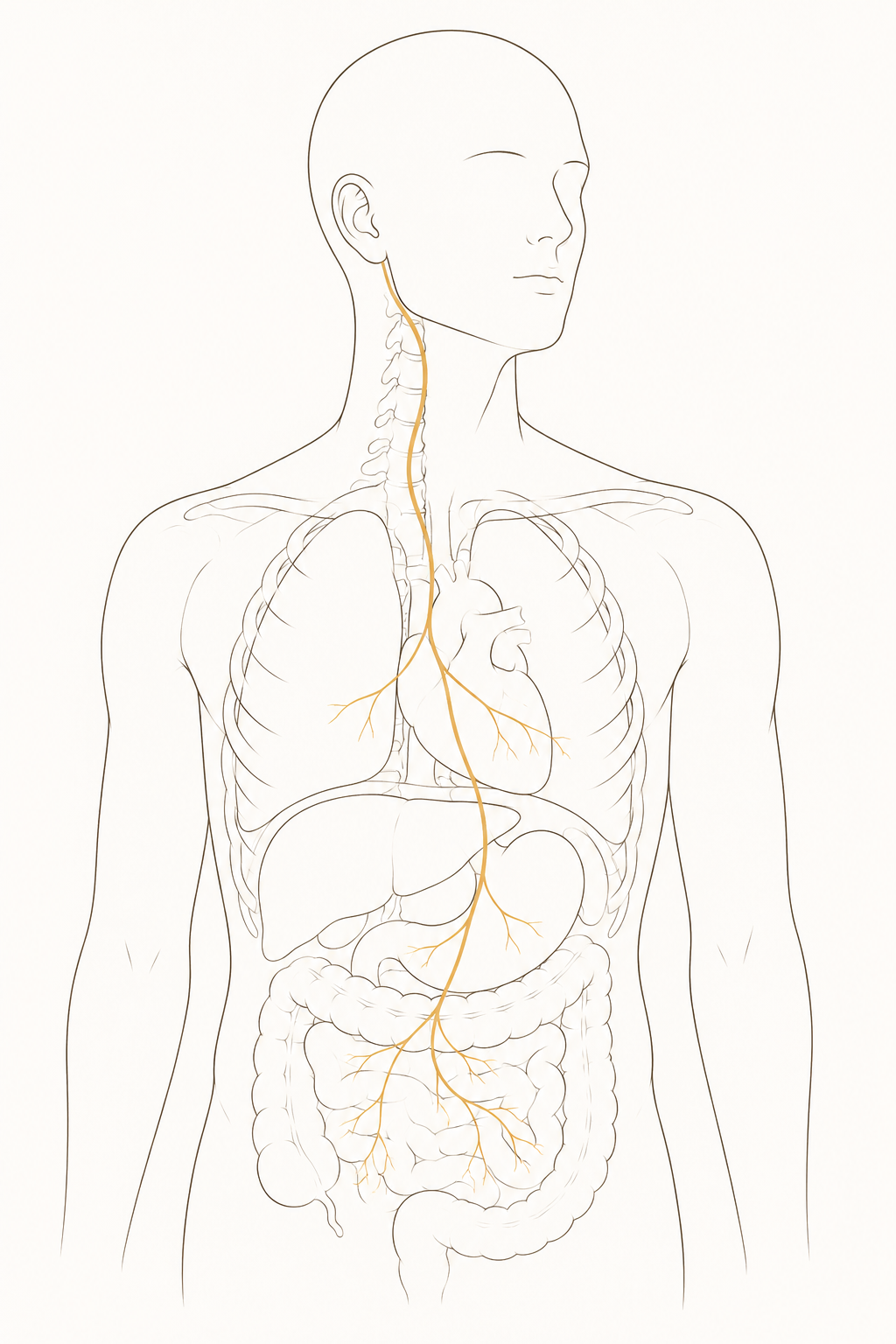
There’s a physical reason the breath gets somewhere a percussion gun can’t. The recovering state is largely set by the vagus nerve, the long wandering nerve that runs from your brainstem down through your neck and branches out across your heart, your lungs, your gut. Most of that system is sealed off from you. You can’t decide to digest, and you can’t decide your heart rate. Breathing is the one input wired straight into that nerve that you can also drive on purpose.
So when you slow the breath down, you are not relaxing in some vague spa sense. You are speaking to the nerve that actually sets the state, in the one language it takes direct requests in. That is a real mechanism, and it is also a modest one. It shifts the state while you do it and for a while after. It does not permanently reset a number, and I am not going to pretend it does.
What actually does the recovering
Sleep. Not doing more than you can absorb. And the autonomic state your breathing and your position quietly set all day long. That is most of it. None of it photographs well, none of it has a subscription, and all of it works better than the thing in the box on your porch. The gadgets aren’t villains. They’re just taking credit for a job the boring stuff is doing.
One honest caveat
This is training, not medicine. If your recovery is genuinely broken, if you’re wrecked for days after ordinary sessions or tired in a way that rest doesn’t fix, that is a workup, not a gadget and not a breathing drill. Thyroid, low iron, sleep apnea, a real sleep disorder, depression, blood-sugar swings, or simply not eating enough for the work you’re doing all cause exactly this, and several of them are common and very treatable. You find them with a doctor, not a wrist strap. Breath work sits alongside that. It doesn’t replace it. Nothing here is medical advice.
Where this meets the method
This is why the first thing that happens here is an assessment, not a program and not a supplement stack.† You can’t design someone’s recovery around a number that can’t tell you what it means. You design it around the state the person is actually in, which you find by looking at how they breathe, how they hold themselves, what their ribs and their nervous system are doing when the day gets hard. A score can’t hand you that.†
Here’s what that looked like with someone who had done, on paper, absolutely everything right.
A case in point — the man optimizing the wrong thing
He arrived with a spreadsheet. Plunge, sauna, two wearables, a supplement drawer, and eight months of a recovery score he was working like a second job. He was still exhausted, and he could not understand why the number wouldn’t cooperate.†
Nothing in his routine was crazy. The problem was that all of it was aimed at the readout and none of it at the system. He was managing the thermometer.
| When | What happened |
|---|---|
| First | The score came off the wrist for a while. Not forever. Just long enough to stop him grading his morning before he’d had it. The number was running his mood, and his mood was costing him more than the number was ever worth. |
| Weeks 1–4 | We fixed the boring things first. An earlier, protected bedtime. One genuinely easy day where there used to be four hard ones. Three minutes of the drill above before sleep. No plunge required. |
| By Wk 8 | He felt recovered before the app agreed. The trend did drift up eventually, weeks behind the way he actually felt. Which is the whole point. The number was reporting on a change it had no part in making.† |
He spends less on recovery than he used to, and recovers better than he ever did chasing it. Those two things are not a coincidence.
Why I keep hammering this one
If you’re chasing the far edge of what a body can do over thirty years, the trap here is subtle and expensive. You can spend a decade perfecting the measurement of your recovery and never once improve the recovery itself. The dashboard gets gorgeous. The engine stays exactly where it was. The people who actually go the distance are almost never the ones with the best data. They’re the ones who did the dull things consistently and spent their attention on the state, not the score.
And if you’re on the other end of my inbox, the person who has tried every protocol and every device and been told your labs are normal while you feel anything but, I want to be straight with you, because you have been sold things before. This isn’t another gadget. It’s close to the opposite. It’s the argument that the thing that helps was never going to arrive in a box, and that the number you’ve been failing to move was never the thing that needed moving.
Same plain note as always: the Pneuma protocol underneath all this isn’t finished, and isn’t supposed to be. It’s a living method I’m building right now, with a psychologist, setting it down piece by piece so every claim has to earn its spot. What you’d meet in the studio is that method, still being sharpened.
The fine print
-
Meeusen R, Duclos M, Foster C, et al. Prevention, diagnosis, and treatment of the overtraining syndrome: joint consensus statement of the European College of Sport Science and the American College of Sports Medicine. Med Sci Sports Exerc. 2013;45(1):186–205. The statement holds that “successful training not only must involve overload but also must avoid the combination of excessive overload plus inadequate recovery,” and on diagnosis concludes that of the available markers “none of them meet all the criteria to make their use generally accepted.” Limitation: this is an expert consensus document, not an experiment. The boundaries between functional overreaching, non-functional overreaching, and overtraining syndrome are contested and diagnosed largely by exclusion. Read it as the field’s best current agreement, not as settled fact.
-
Tegegne BS, Said MA, Ani A, et al. Phenotypic but not genetically predicted heart rate variability associated with all-cause mortality. Commun Biol. 2023;6(1):1013. doi:10.1038/s42003-023-05376-y — in UK Biobank, people with lower measured HRV had a higher risk of death (lowest vs highest RMSSD quartile hazard ratio ≈ 1.31; roughly 54,000 people), but HRV estimated from genetics showed “no association” with mortality across about 412,000 people and 17,503 deaths. Limitation: the genetic (Mendelian-randomization) arm tests a lifelong genetic tendency toward higher HRV, not a training drill that nudges it. A null there is strong evidence against HRV being a lever, though not absolute proof that no intervention could ever help. What it establishes cleanly is the split this letter turns on: measured HRV predicts; genetically-driven HRV does not appear to cause.
-
Zhao Y, Yu H, Gong A, Zhang S, Xiao B. Heart rate variability and cardiovascular diseases: a Mendelian randomization study. Eur J Clin Invest. 2024;54(1):e14085. doi:10.1111/eci.14085 — genetic analysis across nine cardiovascular outcomes (hypertension, heart failure, angina, myocardial infarction, cardiomyopathy, arrhythmia, cardiac arrest, cardiac death, major coronary events) found no protective causal effect of higher HRV; the single statistically significant result pointed the wrong way (genetically higher high-frequency HRV associated with increased odds of cardiac arrest, OR 2.02, 95% CI 1.25–3.28). Limitation: Mendelian randomization rests on genetic assumptions, and a null is not proof of no effect. But read alongside citation 2, it removes the main evidence that pushing HRV up improves hard outcomes.
-
Geurts S, Tilly MJ, Arshi B, et al. Heart rate variability and atrial fibrillation in the general population: a longitudinal and Mendelian randomization study. Clin Res Cardiol. 2023;112(6):747–758. doi:10.1007/s00392-022-02072-5 — in the Rotterdam Study (12,334 people), higher HRV was associated with more new-onset atrial fibrillation (SDNN HR 1.24, RMSSD HR 1.33), and Mendelian randomization agreed (SDNN OR 1.60, RMSSD OR 1.56). Limitation: this is specific to atrial fibrillation, an arrhythmia with a recognised vagally-mediated form, and does not make high HRV “bad” in general. Its point here is narrow and real: “higher is always better” is false.
-
Wearable recovery/readiness scores take HRV as a named input — vendor documentation, read directly 2026-07-25. WHOOP’s Recovery object is built from measurements including resting heart rate and heart-rate variability, and the same data record returns the Recovery score alongside the raw HRV value (developer.whoop.com, “Recovery”). Oura lists Resting Heart Rate as the #1 Readiness contributor and “HRV Balance” as #2 (support.ouraring.com, “Readiness Contributors”). Limitation: neither vendor publishes the exact weightings, so the precise share of HRV in each score is unknown. But because HRV is a named input, a good score cannot serve as independent proof that HRV moved for some other reason. Genuine corroboration has to come from a different measurement path, not another wrist score.
-
Altini M, Plews D. What is behind changes in resting heart rate and heart rate variability? A large-scale analysis of longitudinal measurements acquired in free-living. Sensors (Basel). 2021;21(23):7932. doi:10.3390/s21237932 — across roughly 9 million measurements from 28,175 people, common confounders moved morning HRV substantially: alcohol about −12%, illness about −10%. Limitation: observational free-living data, and the authors describe HRV as a sensitive but non-specific stress marker, which is exactly the point. A single night cannot tell you which stressor moved the number, so it cannot isolate the effect of any one recovery practice. Only multi-week trends are interpretable.
-
Dial MB, Hollander ME, Vatne EA, et al. Validation of nocturnal resting heart rate and heart rate variability in consumer wearables. Physiol Rep. 2025;13(16):e70527. doi:10.14814/phy2.70527 — against ECG across 536 nights, Oura (Gen 3 and 4) nightly HRV was near-perfect (Lin’s concordance 0.97–0.99); WHOOP 4.0 was acceptable but materially noisier (concordance 0.94, mean absolute percentage error 8.2% with a wide ±10% spread). Limitation: 13 participants, healthy adults, one lab. It validates the device’s raw HRV reading only; it says nothing about whether the composite “recovery score” built on top of it means anything.
-
Laborde S, Allen MS, Borges U, et al. Effects of voluntary slow breathing on heart rate and heart rate variability: a systematic review and a meta-analysis. Neurosci Biobehav Rev. 2022;138:104711. doi:10.1016/j.neubiorev.2022.104711 — slow breathing increased vagally-mediated HRV during the practice and for a period afterward. Limitation: the effect is clearest during and around the practice; evidence that it durably raises your all-day resting baseline is thinner and more mixed. And it supports slow rate, not any particular inhale-to-exhale ratio. This is a way into the recovering state, not a way to permanently move a number.
The Letter
The writing here is the why. The letter is where the what to do lives — the protocol, the drill, the case behind each piece.
If any of this changed how you think about your own body, an assessment is where that conversation starts.