
Why one shoe wears out faster.
Your gait has a side — and your shoes know it.
One shoe always wears out faster than the other. Same spot, every pair. You blamed the shoes. But the wear pattern is a record of something upstream — the same structural asymmetry that decides which side you sleep on, now playing out in every step you take.
Check the bottom of your shoes.
Not the ones you just bought. The ones you’ve been wearing for six months. Flip them over. Look at the heels, the balls of the feet, the edges.
One side is more worn than the other. Probably the right. The heel is ground down further. The forefoot has a flat spot the other shoe doesn’t. You’ve noticed this before, maybe with every pair you’ve ever owned.
You assumed it was the shoes. Or the way you tie them. Or some vague notion about “pronation” that a running-store employee mentioned once.
It’s not the shoes. It’s what you’re doing to them.
Your gait has a side.
Last week we talked about the standing pattern — the side you sleep on, the leg you cross, the hip that carries your weight. That’s the system at rest.
Walking is the system in motion. And the same asymmetry shows up.
Normal walking requires your pelvis and ribcage to rotate in opposite directions. Left leg forward: pelvis rotates left, ribcage rotates right. Right leg forward: the reverse. Back and forth, step after step, a continuous counter-rotation that propels you forward.1
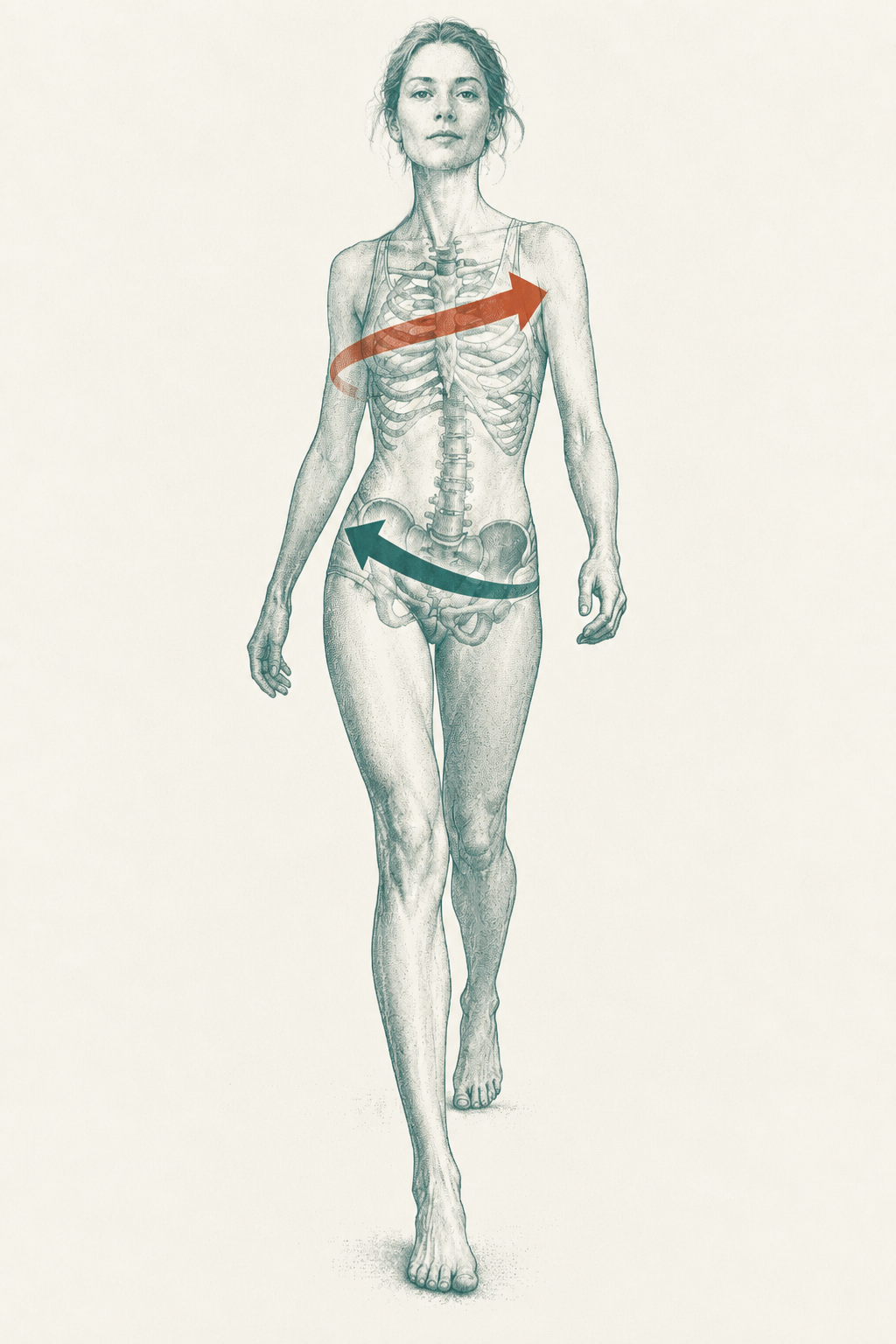
Here’s the thing. Even in people with no injuries and no complaints, gait is not perfectly symmetrical. Your left and right steps aren’t identical. Stance time, stride length, ground-reaction forces — they’re all slightly different side to side.2 That’s normal. The body doesn’t need perfect symmetry to walk efficiently. It needs functional alternation — the ability to shift fully from one side to the other and back.
And here’s what’s interesting: when researchers measured pelvic rotation during walking, the degree of rotation asymmetry predicted step-length asymmetry. The more one-sided the pelvis, the more one-sided the gait.3
What happens when alternation gets stuck.
The standing pattern from Field Notes No. 21 — pelvis oriented one direction, ribcage countering — doesn’t disappear when you start walking. It rides along.†
If the pelvis can’t rotate fully both ways, the gait compensates. One leg becomes the preferred stance leg — the one the system trusts to stand on, push off from, stabilize through. The other becomes the swing leg — it moves forward but doesn’t load the same way. It’s not weaker. It’s just not being asked to do the same job.†
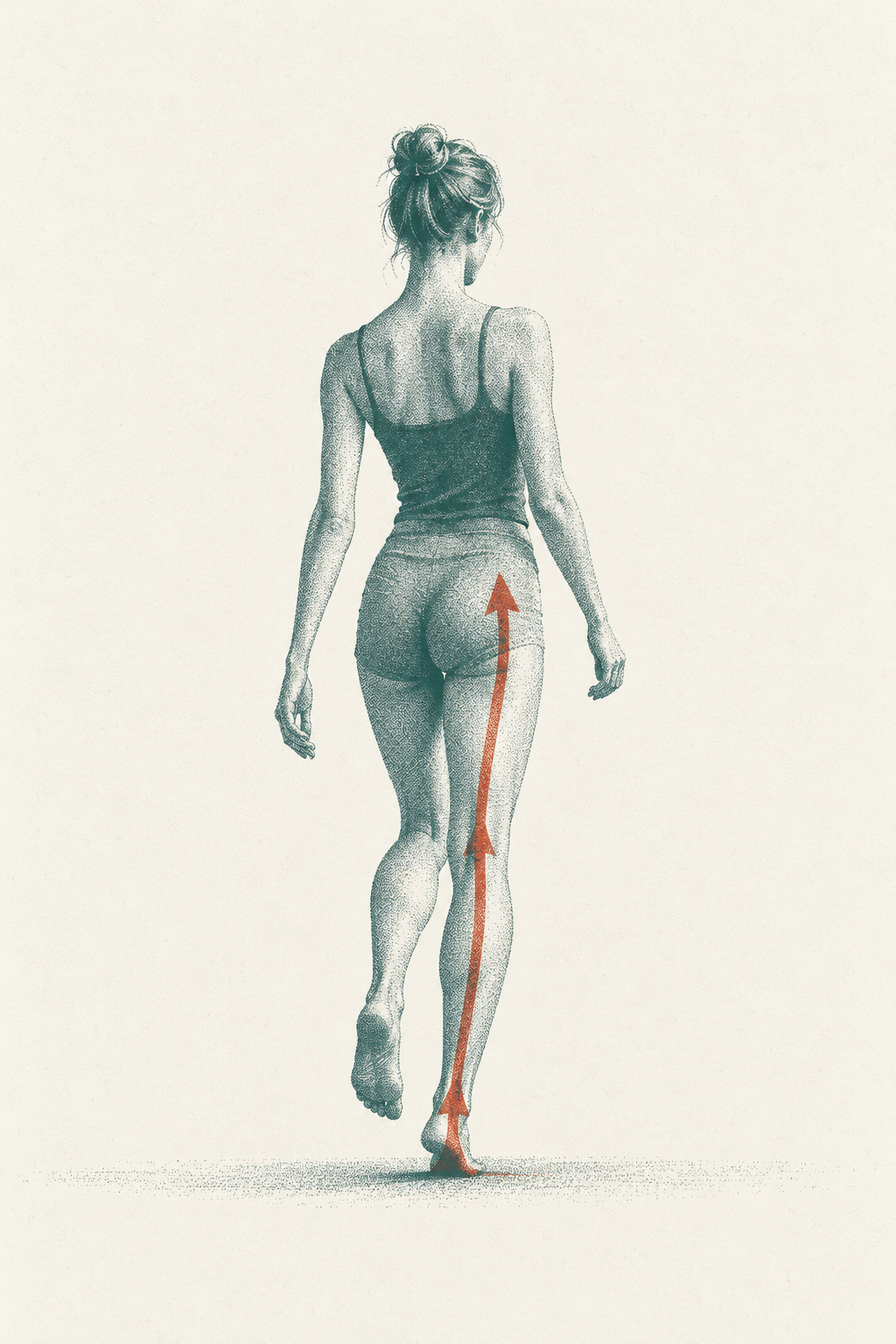
That asymmetry accumulates. Step after step, mile after mile, the stance leg loads differently — different ground contact, different push-off angle, different force distribution through the foot. The shoe on that side records every step.
That’s the wear pattern you’re looking at.
What the shoes are telling you.
The wear isn’t random. It’s a record.4
Heavy lateral heel wear on one side: that foot is striking in a supinated position — rolled slightly outward — because the pelvis is organized to weight-bear on that leg.†
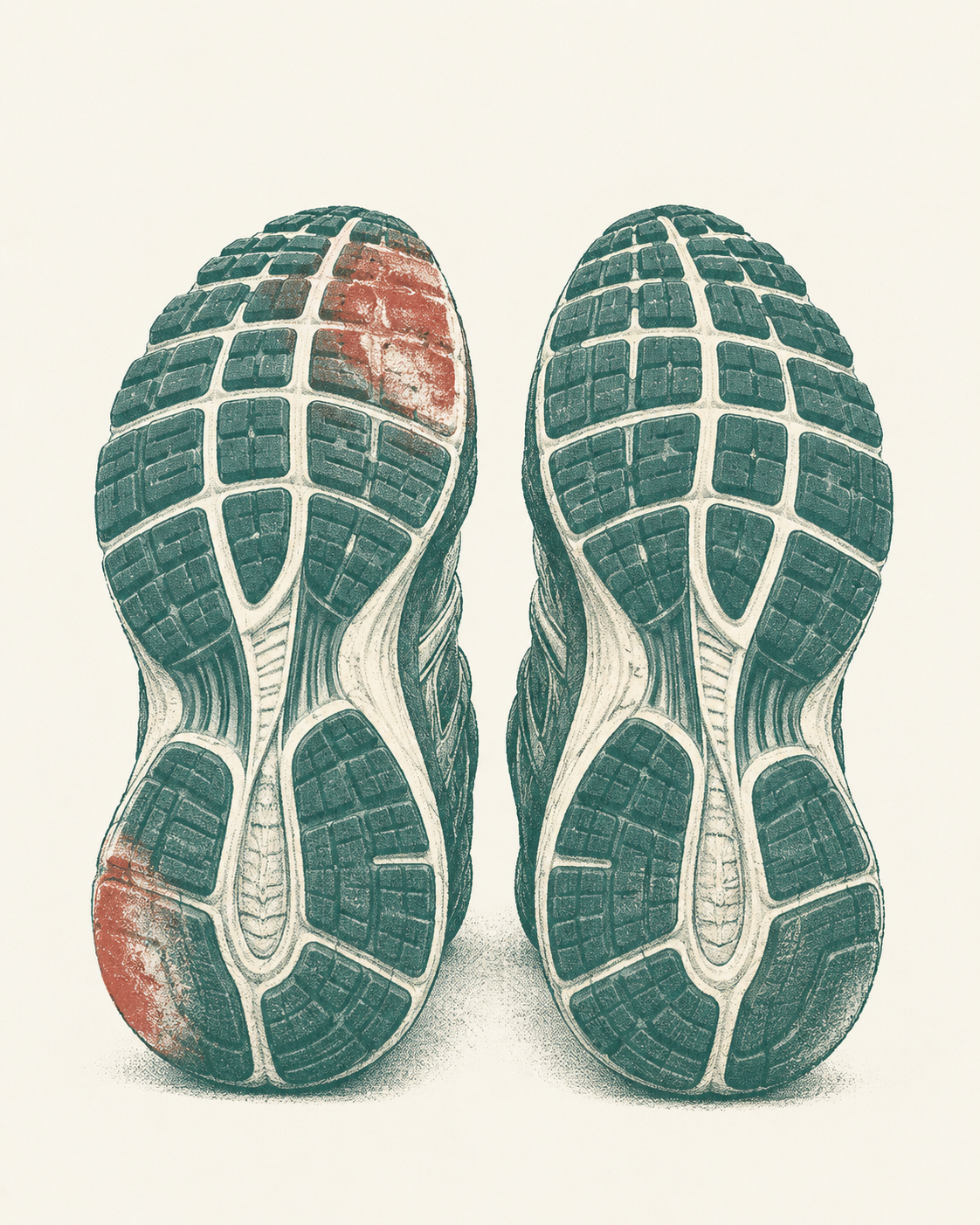
More forefoot wear on one side: that’s the push-off leg. The foot that’s doing more propulsive work. The other foot is just going along for the ride.†
One shoe breaking down at the medial arch while the other stays intact: the foot is compensating for what the pelvis won’t do. If the pelvis can’t rotate, the foot over-pronates to create the rotation the system needs.†
None of this is a foot problem. It’s a gait-organization problem, and the foot is the last link in the chain.
Why new shoes don’t fix it.
You buy new shoes. For a week they feel great. Then the same pattern starts carving into them. Same spot, same side.
Orthotics do the same thing in a different way. A good orthotic can change how force distributes through the foot. But if the pelvis is still oriented to one side, the system is still asking one leg to do more work. The orthotic addresses the foot. The pattern is upstream of the foot.†
This isn’t an argument against orthotics — they have real clinical value for specific conditions. It’s an argument against expecting the foot to solve a problem it didn’t create.
What changes the gait.
Same answer as last week. Position. Breathing. Sensory input.†
But with walking, one more variable matters: what the foot feels. The soles of your feet have some of the densest sensory receptor populations in your body.5 What they feel — ground texture, pressure distribution, contact angle — feeds directly into how the nervous system organizes your next step.
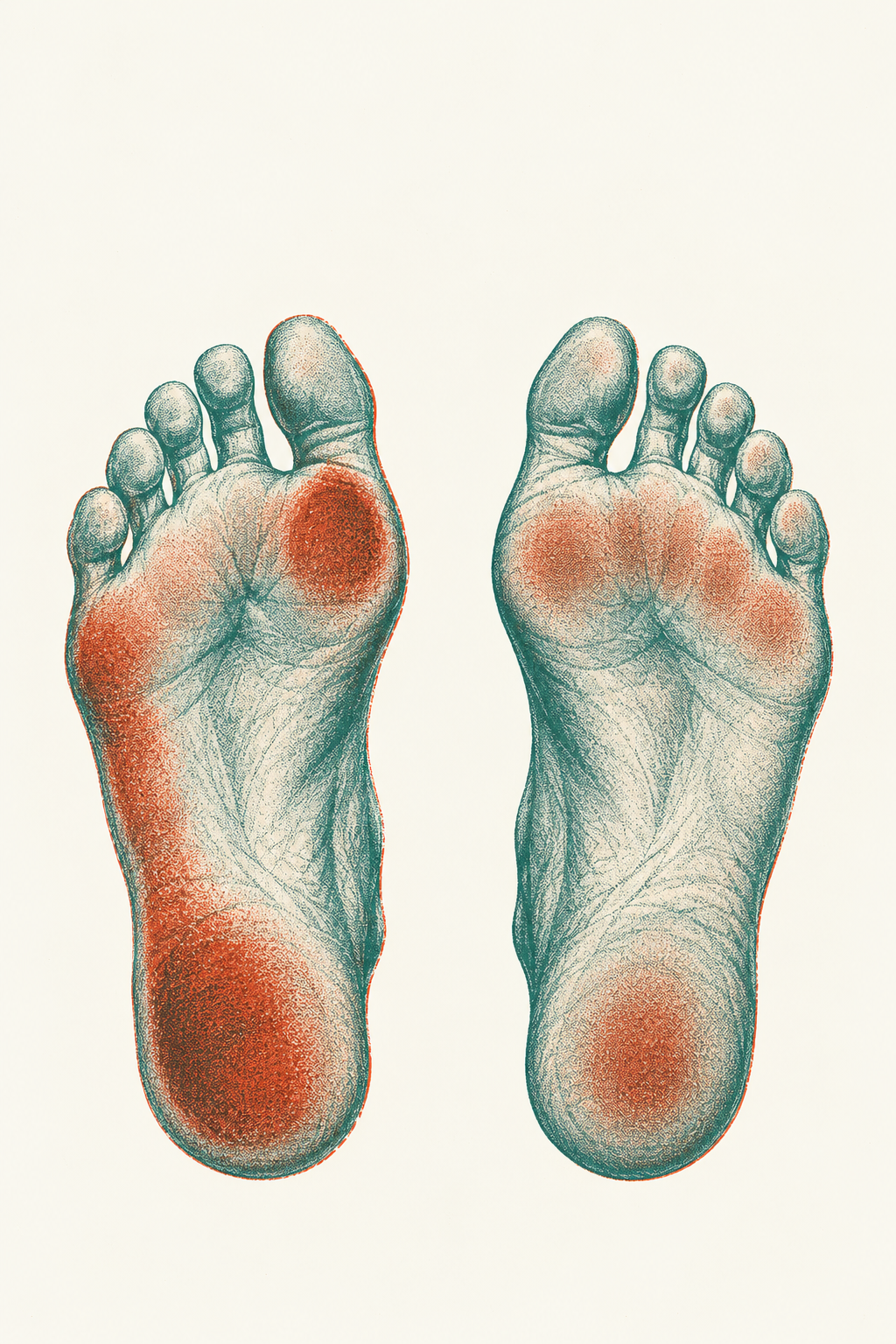
When the sensory input is always the same — same shoes, same flat surfaces, same pattern of loading — the nervous system has no reason to change. Varying the input can shift the gait. Not by forcing it. By giving the system new information to organize around.†
What you can notice.
Go for a walk. A regular walk, at your normal pace. Pay attention to three things:
Your arm swing. Are both arms swinging the same amount? Or does one swing more than the other? The arm that swings more is on the opposite side of the stance leg — it’s counter-balancing the leg that’s doing more work.
Your push-off. Which foot do you push off from more firmly? Which leg propels you forward, and which one just… steps? You’ll feel the difference if you slow down enough to notice.
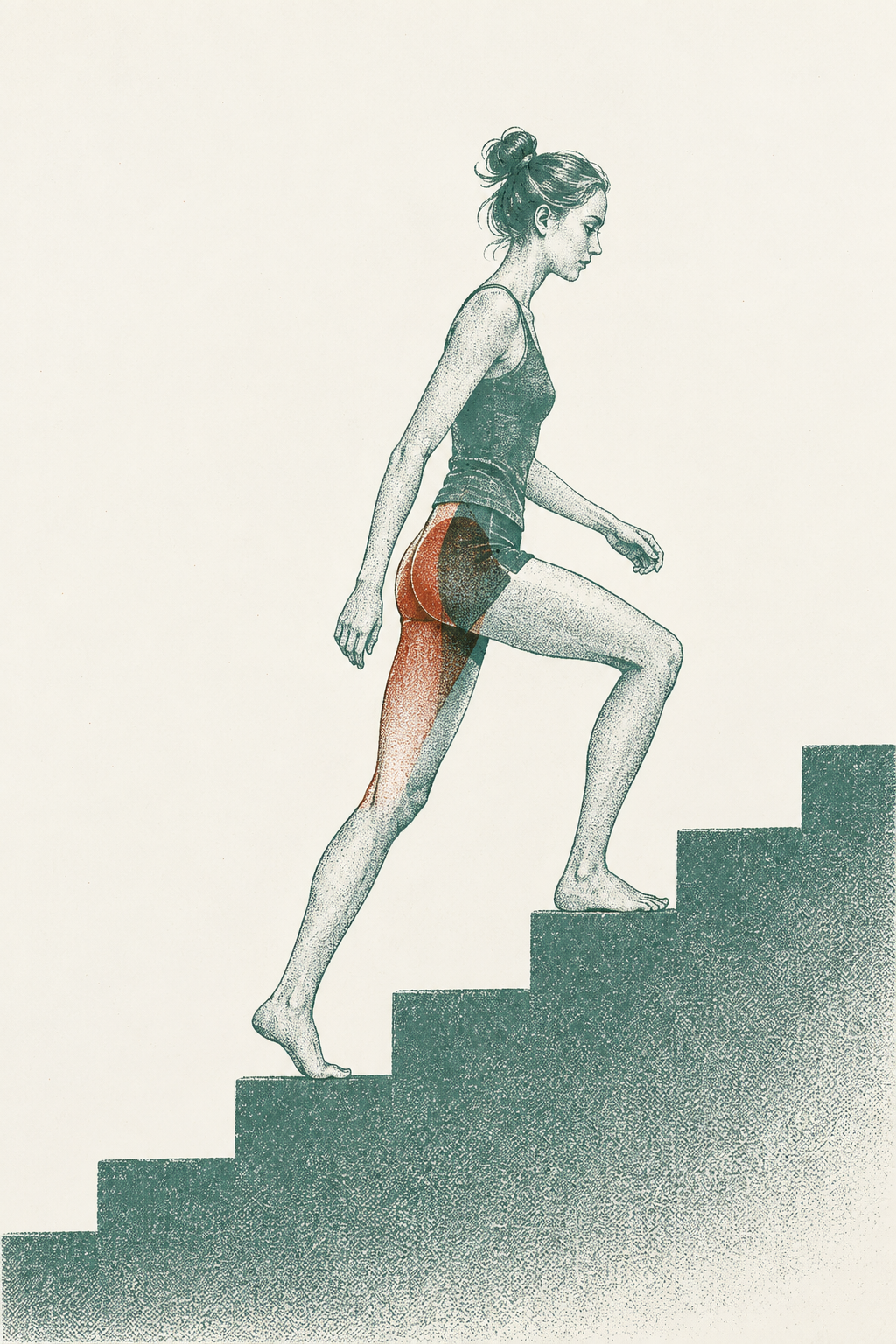
Your stair preference. Next time you go up stairs, notice which leg leads. That’s your stance leg. It’s the leg the system trusts to push your body weight upward.
These aren’t tests. There’s no pass or fail. They’re observations — a way to see the pattern that’s been running underneath every step you’ve taken.
The shoes don’t lie. They’ve been recording your pattern for months. One heel worn down more, one forefoot flattened, one arch collapsed — it’s all the same story.
That story starts upstream. At the pelvis, the ribcage, the diaphragm — the same structures that decide which side you sleep on.
If you want to change the story, you have to change where it starts.
Book an assessment at aerboston.com
The fine print
-
Perry J, Burnfield JM. Gait Analysis: Normal and Pathological Function. 2nd ed. Thorofare, NJ: SLACK Incorporated; 2010. ISBN: 978-1-55642-766-4. Chapters 1–4 on the gait cycle, pelvic rotation, and trunk counter-rotation during normal walking. The definitive clinical reference on gait mechanics. The description of the normal gait cycle, including pelvic and trunk rotation requirements, is established biomechanics.
-
Sadeghi H, Allard P, Prince F, Labelle H. Symmetry and limb dominance in able-bodied gait: a review. Gait & Posture. 2000;12(1):34-45. doi:10.1016/S0966-6362(00)00070-9. PMID: 10996295. Reviews decades of research and concludes that perfect bilateral symmetry is not a feature of normal human gait — healthy individuals show consistent side-to-side differences in multiple gait parameters. Limitation: a narrative review, not a meta-analysis with pooled effect sizes. Establishes the phenomenon but does not quantify a “normal range” of asymmetry.
-
Khamis S, Danino B, Springer S, Ovadia D, Carmeli E. Examination of body static rotation related to step length asymmetry: biomechanics of the thorax and pelvis. J Phys Ther Sci. 2023;35(3):204-210. doi:10.1589/jpts.35.204. PMID: 36866003. Found significant correlations between pelvic rotation asymmetry during gait and step-length asymmetry in healthy adults. Static thorax rotation (measured in sitting) also related to step-length asymmetry during walking, suggesting that trunk rotation asymmetry may reflect habitual gait with biased pelvic rotation. Limitation: small sample (n=30 healthy adults); cross-sectional design shows correlation, not causation.
-
Vernon W, Parry A, Potter M. A theory of shoe wear pattern influence incorporating a new paradigm for the podiatric medical profession. J Am Podiatr Med Assoc. 2004;94(3):261-268. doi:10.7547/0940261. PMID: 15153588. Proposes that shoe wear patterns are primarily driven by “walking intention” (gait strategy) rather than foot pathology alone. Limitation: based on expert-consensus questionnaire, not direct biomechanical measurement. A theoretical model, but peer-reviewed in the field’s flagship journal.
-
Kennedy PM, Inglis JT. Distribution and behaviour of glabrous cutaneous receptors in the human foot sole. J Physiol. 2002;538(Pt 3):995-1002. doi:10.1113/jphysiol.2001.013087. PMID: 11826182. Mapped the density and distribution of mechanoreceptors in the human foot sole, showing dense sensory receptor populations particularly in the forefoot and heel. Limitation: a mapping study of receptor populations; the functional implications for gait organization are inferred, not directly tested in this study.
The Letter
The writing here is the why. The letter is where the what to do lives — the protocol, the drill, the case behind each piece.
If any of this changed how you think about your own body, an assessment is where that conversation starts.