
Why you wake up tight.
Your mattress isn't the problem
You went to bed fine and woke up locked. The stiffness, the jaw, the neck — it's not damage from sleeping wrong. Your nervous system never turned off.
You went to bed fine. Tired, ready for it, nothing hurting. Eight hours later the alarm goes off and your neck won’t turn, your low back is a board, and your jaw aches like you spent the night chewing through a belt. So you do what everybody does. You look at the mattress. You flip the pillow. You google “best pillow for neck pain” and spend forty-five minutes reading reviews written by people who’ve never touched a spine.
The mattress isn’t the problem. Neither is the pillow. What happened is simpler and stranger than that: your nervous system didn’t turn off.
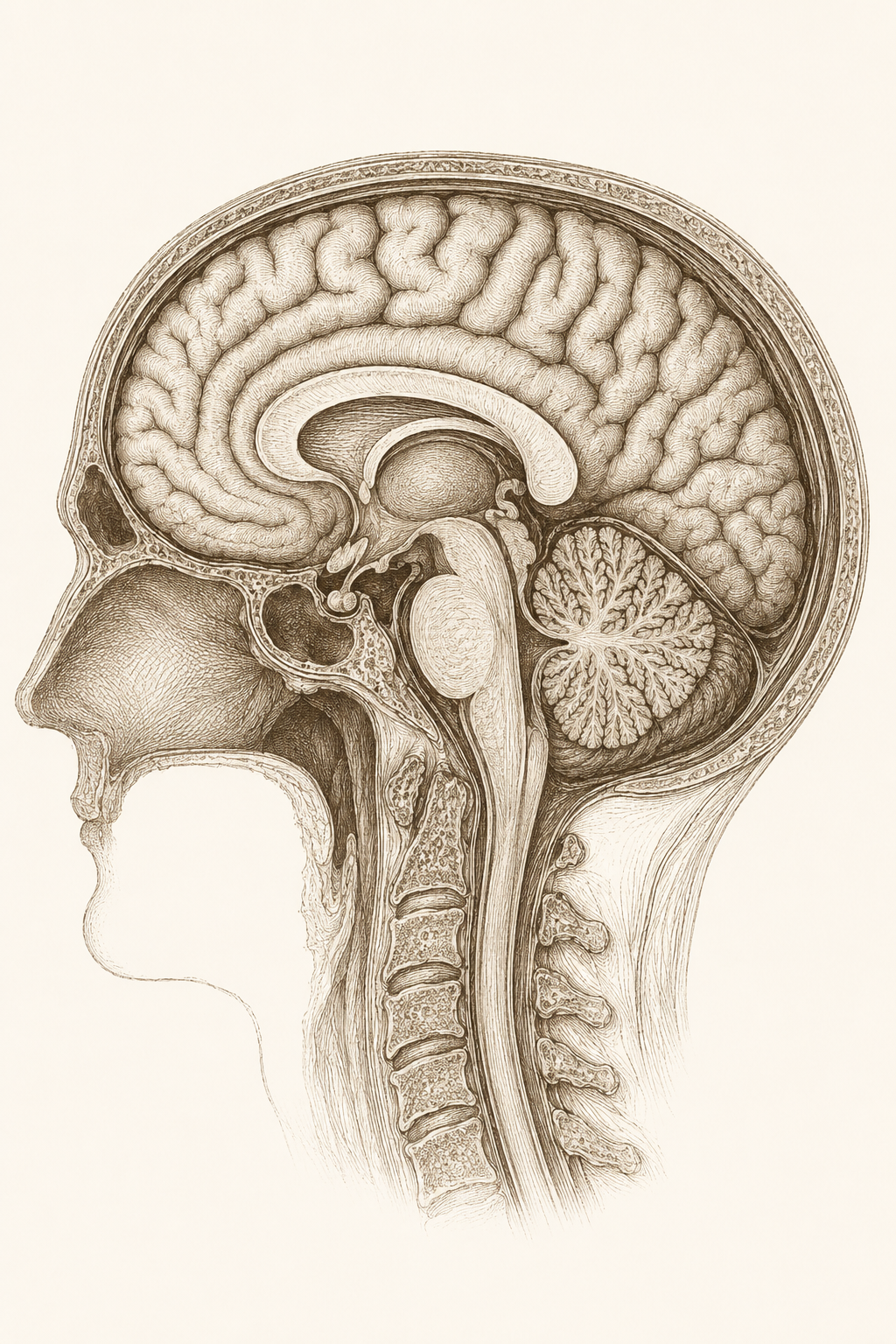
You don’t fall asleep. You downregulate into it.
Sleep isn’t a switch. It’s a transition — your autonomic nervous system has to shift from the sympathetic state (alert, braced, ready) to the parasympathetic state (recovering, releasing, restoring). That transition takes time, and it requires the right conditions. When the shift doesn’t happen fully, you sleep with the engine idling.
The research on this is older than most people realize. In 1985, Nicassio and colleagues developed a scale measuring pre-sleep arousal — both cognitive (the racing mind) and somatic (the physical tension you can feel in your chest and limbs). What they found was that both forms of arousal were significantly associated with disturbed sleep onset.1 The state you’re in when your head hits the pillow isn’t a footnote. It’s the opening chapter of how the night goes.
And your heart rate tells the same story from the inside. A review of HRV across sleep stages showed that deep sleep is dominated by parasympathetic activity — the recovery branch is genuinely running the show. But lighter stages and REM carry more sympathetic input, and arousals spike it further.2 If you enter sleep already running hot, you spend more of the night in those lighter, more activated stages. You’re unconscious. You’re not recovering at the rate you could be.
Your jaw has something to tell you.
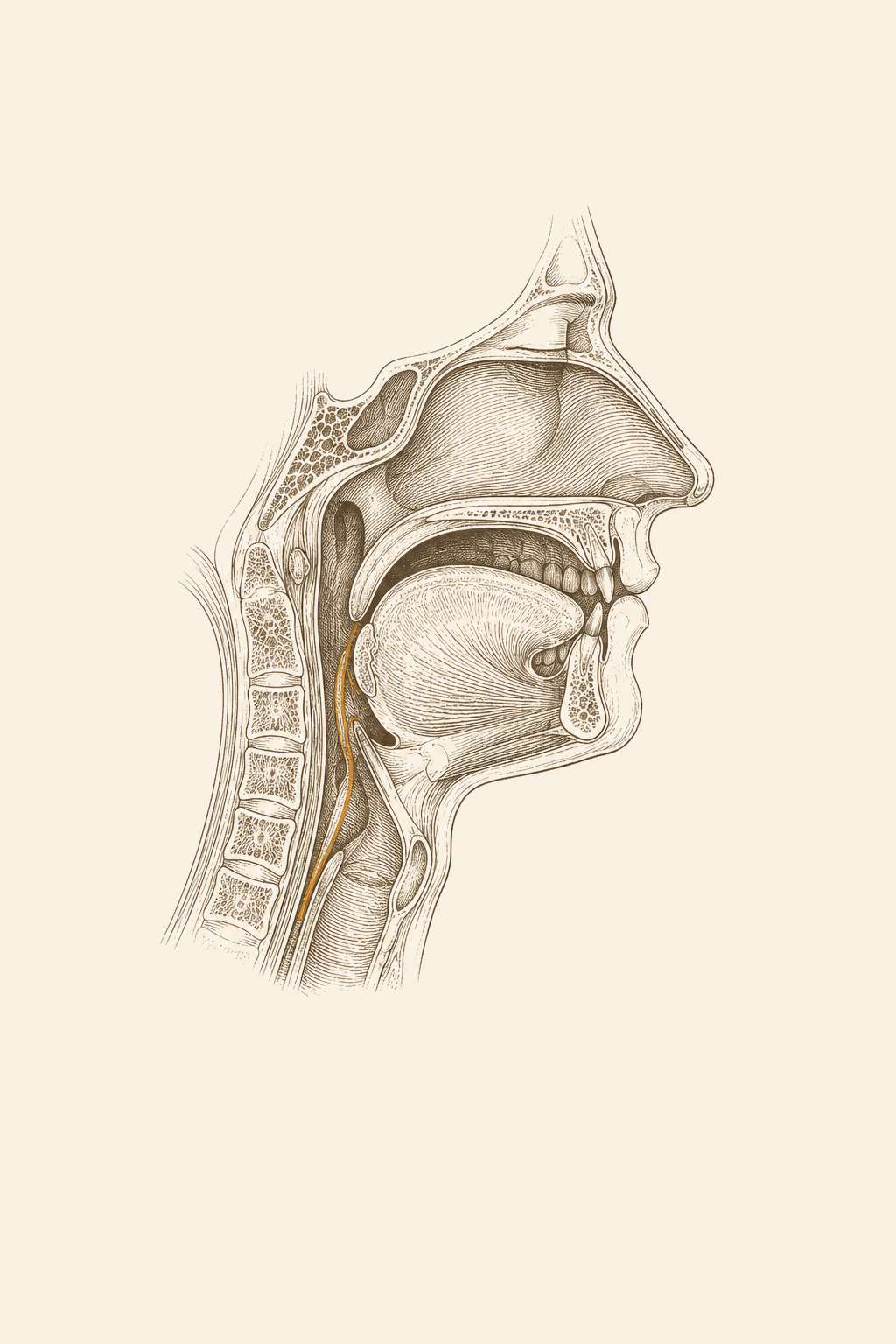
Here’s the part that surprises people. If you wake up with a sore jaw — that dull ache along the angle of the mandible, the feeling that you were clenching all night — most people think it’s stress. Their dentist calls it bruxism and fits a night guard. Problem managed, nobody asks why.
The sleep medicine literature asks why.
Sleep bruxism and awake bruxism are classified as separate conditions with different drivers.3 And the research on sleep bruxism keeps pointing at the airway. One study found that bruxism episodes clustered specifically with respiratory events — apneas and hypopneas — and that the phasic type of bruxism correlated with obstructive apnea, micro-arousals, and oxygen desaturation.4 The jaw isn’t clenching randomly. It’s clenching in response to something happening with breathing.
The proposed mechanism is straightforward: the jaw advances the mandible, which pulls the tongue base forward, which opens the airway. Manfredini and colleagues outlined several competing theories about the bruxism-apnea relationship, including the possibility that bruxism serves exactly this airway-protective function.5 They’re careful to note it’s one of several hypotheses and the literature is inconclusive. Fair. But the temporal clustering is hard to ignore — the jaw is doing something purposeful, timed to breathing events, and “stress” doesn’t explain the timing.
If you wake up with a sore jaw, your body may have spent the night fighting to breathe. That’s not a dental problem. That’s information.
Stiffness without inflammation is a different animal.
Rheumatologists know morning stiffness as an inflammatory marker. If you have rheumatoid arthritis or an autoimmune condition, waking up stiff is a well-documented feature of the disease. But most people reading this don’t have RA. They just wake up tight.
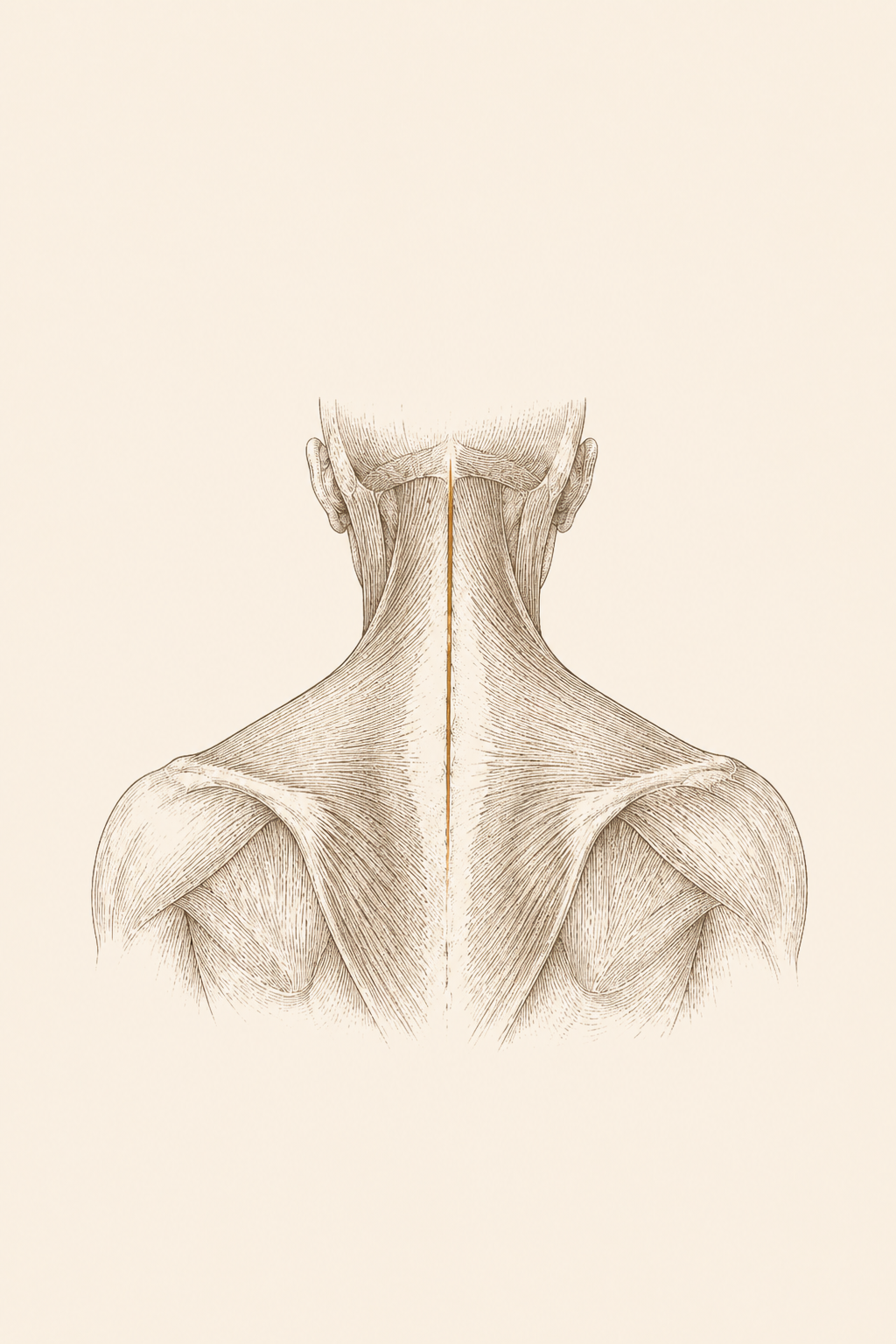
What they have, more often than not, is elevated resting motor tone.† Their muscles didn’t fully release overnight because their nervous system never fully downregulated. The tension in your neck, your shoulders, your low back — that’s not damage from sleeping in a bad position. It’s the same holding pattern you carry during the day, continued into sleep because the system that should have released it never got the signal to let go.†
I see this constantly. Someone walks in on a Monday morning and they’re tighter than they were on Friday. Nothing happened over the weekend. They didn’t get hurt, they didn’t lift anything heavy. They just slept two nights in a state that doesn’t recover. The stiffness is a readout of the overnight autonomic state, not an injury report.
The pre-sleep window is the lever you can reach.
If the state you fall asleep in determines the trajectory of the night, then the five to ten minutes before sleep aren’t a luxury. They’re the intervention.
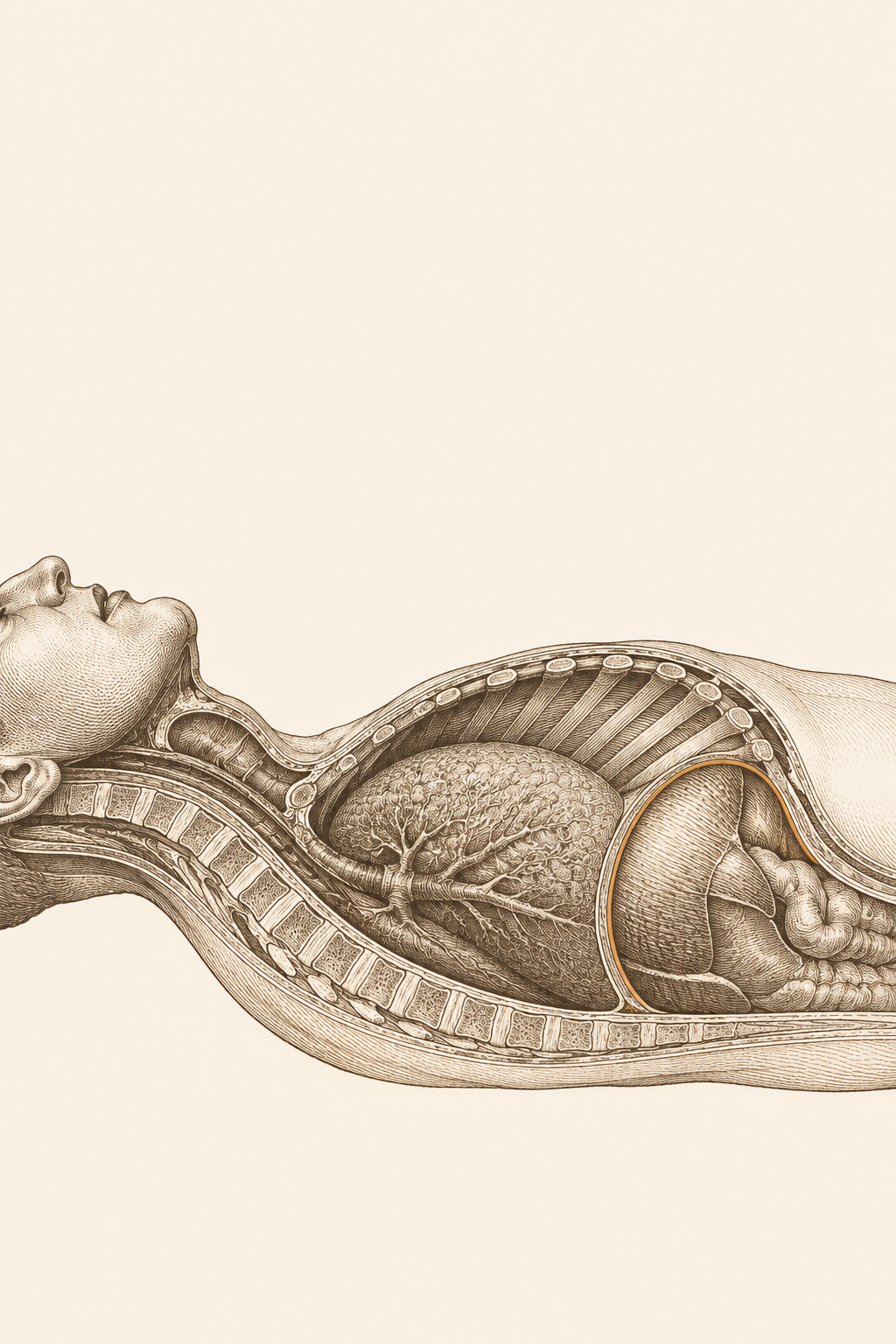
Slow, exhale-focused breathing shifts the autonomic balance toward the parasympathetic side — during the practice and for a period afterward.6 The mechanism is the same one from the diaphragm work I’ve written about before: the exhale lengthens vagal output, the diaphragm moves back toward a position that supports quiet breathing, and the system enters sleep from a lower baseline.†
This isn’t meditation. It isn’t a sleep hack. It’s targeted respiratory work, aimed at a specific window — the transition into sleep — where the nervous system is deciding what state to hold for the next eight hours.†
The honest version.
The bruxism-airway connection is the strongest piece of this. Multiple studies show the temporal clustering, the proposed mechanism is anatomically coherent, and the clinical implications are real — if someone wakes up with a sore jaw every morning, a sleep study may be worth more than a night guard.
The pre-sleep breathing recommendation is built on solid mechanism (slow breathing shifts autonomic tone6) applied to a specific context (the minutes before sleep) where less direct research exists. The logic holds. The specific application is inference, not a replicated finding in a pre-sleep protocol trial.
The morning stiffness as motor tone — that’s the most framework-dependent claim in this piece. It’s how I read it clinically. I can point to the autonomic literature and the motor control literature and connect them, but the specific causal chain (incomplete downregulation → sustained motor tone → morning stiffness in non-inflammatory cases) hasn’t been tested directly.† I’d rather tell you that than dress it up as something it isn’t.
What I can tell you is that clients who start doing exhale-focused breathing before bed report sleeping differently within the first week. That’s not a study. It’s a pattern I see consistently enough to mention honestly. Take it for what it is.
If you wake up tight every morning and nobody’s been able to explain why, an assessment might tell you something a new mattress won’t. I’ll read where your system is sitting and what it’s doing overnight, and we’ll figure out together whether this is the pattern.
Book an assessment at aerboston.com
The fine print
-
Nicassio PM, Mendlowitz DR, Fussell JJ, Petras L. The phenomenology of the pre-sleep state: the development of the pre-sleep arousal scale. Behav Res Ther. 1985;23(3):263–271. doi:10.1016/0005-7967(85)90004-X. Limitation: validated on college students and a clinical insomnia sample — not a population study, and focused on sleep-onset latency as the outcome, not a comprehensive measure of sleep quality. Cross-sectional design; it establishes an association, not a prospective prediction.
-
Tobaldini E, Nobili L, Strada S, Casali KR, Braghiroli A, Montano N. Heart rate variability in normal and pathological sleep. Front Physiol. 2013;4:294. doi:10.3389/fphys.2013.00294. Limitation: a narrative review, not an original study or meta-analysis. Summarizes established patterns in HRV across sleep stages but does not generate new data. The autonomic shifts described are well-replicated across studies; the clinical implications for non-pathological populations are less established.
-
Lobbezoo F, Ahlberg J, Glaros AG, et al. Bruxism defined and graded: an international consensus. J Oral Rehabil. 2013;40(1):2–4. doi:10.1111/joor.12011. Limitation: a consensus paper proposing definitions and a diagnostic grading system. It establishes sleep and awake bruxism as distinct conditions but does not itself investigate causes or associations — it is a classification framework, not a causal study.
-
Hosoya H, Kitaura H, Hashimoto T, et al. Relationship between sleep bruxism and sleep respiratory events in patients with obstructive sleep apnea syndrome. Sleep Breath. 2014;18(4):837–844. doi:10.1007/s11325-014-0953-5. Limitation: studied patients already diagnosed with obstructive sleep apnea, not the general population. The temporal clustering finding is specific to this clinical group. Whether the same pattern applies to people without diagnosed OSA is an open question.
-
Manfredini D, Guarda-Nardini L, Marchese-Ragona R, Lobbezoo F. Theories on possible temporal relationships between sleep bruxism and obstructive sleep apnea events. An expert opinion. Sleep Breath. 2015;19(4):1459–1465. doi:10.1007/s11325-015-1163-5. Limitation: an expert opinion piece, not an original study. It presents four competing hypotheses about the bruxism-apnea relationship, including the airway-protective hypothesis, and concludes the literature findings are “inconclusive.” The airway-protective theory is plausible and mechanistically coherent, but it is not the paper’s conclusion — it is one scenario among four.
-
Laborde S, Allen MS, Borges U, et al. Effects of voluntary slow breathing on heart rate and heart rate variability: a systematic review and a meta-analysis. Neurosci Biobehav Rev. 2022;138:104711. Limitation: the vagal effects are clearest during and shortly after the practice; evidence that slow breathing durably shifts resting autonomic tone is thinner and more mixed. Supports slow rate, not any particular inhale-to-exhale ratio. Applying this to a pre-sleep context specifically is our reasoning based on the mechanism, not a tested pre-sleep protocol.
The Letter
The writing here is the why. The letter is where the what to do lives — the protocol, the drill, the case behind each piece.
If any of this changed how you think about your own body, an assessment is where that conversation starts.