
The desk is a position.
And you hold it eight hours a day.
Your desk trained you for 8 hours today. Your workout got 1. The problem isn't that sitting is sedentary — it's that it locks you into one position. Standing desks don't fix it. Position changes do. Three repositioning breaks, 5 minutes, twice a day.
Your desk trained you for 8 hours today. Your workout got 1.
Nobody thinks of sitting as training. But your body doesn’t know the difference between a position you chose and one you defaulted into. It just adapts to whatever you hold the longest. And the desk — hips flexed, ribs forward, head out in front of you — is the longest hold most people do all day.
This isn’t a lecture about sitting less. Sitting isn’t the enemy. The enemy is positional lock — holding any single position for so long that the body loses its ability to do anything else. Standing desks don’t fix this. They trade one fixed position for another. The fix is changing the position itself.
The longest isometric you didn’t sign up for.
When you sit in a standard office chair, unsupported, your lumbar spine bears roughly 60% more compressive load than it does when you stand — about 1,700 N versus 1,080 N in the Callaghan and McGill data.1 That’s not damage. It’s position. The spine is loaded differently depending on how you arrange yourself, and seated flexion produces more compression per unit of body weight than upright standing does.
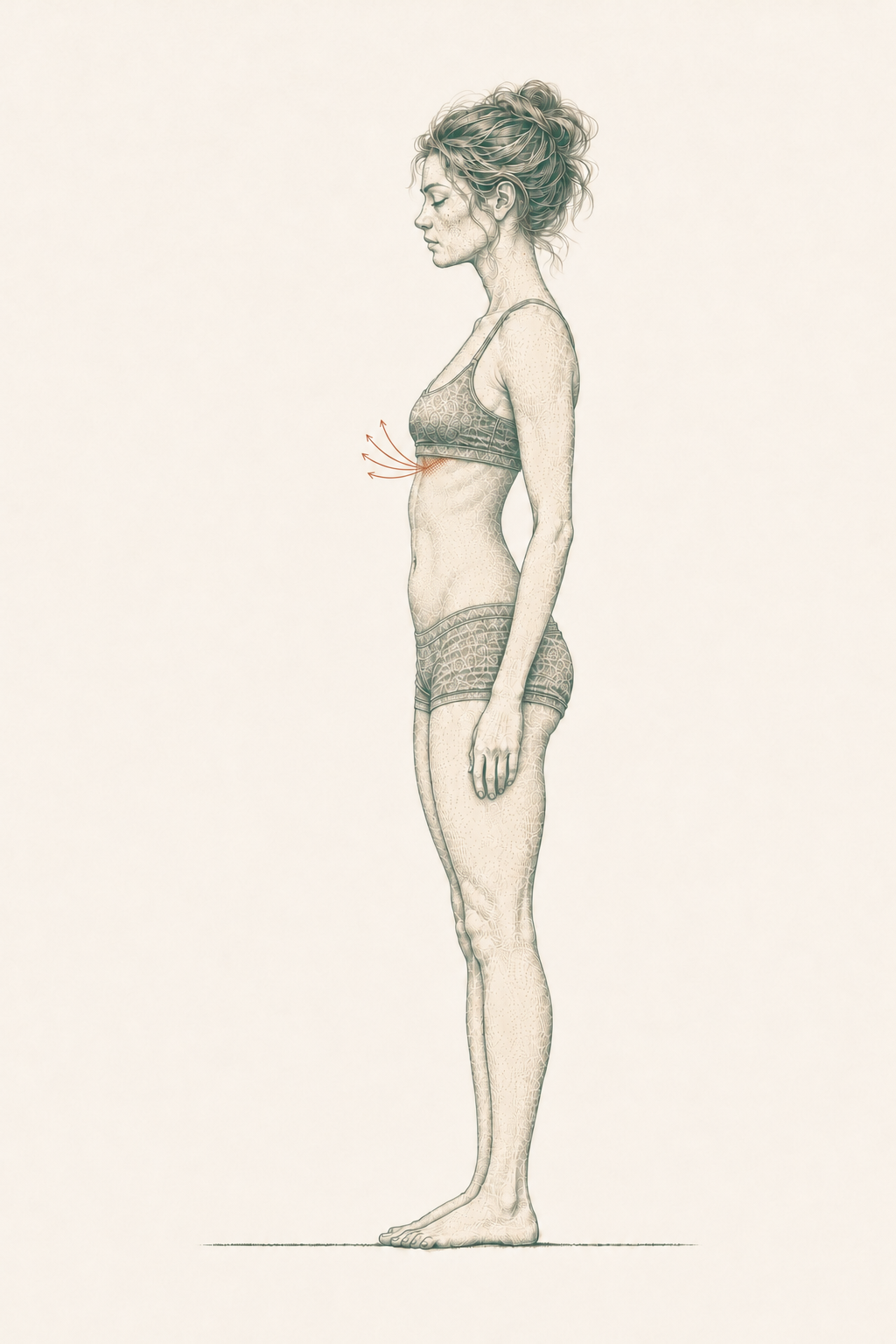
That’s just the spine. Go downstream. Your hips are flexed to roughly 90 degrees for eight hours. The tissues at the front of the hip — the hip flexor complex — adapt to that shortened position. When you stand up at 6pm, those tissues pull the pelvis forward into anterior tilt. The ribcage flares to compensate. The head drifts forward. The low back compresses more.5†
This is the positional cascade. Not from a single bad day, but from 2,000 hours a year of the same arrangement.
The variability problem.
Here’s the part that surprises people: the issue isn’t the position itself.6 It’s that the position never changes.
Vergara and Page measured this directly. They tracked seated posture and comfort over time and found that lordotic postures with forward-leaned pelvis and low mobility are the principal causes of the increase of discomfort. Movement — shifting, adjusting, fidgeting — is the body’s own strategy for reducing muscular strain.2 The people who moved the least in their chairs got the most uncomfortable, and the discomfort tracked with immobility, not with the specific posture they were in.
This connects to a broader principle in occupational biomechanics. Srinivasan and Mathiassen reviewed the motor variability literature across disciplines and concluded that low variability in postures, movements, and muscle activity is a relevant risk factor for musculoskeletal disorders.3 A system that repeats the same coordination pattern — the same joint angles, the same muscle recruitment, the same load distribution — concentrates strain on the same tissues over and over. The adaptive system stops adapting.
Your desk isn’t bad because you’re sedentary. Your desk is bad because it’s an isometric you hold for eight hours a day. One position, one load distribution, one pattern.†
Standing desks: trading one position for another.
The standing desk feels like the answer. You’re not sitting, so you’ve solved the sitting problem, right?
Not quite. Agarwal and colleagues conducted a systematic review and meta-analysis of sit-stand workstation studies and found a modest reduction in low back discomfort (standardized mean difference of −0.23) — but with important caveats. The evidence came mainly from pain-free populations. The optimal dosage — how much standing, how often, alternating with what — was not established. And the studies couldn’t answer whether sit-stand was better than simply moving more within a seated position.4
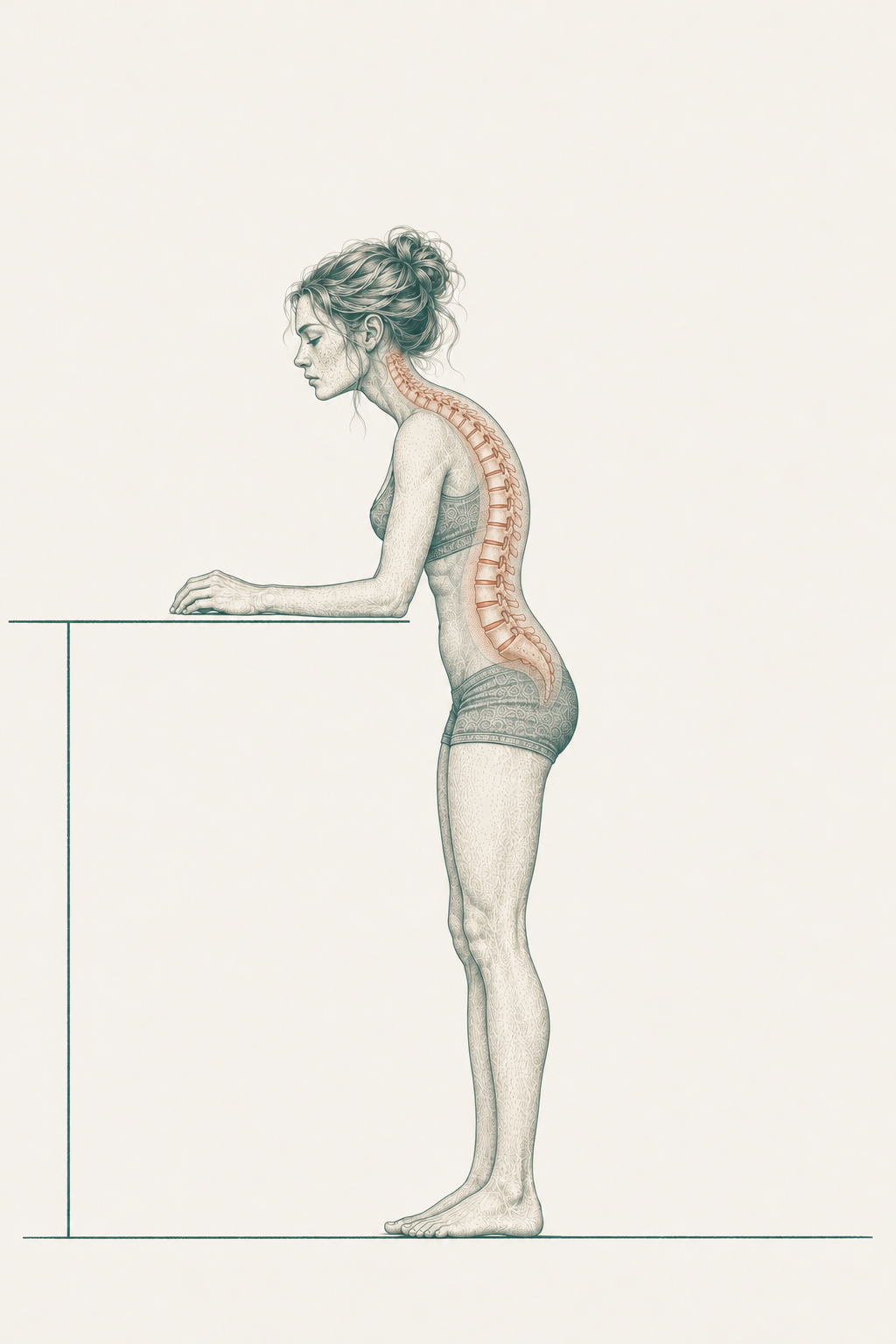
Standing is a position too. If you stand at your desk with the same pelvic tilt, the same ribcage flare, the same forward head — you’re in the same pattern at a different height. The joints are at different angles, but the variability is still zero. And prolonged standing introduces its own compressive loads on the lumbar spine and lower extremities.
The problem was never sitting vs. standing. The problem is positional lock — committing to any arrangement long enough that the body loses its options.†
What actually helps.
The fix isn’t a different desk. It’s introducing variability into the position itself. Not stretching — stretching pulls on tissues that are already adapted to a shortened range and doesn’t change the nervous system’s strategy. Repositioning — putting the pelvis, ribcage, and head somewhere different long enough for the system to register the new option.†
Three breaks. 90 seconds each. Twice a day.
Break 1 — Seated hip shift with exhale
- Sit back in your chair. Both feet flat on the floor.
- Shift your weight slightly to your left hip. Not a lean — a settle. Feel the left sit bone take more of the load.
- Exhale slowly through your mouth. Let the ribs come down. Pause at empty.
- Inhale through your nose. Feel the air fill the back of your left ribcage.
- 5 breaths. 90 seconds.
What this does. The left hip shift changes the pelvic position your body has been locked into all morning. The exhale lets the ribcage settle — the flare that built up from hours of seated extension comes down. You’re not stretching anything. You’re giving the pelvis a position it hasn’t been in since breakfast.†
Break 2 — Standing wall lean with breath
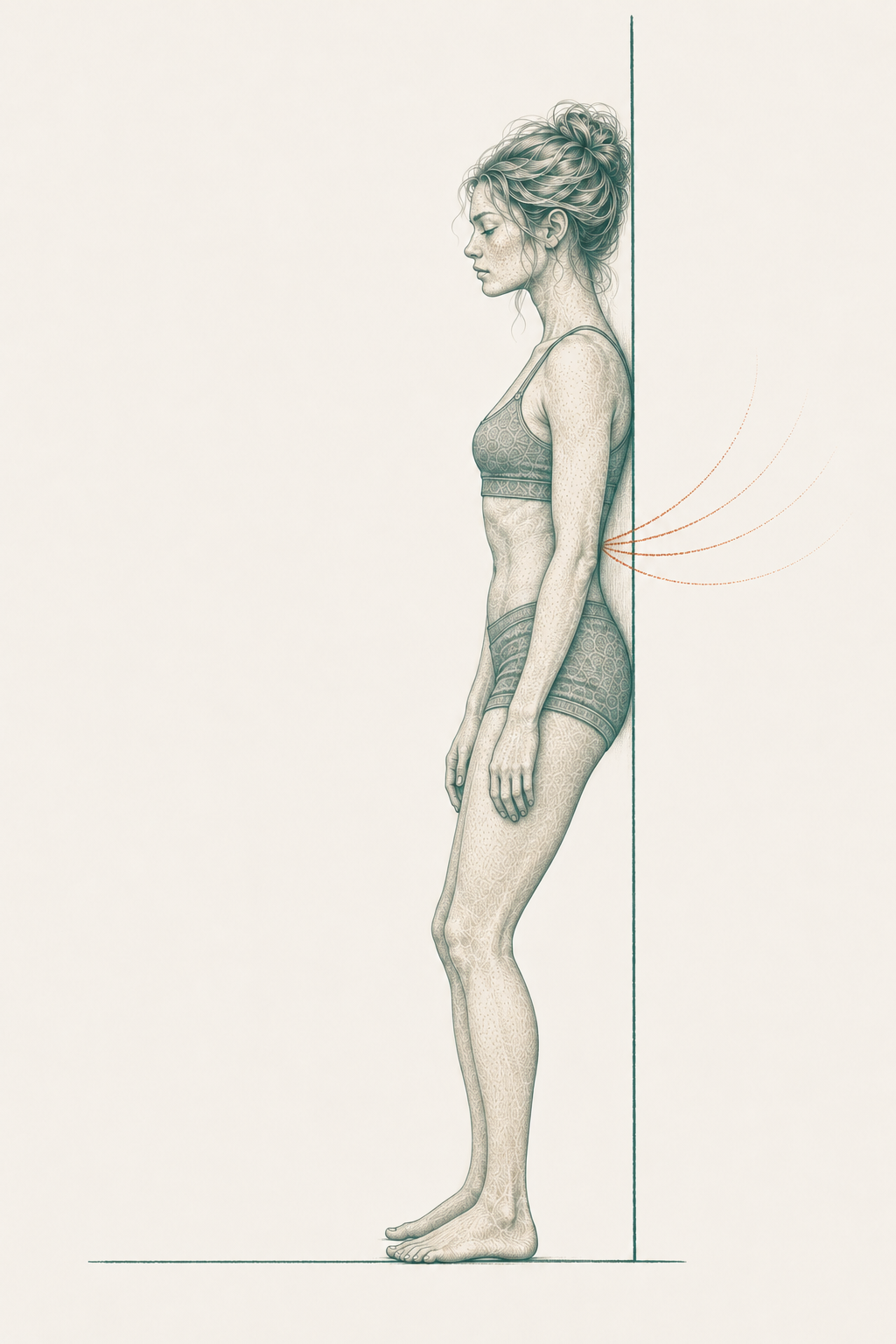
- Stand with your back to a wall. Feet a few inches from the baseboard. Knees slightly bent.
- Exhale slowly through your mouth. Let your low back settle toward the wall. Feel the ribs come down.
- Inhale through your nose. Try to feel the air fill the back of your ribcage — the part that’s touching the wall.
- 5 breaths. 90 seconds.
What this does. The wall gives your back a reference point it hasn’t had all day. The slightly bent knees and the exhale take the pelvis out of the anterior tilt the desk put it in. The posterior ribcage expansion (breathing into the wall) is the opposite of the anterior flare pattern. You’re undoing 4 hours of positional commitment in 90 seconds.†
Break 3 — Chair-assisted left sidelying (the “office 90/90”)
- Find a wall or the back of your chair. Turn so your left side leans against it. Knees drawn up if you’re on the floor, or just lean your left shoulder and hip into the support if standing.
- Place your right hand on your right ribcage — the side facing away from the wall.
- Exhale slowly through your mouth. Feel the right ribs drop down.
- Inhale through your nose into your right hand. You’re trying to expand the right ribcage — the side that’s been compressed toward the desk all day.
- 5 breaths. 90 seconds.
What this does. Left sidelying is the repositioning posture that gives the left side of the body a chance to participate. In the desk position, the body tends to weight the right side — the same stance-platform bias that shows up in everything else.† Leaning left and breathing into the right ribs reverses that pattern for 90 seconds. The system gets an option it didn’t have five minutes ago.
Total investment: 5 minutes. Twice a day. Not instead of your workout — in addition to it. The workout is 1 hour. The desk is 8. These breaks are the bridge.
The honest summary.
The evidence that prolonged sitting increases spinal loading is solid — Callaghan and McGill measured it directly, and the numbers are large.1 And the cost isn’t just compression: the diaphragm modulates intra-abdominal pressure for spinal stability simultaneously with breathing, and Hodges and Gandevia demonstrated that when the ribcage position changes, that postural function is compromised.5 The evidence that postural immobility drives discomfort more than any specific posture is strong — Vergara and Page showed it, the motor variability literature supports it across occupational contexts,2,3 and Claus and colleagues confirmed that “ideal” sitting posture isn’t even a fixed, definable position — spinal curves vary substantially across sitting types.6 The evidence that sit-stand desks produce modest benefit is real but limited in scope — mainly pain-free populations, no clear dosage, and the mechanism may be variability itself rather than standing per se.4
The repositioning breaks are built from the PRI clinical framework — repositioning through breath-driven position changes, with left sidelying as a specific strategy for shifting stance bias. This framework is coherent, decades-refined, and clinically applied daily. It is not validated in controlled trials against other break strategies for desk workers. I’m giving you what I use with clients because it works in my hands, not because a randomized trial compared it to walking breaks or standing desk protocols.†
Try the wall lean once today. If your low back feels different after 5 breaths, that’s data.
One honest caveat
The three repositioning breaks are general guidance for introducing variability into a sustained seated position. They are not a treatment plan for any specific condition. Everyone’s desk setup, injury history, and postural pattern is different — what works for the general case may not apply to yours. An assessment determines what applies to you specifically.
Nothing here is medical advice. If any position causes pain, stop.
The fine print.
1 — Callaghan JP, McGill SM. Low back joint loading and kinematics during standing and unsupported sitting. Ergonomics. 2001;44(3):280-294. Limitation: lab study measuring 2-hour sitting bouts in young healthy subjects (n=13). Compressive loads were modeled, not directly measured in vivo. The 60% figure (1,698 N vs. 1,076 N) applies to the specific unsupported sitting and standing conditions tested — real-world desk postures vary.
2 — Vergara M, Page A. Relationship between comfort and back posture and mobility in sitting-posture. Applied Ergonomics. 2002;33(1):1-8. Limitation: small sample in a controlled lab setting. Comfort was self-reported. The finding that reduced mobility drives discomfort more than specific posture is consistent with the motor variability literature but has not been replicated at scale in longitudinal workplace studies.
3 — Srinivasan D, Mathiassen SE. Motor variability in occupational health and performance. Clinical Biomechanics. 2012;27(10):979-993. Limitation: narrative review synthesizing across motor control, sports science, and occupational biomechanics. The variability-health link is proposed as a framework rather than tested in a single definitive study. Causal direction is not established — low variability may reflect pain avoidance rather than cause injury.
4 — Agarwal S, Steinmaus C, Harris-Adamson C. Sit-stand workstations and impact on low back discomfort: a systematic review and meta-analysis. Ergonomics. 2018;61(4):538-552. Limitation: moderate effect size (SMD −0.23). Studies were mainly in pain-free populations. Optimal dosage and sit-stand ratio not established. Does not distinguish whether benefit comes from standing itself or from the act of changing position.
5 — Hodges PW, Gandevia SC. Changes in intra-abdominal pressure during postural and respiratory activation of the human diaphragm. J Appl Physiol. 2000;89(3):967-976. PMID 10956340. Limitation: 7 healthy subjects with fine-wire EMG. Foundational study establishing the diaphragm’s dual postural-respiratory role. Small sample, invasive measurement technique limits replication, but the finding has been consistently supported in subsequent research.
6 — Claus AP, Hides JA, Moseley GL, Hodges PW. Is ‘ideal’ sitting posture real? Measurement of spinal curves in four sitting postures. Man Ther. 2009;14(4):404-408. PMID 18793867. Limitation: 13 subjects in laboratory conditions. Demonstrates that spinal curvature varies substantially across sitting postures, challenging the concept of a single ideal position. Small sample, but the central finding — that ‘ideal’ sitting posture is not a fixed, definable position — has been widely supported.
† The framework. Marked claims describe the Postural Restoration Institute® clinical model and AER’s applied method — sustained positional commitment as an obstacle to alternation, breath-driven position changes as a way to restore options, left sidelying as a specific repositioning strategy, and the desk as an extension-reinforcing position. Coherent, decades-refined clinical framework with thousands of practitioners, not controlled trials on these specific claims. The repositioning breaks described above are adapted from PRI techniques for a desk-worker context; the adaptation is mine.
Not medical advice. Nothing in this letter diagnoses, treats, or replaces a conversation with your doctor. Individual results vary. An assessment determines what applies to you.
Peter Jang, MFA CSCS PRT Certified Postural Restoration Center · Back Bay, Boston aerboston.com
The Letter
The writing here is the why. The letter is where the what to do lives — the protocol, the drill, the case behind each piece.
If any of this changed how you think about your own body, an assessment is where that conversation starts.