
Your jaw knows.
The clench isn't the problem. It's the report.
Jaw clenching, night grinding, and TMJ tension aren't just stress. They're a positional signal — and the chain runs from your jaw through your neck to your breath.
Put your tongue on the roof of your mouth. Keep your teeth apart. Lips together. Hold that for 60 seconds.
Most people can’t do it. Somewhere around 30 seconds the teeth drift back into contact, the jaw tightens, and you’re clenching again without deciding to. You weren’t stressed. You weren’t anxious. You were reading a sentence.
That’s the test. And that’s the whole letter.
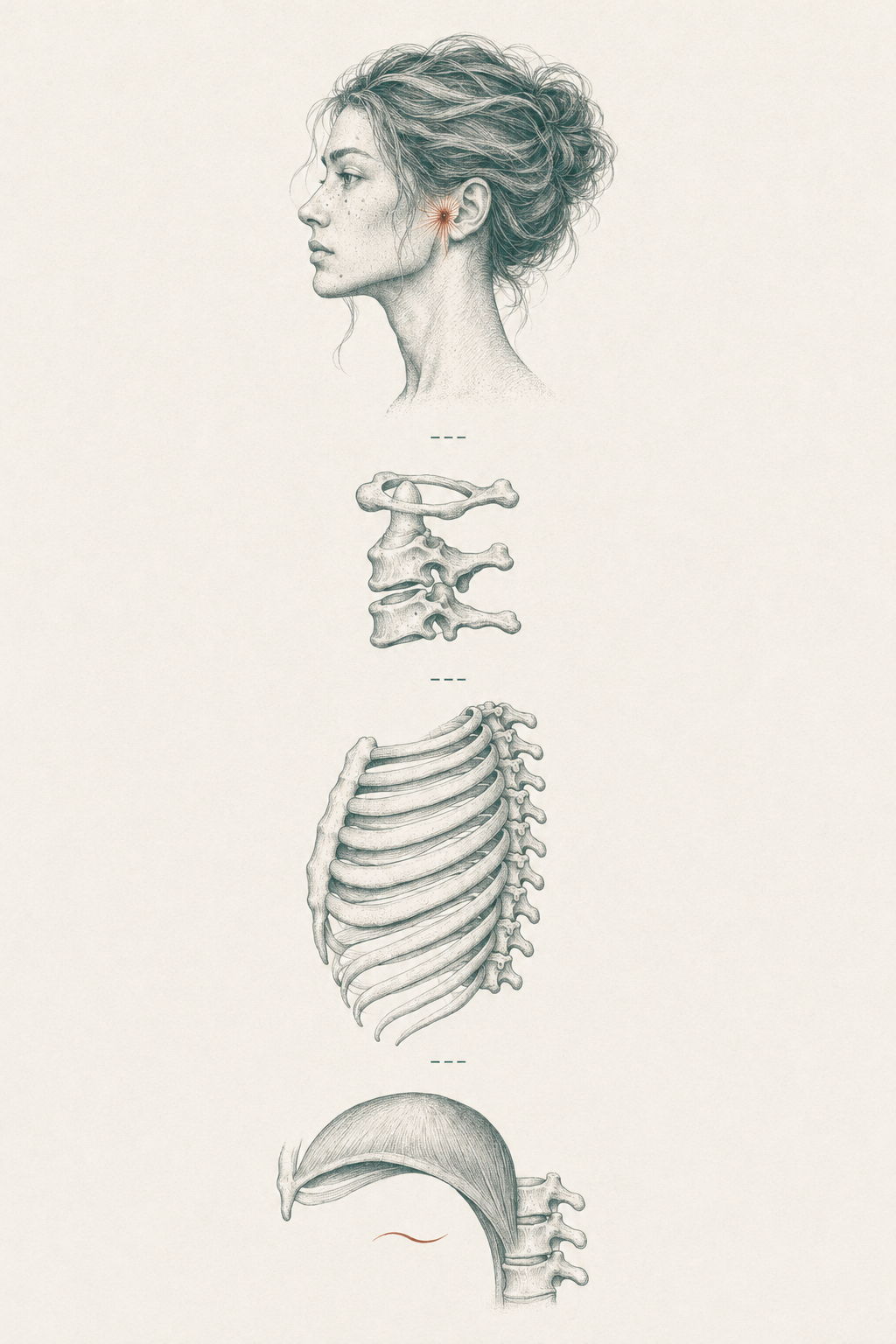
If you read Field Notes No. 4, you already know the jaw isn’t the origin — it’s the last link, not the first. The brain fires, the heart rate shifts, then the jaw moves. This time we’re following the chain in a different direction: not upstream to the nervous system’s timing, but downstream through the body. Jaw to neck to ribcage to breath.
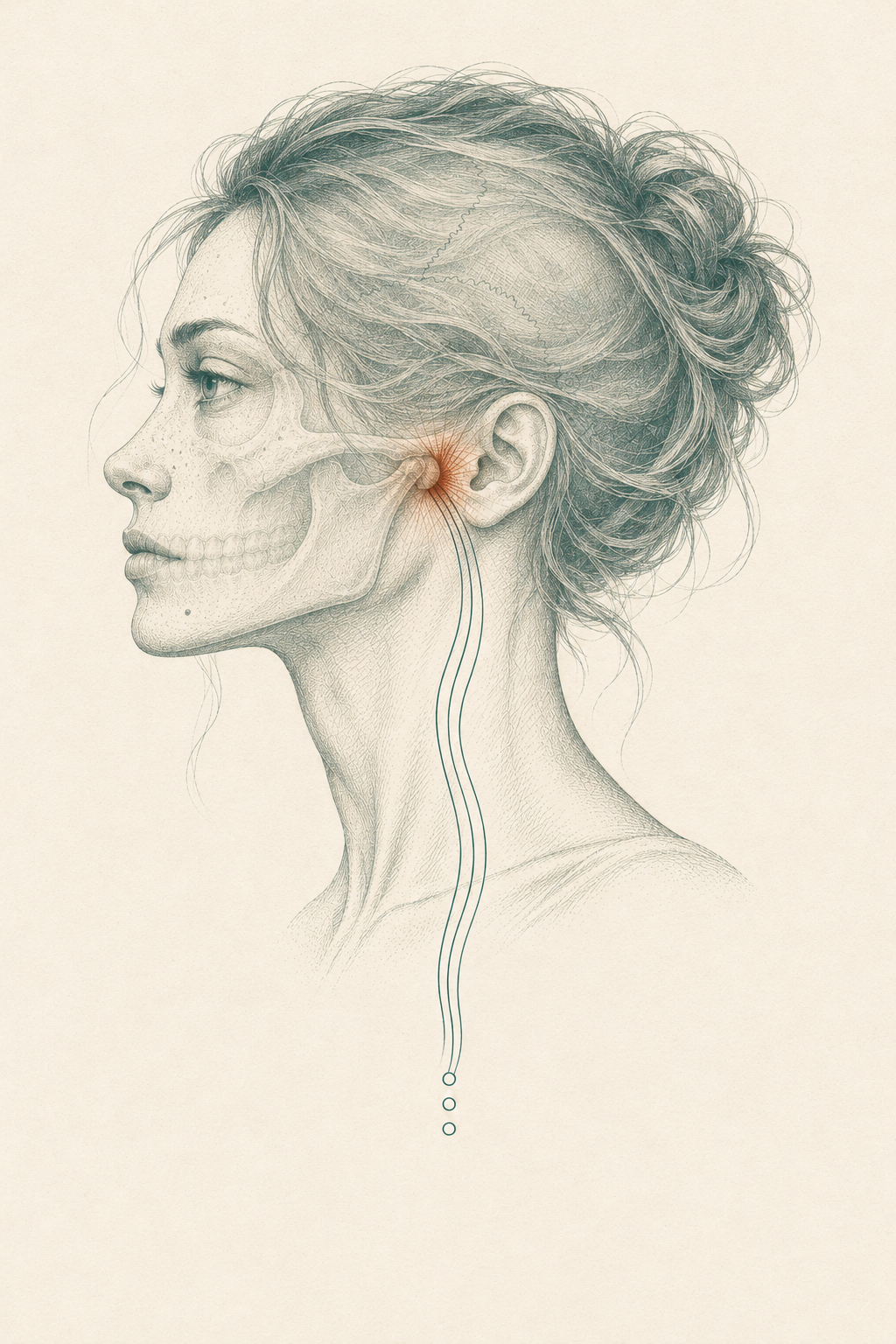
Before you read anything — 60 seconds
The jaw tension awareness test
Tongue on the roof of your mouth, just behind your top teeth. Lips gently closed. Teeth apart — there should be a small gap between your upper and lower teeth. This is the resting position of a jaw that doesn’t need to brace.
Hold that for 60 seconds. Don’t read, don’t scroll, just sit with it.
If the teeth drifted back together without you choosing it — something is asking the jaw to brace. That’s not stress. That’s a positional signal.
The story everyone tells you
You’ve been told this is stress. You grind because you’re anxious. You clench because the world is too much. The night guard protects your enamel and that’s the end of the conversation.
Maybe stress is involved. But stress doesn’t explain the specifics — why the jaw and not the fists, why the same side every time, why it comes back even after you consciously relax it, and why the night guard quietly became permanent instead of temporary.
Field Notes No. 4 laid out the timing evidence: the autonomic nervous system starts shifting eight minutes before the jaw moves,7 the cortex fires four seconds before,8 the heart rate accelerates one beat before.8 Brain, heart, then jaw. The jaw is last.
That’s the “why” — the jaw is reporting a nervous system state, not generating it. This letter is the “where.” Where in the body does that signal travel, and what is the jaw actually bracing for?
The wiring
The trigeminal nerve is the main sensory nerve of your face and jaw. The upper cervical spine — C1 through C3 — carries sensory information from the back of your head and the top of your neck. These two systems converge in a brainstem relay station called the trigeminocervical complex.1
That convergence is the wiring that connects your jaw to your neck. It’s why jaw pain and neck pain travel together. It’s why a headache can start at the base of your skull and end up behind your eye. And it’s why what’s happening at the top of your cervical spine directly affects what your jaw is doing.
This isn’t a theory. The neuroanatomical convergence is well-established.1 What’s built on top of it — the chain I’m about to describe — is partly measured and partly framework. I’ll mark which is which.
The chain
Here’s what the studies show, one link at a time.
Link 1: Jaw ↔ Neck. Ask someone to clench hard and their sternocleidomastoid and trapezius fire at 7.6 to 33 times resting activity.2 The jaw does not brace alone; it recruits the neck every time. And it runs the other direction too — move the head into a forward position and the masseter, the main chewing muscle, works harder during chewing.3
Link 2: Neck → Ribcage → Breath. Forward head posture compresses the upper thorax and restricts the lower ribcage, significantly reducing forced vital capacity, expiratory and inspiratory reserve volumes, and peak airflow.4 The mobility of the lower thorax during respiration drops. The upper chest compensates. The breath moves up and gets shallow.
The integrated chain: Jaw. Neck. Ribs. Breath. Top to bottom.†
Each individual link is separately measured. But the chain as a chain — the claim that these links form a single functional unit and that intervening at the cervical spine releases the jaw — is PRI framework, not a trial result.† I want you to have both: the parts that are measured, and the inference I’m drawing from them.
And here’s the part most people miss: the chain doesn’t just run top to bottom. The cervical spine doesn’t position itself. It sits on top of the ribcage, which sits on top of the pelvis. When the pelvis tips and the ribcage shifts, the thoracic spine extends to compensate — and the cervical spine follows it. The head position that’s driving the jaw problem was driven from below by the rib and pelvic position.† That’s why treating the jaw or the neck alone rarely holds. The position was set further down.
The honest limit
I need to put two reviews in front of you before we go further, because the population-level evidence does not line up as cleanly as the mechanism.
A 2012 review of the literature found no consistent association between dental occlusion and body posture at the population level — most likely due to the many compensation mechanisms the neuromuscular system uses to maintain balance.5 And a systematic review of the TMD–cervical posture relationship found the evidence mixed and methodologically limited, with roughly a third of studies finding no relationship at all.6
These are real limits. They mean I cannot tell you that everyone who clenches has a cervical position problem, or that fixing cervical position always releases the jaw. What I can tell you is that the individual couplings — jaw-to-neck, neck-to-ribcage, ribcage-to-breath — are each separately measured in controlled conditions. The clinical question is whether those couplings are operative in your body, and that’s what an assessment is for.
What the jaw is bracing for
Here’s the PRI interpretation, marked for what it is.†
When the cervical spine can’t hold the head in a stable resting position, the jaw steps in. It braces. It co-contracts. It tries to anchor what the spine can’t support. The clench isn’t a stress response — it’s a postural stabilisation strategy.
Think about it from the nervous system’s perspective. The head weighs roughly 10 to 12 pounds. It needs to sit on a cervical spine that can hold it without effort. When the cervical spine is extended, the head drifts forward, and now something has to work to keep it from falling off the front of the body. The suboccipital muscles work. The upper traps work. And the jaw works — because the jaw has mechanical access to the skull, and the masseter is one of the strongest muscles for its size in the human body.
The jaw isn’t broken. The jaw is doing a job nobody assigned it.†
The dental piece is real
Persistent jaw pain, locking, or clicking needs a dental or TMJ evaluation first. That’s their call, not mine.
Bite registration, joint mechanics, disc displacement — those are real pathologies that require clinical intervention I am not qualified to provide. I am a movement specialist, not a dentist and not a physician.
This content is about the postural piece — the part your dentist isn’t looking at. When the dental evaluation comes back clean, or when the night guard has been in for years and nothing has changed, the question becomes: what else is asking the jaw to work? That’s where the cervical spine enters the conversation.
If you clench or grind, see a dentist. And then let’s talk about your neck.
What this means for training
What I see on the training floor, again and again: when the cervical position changes — when the head has somewhere to be — the jaw lets go on its own. Not because I trained the jaw. Because I took away its job.†
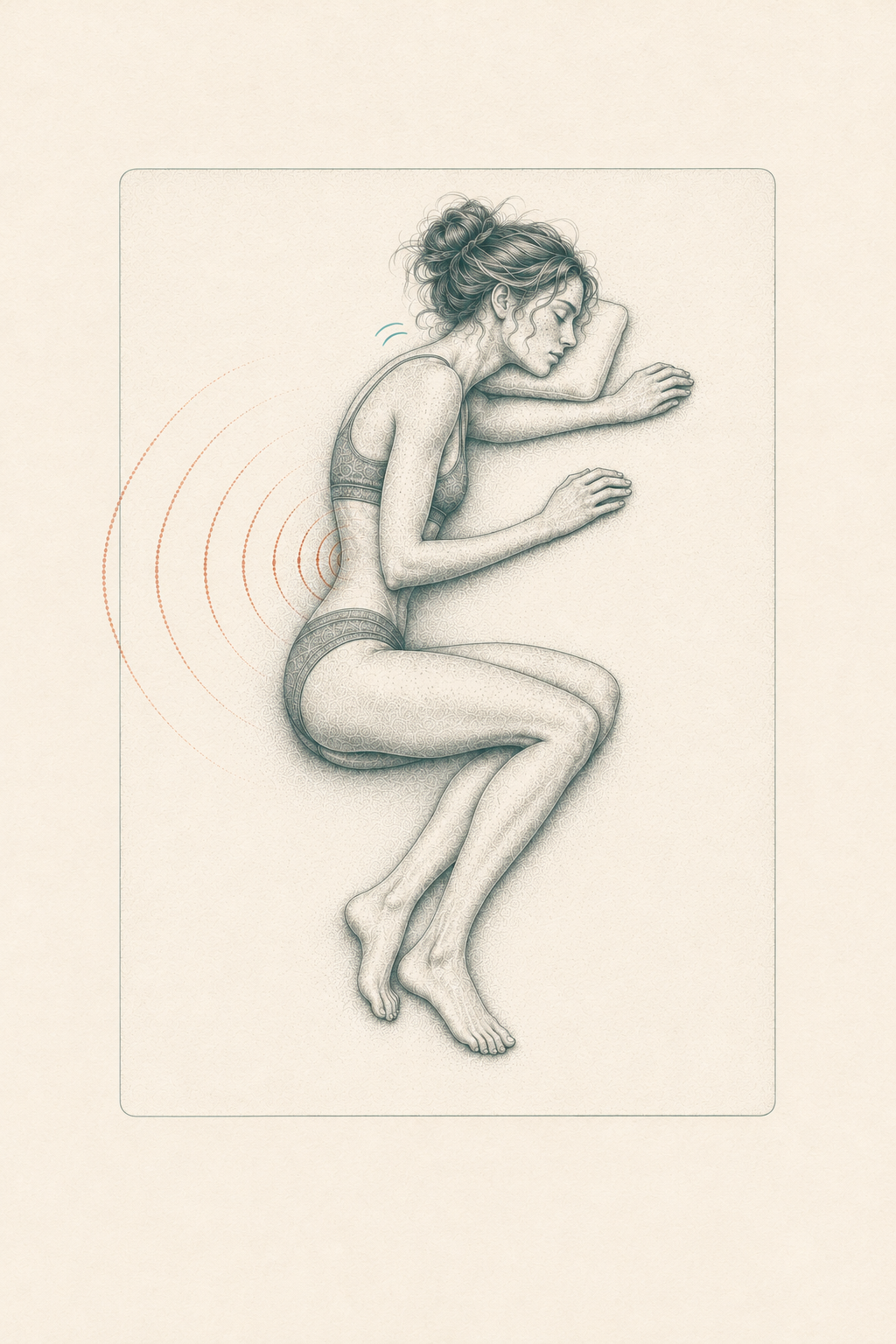
The drill I use most often for this is a left sidelying chin nod with breathing. Nothing dramatic. You lie on your left side, nod your chin gently to lengthen the back of the neck, and breathe into your right ribcage for five cycles. That’s it.
The chin nod repositions the cervical spine. The sidelying position puts the ribcage where it can reorganise. The breathing drives the new shape. When you stand up, the head has a slightly different starting point — and the jaw doesn’t have to hold it there anymore.†
It’s not magic. It’s the chain in reverse. Fix the position. The jaw lets go.
Two things you can try today
1. The jaw tension awareness test. Tongue on palate, teeth apart, lips closed. 60 seconds. If the teeth creep back into contact, something is asking the jaw to brace. Notice what else is on — is the neck tight? Are the shoulders up? Is the breath high in the chest? The jaw is rarely the only thing working.
2. The chin nod sidelying drill. Lie on your left side. Knees stacked at 90 degrees. Pillow under your head so the neck is neutral. Gently nod your chin — not chin-to-chest, just lengthen the back of the neck. Right hand on your right ribcage. Exhale through your mouth, feel the ribs drop. Inhale through your nose into your right hand. 5 breaths. Then stand up and try the jaw test again.†
Neither of these is a treatment. They’re both questions you’re asking your body. The answers are the useful part.
Is this you
If you’ve worn a night guard for years and nothing has changed — the guard was always protecting the surface, not addressing the cause.
If your jaw, your neck, and your headaches all travel together — they do, and now you know the wiring.
If you’ve had the nagging sense that the clench is a symptom and not the source: you’re right. The jaw is the last thing that fires and the first thing everyone blames. The source is a head that doesn’t have a position — and a system that recruited the strongest muscle it could find to make up for it.
The fine print
-
Bartsch T, Goadsby PJ. The trigeminocervical complex and migraine: current concepts and synthesis. Curr Pain Headache Rep. 2003;7(5):371-376. PMID 12946290. Trigeminal afferents (face, jaw, meninges) and upper cervical afferents (C1–C3, back of the head and upper neck) converge in the trigeminocervical complex, a functionally continuous column of neurons in the brainstem and upper spinal cord. This convergence is the neuroanatomical basis for referred pain between the jaw, face, and neck. Limitation: a narrative synthesis, not an empirical study. The neuroanatomical convergence it describes is well-established and not disputed; the clinical implications for migraine treatment are the authors’ synthesis.
-
Ehrlich R, Garlick D, Ninio M. The effect of jaw clenching on the electromyographic activities of 2 neck and 2 trunk muscles. J Orofac Pain. 1999;13(2):115-120. PMID 10425983. Jaw clenching raised neck-muscle EMG (sternocleidomastoid, trapezius) to 7.6–33× resting activity; trunk muscles rose 1.4–3.3×. Limitation: 10 university students performing a strong voluntary clench in a lab, supine and sitting. It demonstrates that jaw and neck are motorically coupled during a hard clench. It does not measure habitual or nocturnal clenching, and the multiples should not be read as what your neck is doing all night. This study also appeared in Field Notes No. 4, note 8.
-
Gadotti IC, Hicks K, Koscs E, Lynn B, Estrazulas J, Civitella F. Electromyography of the masticatory muscles during chewing in different head and neck postures — a pilot study. J Oral Biol Craniofac Res. 2020;10(2):23-27. PMID 32071851. Masseter muscle activity significantly increased during forward head posture compared to natural head posture; a trend of increased activity was observed for the anterior temporalis as well. Limitation: a pilot study with 15 healthy subjects (not TMD patients), using a maximum-yet-comfortable forward head position rather than the subjects’ habitual posture. It demonstrates the direction of influence — head posture changes jaw muscle activity — but the sample is small and the condition is experimentally imposed, not naturally occurring.
-
Koseki T, Kakizaki F, Hayashi S, Nishida N, Itoh M. Effect of forward head posture on thoracic shape and respiratory function. J Phys Ther Sci. 2019;31(1):63-68. PMID 30774207. Forced vital capacity, expiratory and inspiratory reserve volumes, forced expiratory volume at 1 second, and peak flow rate were all significantly lower with forward head posture compared to neutral. The upper thorax shifted forward and the lower thorax shifted forward and inward; mobility of the lower thorax during respiration was significantly reduced. Limitation: a cross-sectional comparison in healthy young adults, divided by craniovertebral angle into FHP and non-FHP groups. Association, not causation — it does not prove that correcting head posture will improve respiratory function, only that the two track together.
-
Manfredini D, Castroflorio T, Perinetti G, Guarda-Nardini L. Dental occlusion, body posture and temporomandibular disorders: where we are now and where we are heading for. J Oral Rehabil. 2012;39(6):463-471. PMID 22435603. No consistent association between body posture and dental occlusion was found, most likely due to the many compensation mechanisms within the neuromuscular system regulating body balance. TMDs are not often related to specific occlusal conditions and do not have detectable relationships with head and body posture at the population level. Limitation: a narrative review, not a meta-analysis. I am citing it as the counterweight — the honest limit of what the population-level literature shows. Individual-level couplings (notes 2, 3, 4) can exist even when population averages wash out, because individual compensatory strategies vary enormously. But that’s an explanation, not a pass — it means the chain must be assessed case by case, not assumed.
-
Olivo SA, Bravo J, Magee DJ, Thie NM, Major PW, Flores-Mir C. The association between head and cervical posture and temporomandibular disorders: a systematic review. J Orofac Pain. 2006;20(1):9-23. PMID 16483016. Some evidence of association between altered head posture and TMD, but the evidence is mixed and methodologically limited — roughly 30–42% of included studies found no relationship. Limitation: a systematic review that highlights the inconsistency of the evidence base, not a confirmation of the relationship. The methodological quality of the included studies was generally low to moderate.
-
Huynh N, Kato T, Rompré PH, et al. Sleep bruxism is associated to micro-arousals and an increase in cardiac sympathetic activity. J Sleep Res. 2006;15(3):339-346. PMID 16911037. Cited from Field Notes No. 4, note 6. Sympathetic shift began ~8 minutes before jaw activity onset. Limitation: 60 subjects, polysomnography, association in time only.
-
Kato T, Rompré P, Montplaisir JY, Sessle BJ, Lavigne GJ. Sleep bruxism: an oromotor activity secondary to micro-arousal. J Dent Res. 2001;80(10):1940-1944. PMID 11706956. Cited from Field Notes No. 4, note 5. Cortical activation preceded jaw movement by 4 seconds in 79% of episodes; heart rate accelerated one beat before. Limitation: 10 patients, 10 controls. Establishes order, not magnitude.
Persistent jaw pain, locking, or clicking needs a dental or TMJ evaluation. Bite registration, joint mechanics, and disc displacement are real pathologies that require clinical intervention this letter is not qualified to address. This content is about the postural piece — the part your dentist isn’t looking at. It is not a substitute for their evaluation. AER on Newbury is a one-person practice; I am a movement specialist, not a physician or a dentist. Individual results vary. Nothing here is medical advice.
The Letter
The writing here is the why. The letter is where the what to do lives — the protocol, the drill, the case behind each piece.
If any of this changed how you think about your own body, an assessment is where that conversation starts.