
The hip that won't open.
It's not tight. The pelvis put it there.
Your hip flexor isn't tight — it's short because the pelvis is committed to anterior tilt. Stretching a muscle that's short because of position doesn't change the position. Here's what does.
You’ve been stretching your hip flexor for years. Couch stretch after the gym. Kneeling lunge before a run. A pigeon pose every morning because a physio told you your hip flexors are “tight.”
Is it less tight?
The stretch feels good. It releases something for a few minutes. Then the tightness comes right back. Same spot, same feeling, same hip. Every time.
That’s not a discipline problem. That’s information. The stretch isn’t fixing what’s actually wrong.
Your hip flexor isn’t tight.
Let me be precise about what “tight” means, because the word gets used to describe two very different things.
A muscle can be contractured — structurally shortened, fibrotic, physically unable to reach its normal length. That’s rare. It happens after prolonged immobilization, post-surgical scarring, or neuromuscular conditions. Your hip flexor almost certainly doesn’t have that.
What your hip flexor has is a short resting length. It’s sitting in a shortened position at rest — not because the tissue has changed, but because the bones it’s attached to are positioned in a way that brings its two ends closer together.†
Here’s the mechanism: the hip flexor (the iliopsoas, specifically) connects your lumbar spine and the inside of your pelvis to the top of your femur. When the pelvis tips forward — anterior tilt — the top attachment moves closer to the bottom attachment. The muscle is short because the skeleton is positioned that way.
That’s not tight. That’s positioned.
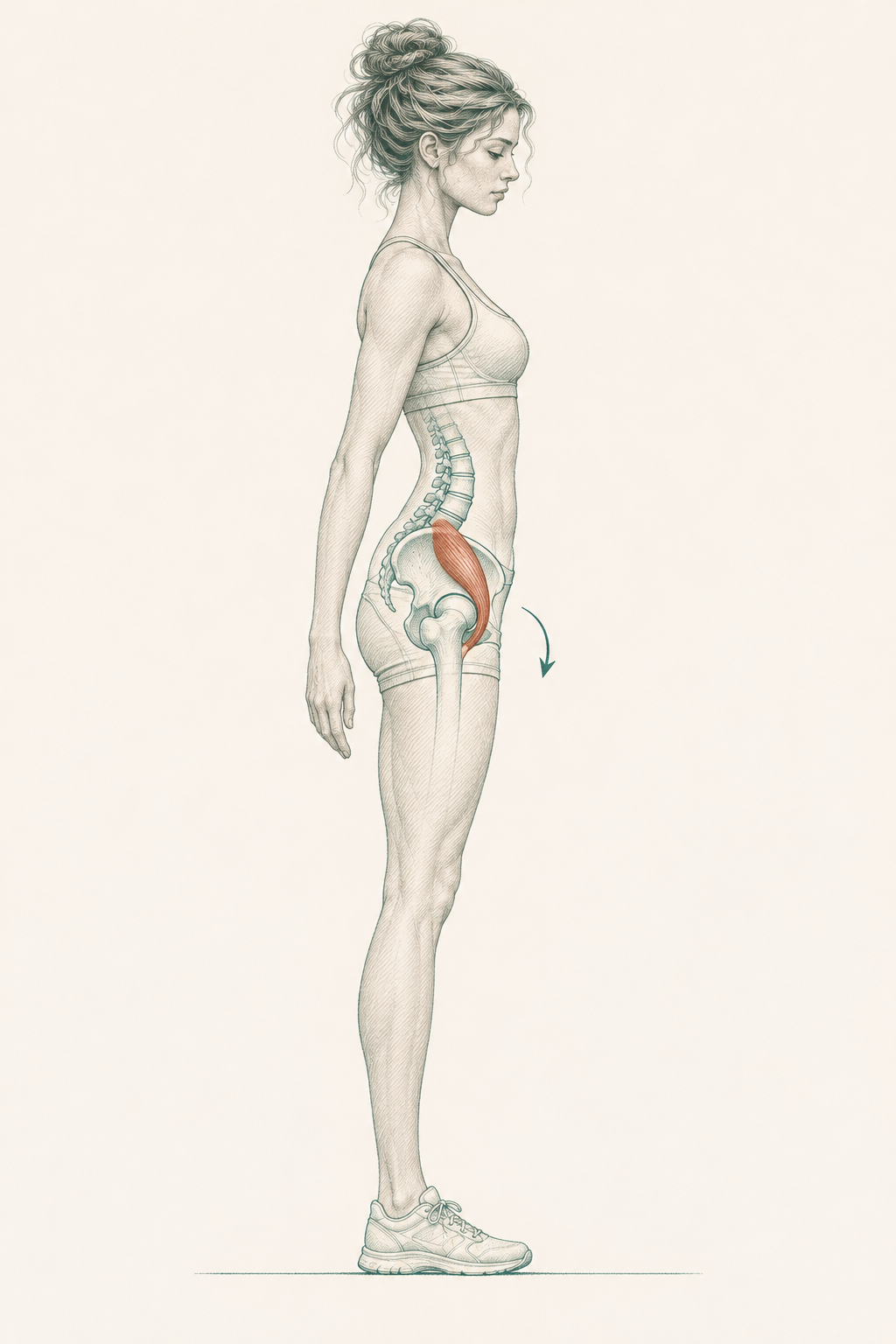
Why stretching doesn’t fix it.
If the muscle were contractured — truly shortened at the tissue level — stretching might be the right approach. You’d be mechanically lengthening fibrotic tissue over time.
But that’s not what’s happening. The muscle is at a normal tissue length. It just lives in a shortened position because the pelvis is tilted forward. When you stretch it, you’re temporarily pulling the muscle past its resting position. That feels like relief. Then you stand up, the pelvis is still tilted forward, the muscle returns to its shortened resting length, and you’re right back where you started.
A six-week stretching study makes this clear. Konrad and Tilp (2014) found that after six weeks of static stretching, range of motion increased significantly — but muscle and tendon structure were completely unchanged. No change in muscle stiffness. No change in tendon stiffness. No structural adaptation at all. The subjects could tolerate more stretch. The tissue hadn’t changed.1
This is stretch tolerance, not stretch adaptation. The nervous system learned to accept more range. The muscle-tendon unit itself did exactly nothing different.6
Now apply that to the hip flexor in anterior tilt. Even if stretching increases your tolerance — lets you push the muscle further — it doesn’t change the pelvic position that’s keeping the muscle short. The moment you stop stretching, the pelvis is still tilted forward, and the resting length hasn’t moved.
This is why the tightness always comes back.
The Thomas test problem.
The standard way clinicians assess hip flexor length is the modified Thomas test: you lie on the edge of a table, pull one knee to your chest, and let the other leg hang. If the hanging thigh floats above the table, the hip flexor is “short.”
There’s a problem. Vigotsky and colleagues (2016) showed that the modified Thomas test has a sensitivity of 31.82% and a specificity of 57.14% for detecting actual hip extension deficits — unless pelvic tilt is controlled. When they controlled for pelvic tilt, the correlation jumped to 0.98.2
Read that again. The test is measuring pelvic tilt more than it’s measuring hip flexor length. If the pelvis is anteriorly tilted during the test, the thigh floats above the table. That looks like a “short” hip flexor. But it’s the pelvic position doing most of the work.
This is exactly the point. The test is reading the pelvis, not the muscle. And the intervention everyone defaults to — stretching the muscle — doesn’t change what the test is actually measuring.
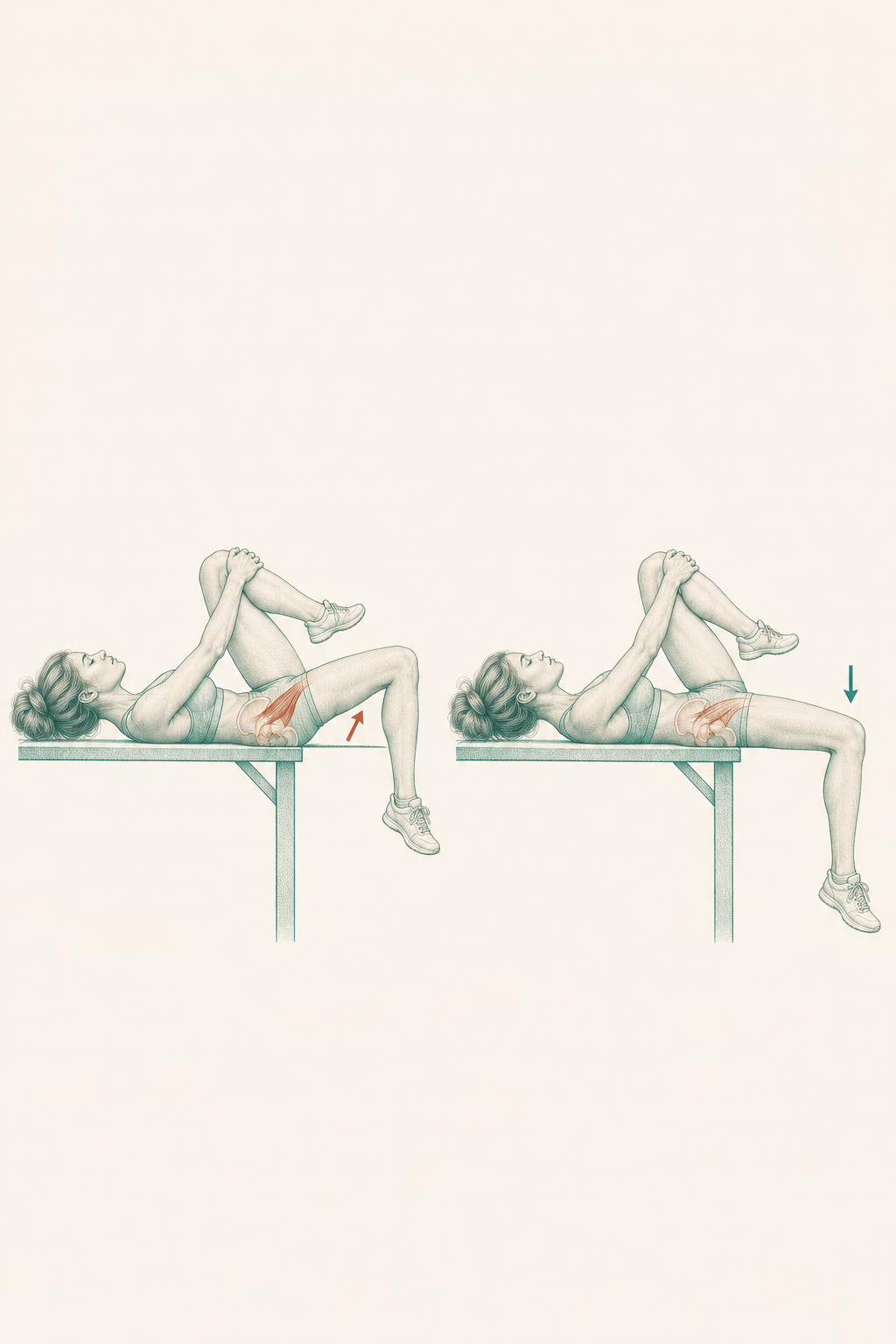
The real question: why is the pelvis there?
If the hip flexor is short because the pelvis is tilted forward, then the question isn’t “how do I stretch the hip flexor?” It’s “why is the pelvis stuck in anterior tilt?”
The answer, from the clinical framework we use:† the pelvis doesn’t tip forward by accident. The nervous system has committed to that position because it provides stability.7 An anteriorly tilted pelvis extends the hip, locks the femur into the socket, and creates a stable platform for standing and walking. The cost is that the hip flexor lives at a shortened resting length, the lumbar spine is in extension, and the system is “on” all the time — stable, but not available for other positions.
This is positional. It’s a strategy. And stretching the hip flexor doesn’t change the strategy. It just temporarily lengthens one consequence of it.
Moreside and McGill (2013) demonstrated this directly. They improved hip flexibility through targeted stretching — the range of motion gains were real, measurable improvements. But those gains did not transfer to mobility in functional movement patterns. The pelvis didn’t move differently. Posture didn’t change. The flexibility existed on the treatment table and vanished in the real world.3
The flexibility improved. The position didn’t.
The fix: reposition, then load.
The approach that works is different from stretching. Instead of asking the muscle to lengthen, you ask the pelvis to move.†
Here’s the sequence:
Step 1 — Test. Modified Thomas test position. Sit on the edge of a sturdy table. Lie back. Pull one knee to your chest. Let the other leg hang. Notice where the thigh sits relative to the table. That’s your baseline.
Step 2 — Reposition. 90/90 hip lift with balloon. Lie on your back, feet on a wall, knees and hips at roughly 90 degrees. Place a balloon between your knees. Squeeze it gently — just enough to engage the inner thighs. Lift your hips slightly off the floor — just enough to feel the hamstrings turn on. Your lower back should flatten toward the floor, not arch. Inhale through your nose. Exhale slowly through your mouth. Feel the ribs drop. 4–5 breaths.†
Step 3 — Retest. Same position as step 1. Pull one knee to your chest. Let the other leg hang. Compare.
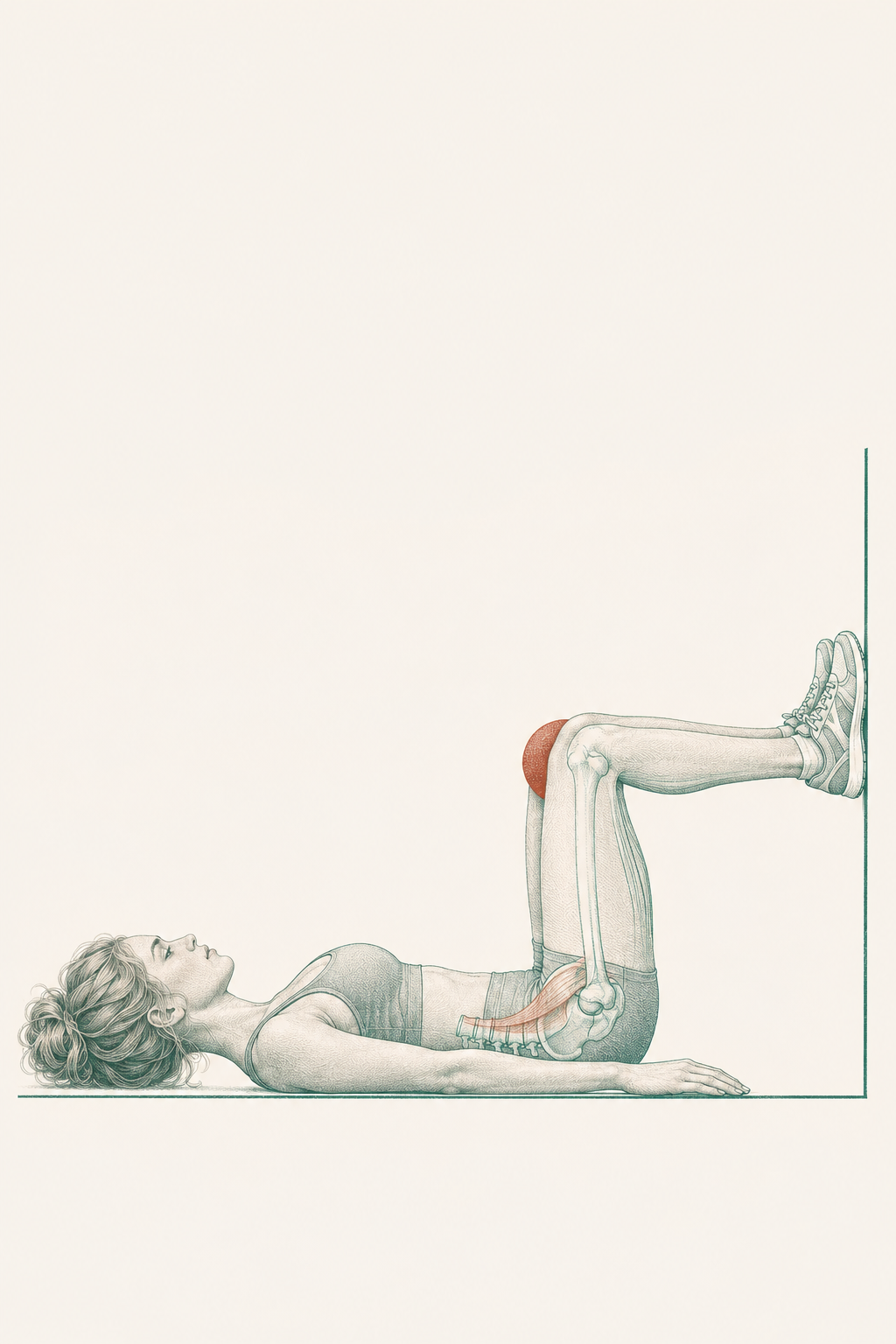
What typically happens: the hanging thigh drops closer to the table. Not because you stretched the hip flexor. You didn’t touch the hip flexor. The hamstrings and abdominals pulled the pelvis out of its forward tilt, the distance between the hip flexor’s attachment points increased, and the muscle found a new resting length.
That’s not stretching. That’s repositioning. The muscle length changed because the position changed.†
Why this matters beyond the hip flexor.
The pattern generalizes. When something tests “tight,” the first question shouldn’t be “how do I stretch it?” The first question should be “what position is it in, and why?”
Muscles adapt to the positions the skeleton gives them. If the position doesn’t change, the adaptation doesn’t change.8 Stretching addresses the muscle. Repositioning addresses the reason the muscle is short in the first place.
This is the difference between flexibility and motor control. Van Dillen and colleagues (2021) showed that person-specific motor skill training — which targets how you move, not how far you can stretch — produced almost double the functional improvement versus strength and flexibility exercise in chronic low back pain patients.4 Stretching more didn’t help. Moving differently did.
The hip flexor that won’t open is the same story at a smaller scale. The muscle isn’t the problem. The position is the problem. Change the position, and the muscle takes care of itself.
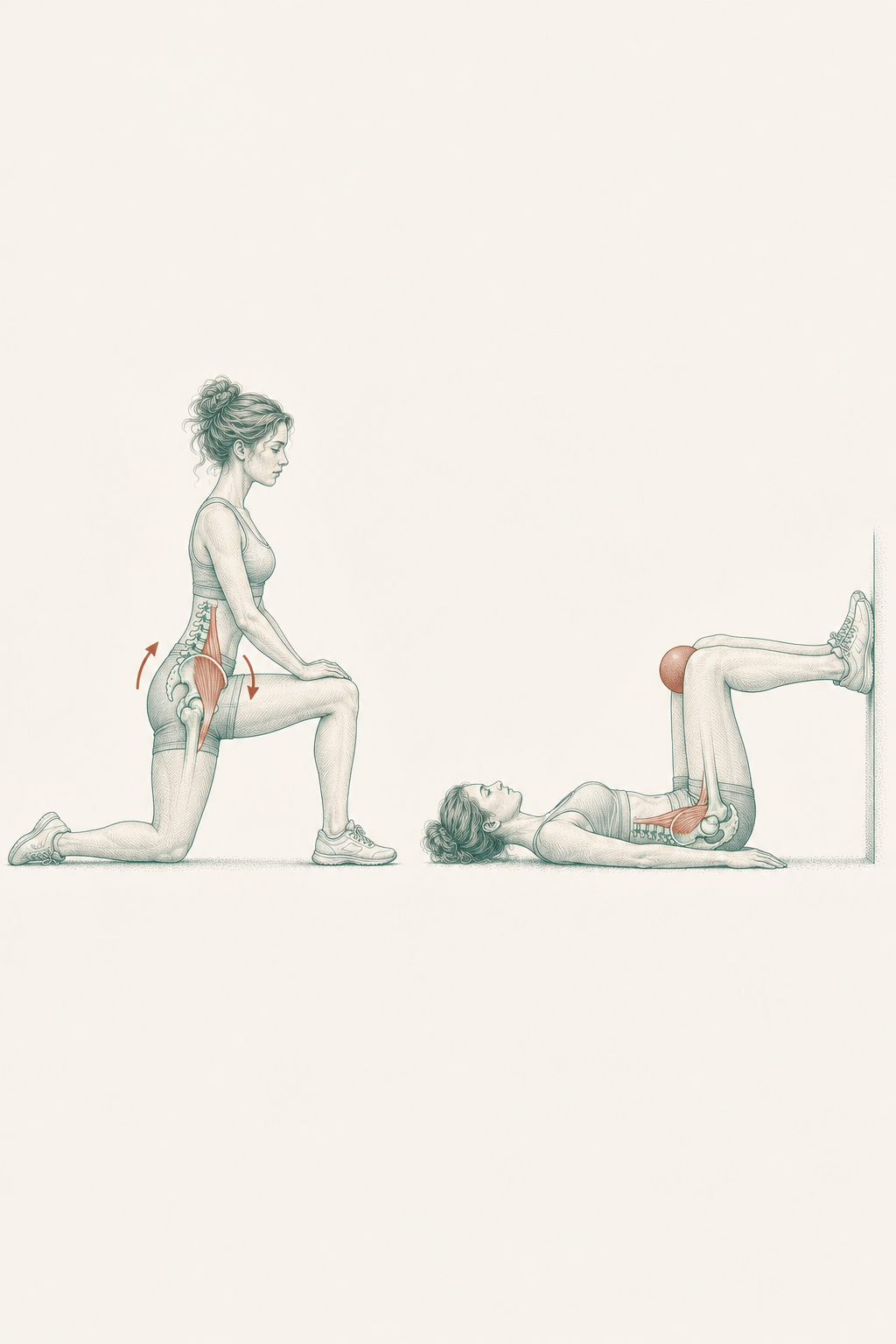
If you’ve been stretching and it keeps coming back, an assessment looks at the position — not just the muscle.
Book an assessment at aerboston.com
The fine print
-
Konrad A, Tilp M. Increased range of motion after static stretching is not due to changes in muscle and tendon structures. Clin Biomech. 2014;29(6):636-642. doi:10.1016/j.clinbiomech.2014.04.013. Limitation: studied the gastrocnemius and Achilles tendon, not the hip flexor specifically. The principle — that ROM gains reflect stretch tolerance rather than structural tissue change — is consistent across the stretching literature, but the direct application to the iliopsoas is our inference, not the study’s finding. n=49 healthy subjects; results may differ in clinical populations.
-
Vigotsky AD, Lehman GJ, Beardsley C, Contreras B, Chung B, Feser EH. The modified Thomas test is not a valid measure of hip extension unless pelvic tilt is controlled. PeerJ. 2016;4:e2325. doi:10.7717/peerj.2325. Limitation: cadaveric and in vivo components; the sensitivity/specificity figures apply to the test as traditionally administered. The finding that controlling pelvic tilt rescues validity (r=0.98) supports the positional interpretation but does not itself prove that repositioning the pelvis changes hip flexor resting length.
-
Moreside JM, McGill SM. Improvements in hip flexibility do not transfer to mobility in functional movement patterns. J Strength Cond Res. 2013;27(10):2635-2643. doi:10.1519/JSC.0b013e318295d521. Limitation: 24 healthy young males. The non-transfer finding is specific to this population and these interventions. It demonstrates that flexibility and functional mobility are dissociated, not that stretching is useless — stretching may serve other goals (pain relief, pre-activity preparation) even if it doesn’t change posture.
-
van Dillen LR, Lanier VM, Steger-May K, et al. Effect of Motor Skill Training in Functional Activities vs Strength and Flexibility Exercise on Function in People With Chronic Low Back Pain: A Randomized Clinical Trial. JAMA Neurol. 2021;78(4):385-395. doi:10.1001/jamaneurol.2020.4821. Limitation: specific to chronic low back pain (n=149). The finding that motor skill training outperformed strength/flexibility exercise supports the motor control vs. flexibility distinction but does not directly test the hip flexor repositioning mechanism described in this piece.
-
Schache AG, Blanch PD, Murphy AT. Relation of anterior pelvic tilt during running to clinical and kinematic measures of hip extension. Br J Sports Med. 2000;34(4):279-283. doi:10.1136/bjsm.34.4.279. Limitation: 14 elite runners on a treadmill at 20 km/h. The correlation between anterior pelvic tilt and reduced hip extension is significant but observational — directionality is inferred, not established. Generalizability to non-running populations is limited.
-
Weppler CH, Magnusson SP. Increasing muscle extensibility: a matter of increasing length or modifying sensation? Phys Ther. 2010;90(3):438-449. PMID 20075147. Limitation: systematic review synthesizing evidence from stretching studies. The conclusion that ROM gains are primarily sensory (stretch tolerance) rather than mechanical (tissue change) is well-supported across studies, but the review notes that very prolonged or aggressive stretching protocols may produce structural changes not seen in typical clinical durations.
-
Hodges PW, Richardson CA. Inefficient muscular stabilization of the lumbar spine associated with low back pain: a motor control evaluation of transversus abdominis. Spine. 1996;21(22):2640-2650. PMID 8961451. Limitation: 15 LBP patients vs 15 controls. Foundational motor control study establishing the delayed TrA onset paradigm. Widely replicated but the original sample is small, and the clinical relevance of feed-forward timing delays remains debated.
-
Moseley GL, Hodges PW. Reduced variability of postural strategy prevents normalization of motor changes induced by back pain: a risk factor for chronic trouble? Behav Neurosci. 2006;120(2):474-476. PMID 16719709. Limitation: 13 subjects recovering from acute LBP. Brief report demonstrating that subjects with reduced postural variability failed to return to a normal strategy when pain stopped — framed as a risk factor for chronicity. Small sample and short follow-up, but the finding that motor strategy rigidity is a risk factor has been supported in subsequent work.
The Letter
The writing here is the why. The letter is where the what to do lives — the protocol, the drill, the case behind each piece.
If any of this changed how you think about your own body, an assessment is where that conversation starts.