
Adaptation — Part 3
What training looks like when you get this right.
The Pneuma Protocol, start to finish
Three weeks of argument arrive at one session. Four phases, from assessment to barbell, with every limit this method still has said out loud.
The last two letters have been about what sits underneath a training program. The first said the nervous system is the variable nobody plans around, and that the diaphragm is the one lever you can actually reach. The second said the recovery score everybody chases is a thermometer, not a thermostat — good at telling you what state you’re in, useless for changing it. This one is the method — what training looks like when you stop chasing the score and start building the system underneath it. One session. Four phases. Every limit it still has, said out loud.
She walked in on a Tuesday because a friend told her to. Fit, years of solid training behind her, no injury worth naming. Just stuck in a way she couldn’t explain — doing everything right on paper and knowing in her body that something wasn’t landing. Here’s what happened.
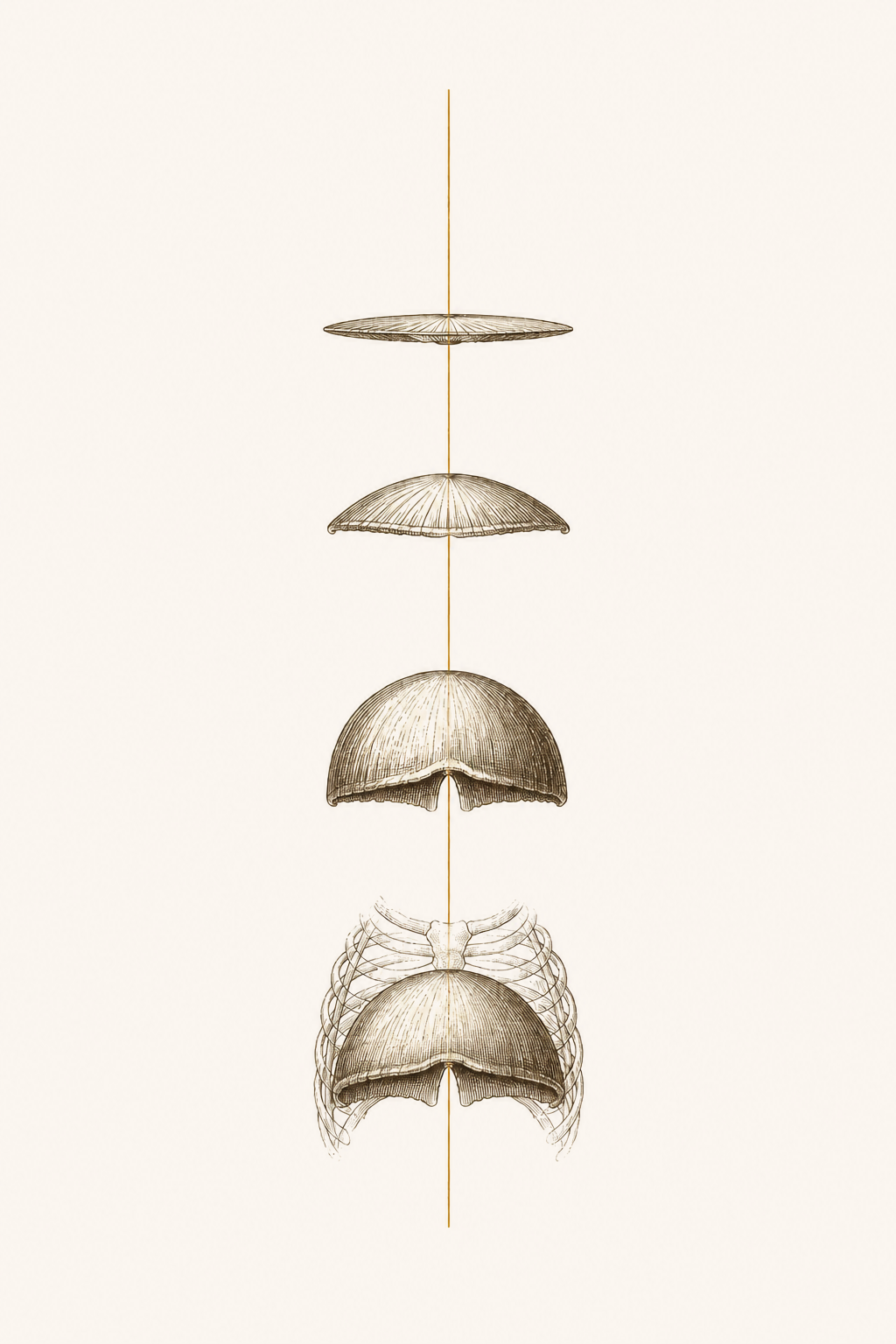
First: where is your nervous system today?
Before she touched a weight, before she warmed up, before anything that looked like a gym — I asked her to stand there and breathe.
She told me later that this was the part that threw her. She’d been training for years. Nobody had ever started by watching her breathe. She stood there, breathing normally, while I watched. Two minutes of that tells me almost everything I need to know about where someone’s system is sitting and what the session needs to be.
That’s the assessment, and it comes first for a reason.† I’m reading the state of her system. How the rib cage moves. What her breathing pattern tells me about where her nervous system sits right now — not last week, not on average, but today, at this hour, before any demand has landed on it. Not a questionnaire, not a body-comp scan. A clinical read that determines everything that follows.†
The logic behind it stands on solid ground. Heart-rate variability — the tiny beat-to-beat variation in your heart’s timing — reflects how much regulatory capacity your brain currently has over your body.2 It’s a real readout of the state of the system. And training timed to that state has outperformed fixed programming: in one study, an HRV-guided group improved more over four weeks than a group running a good preset plan, and a pooled analysis of similar studies found that training by state consistently produced fewer people who did all the work and got nothing for it.3
The assessment doesn’t produce a score. It produces a map of where this person is right now, and that map sets the session.†
Then: targeted breathing, not warming up
She lay down on a treatment table. Specific position, specific support — a bolster here, a pad there, nothing random about it.† Then she breathed. Slowly, on purpose. Five to ten minutes of deliberate, targeted respiratory work that looks nothing like a warm-up and everything like physical therapy.
This is the lever from the first letter, applied.
Your diaphragm is simultaneously your main breathing muscle and part of how your trunk holds itself together under load. Researchers put fine-wire electrodes into the diaphragm and found it active at both rhythms at once — the breathing rhythm and the movement rhythm — no handoff, no taking turns.4 The position of that muscle against the inside of your lower ribs matters enormously.† When the diaphragm is sitting well, it can manage both jobs. When it’s flattened out and riding high, it has to start picking, and your neck and chest muscles get recruited to breathe instead.†
What’s happening on that table isn’t stretching and it isn’t meditation. The positions are designed to let gravity and the breath move the diaphragm back toward the rib cage — restoring the mechanical relationship that lets it do both jobs at once.†
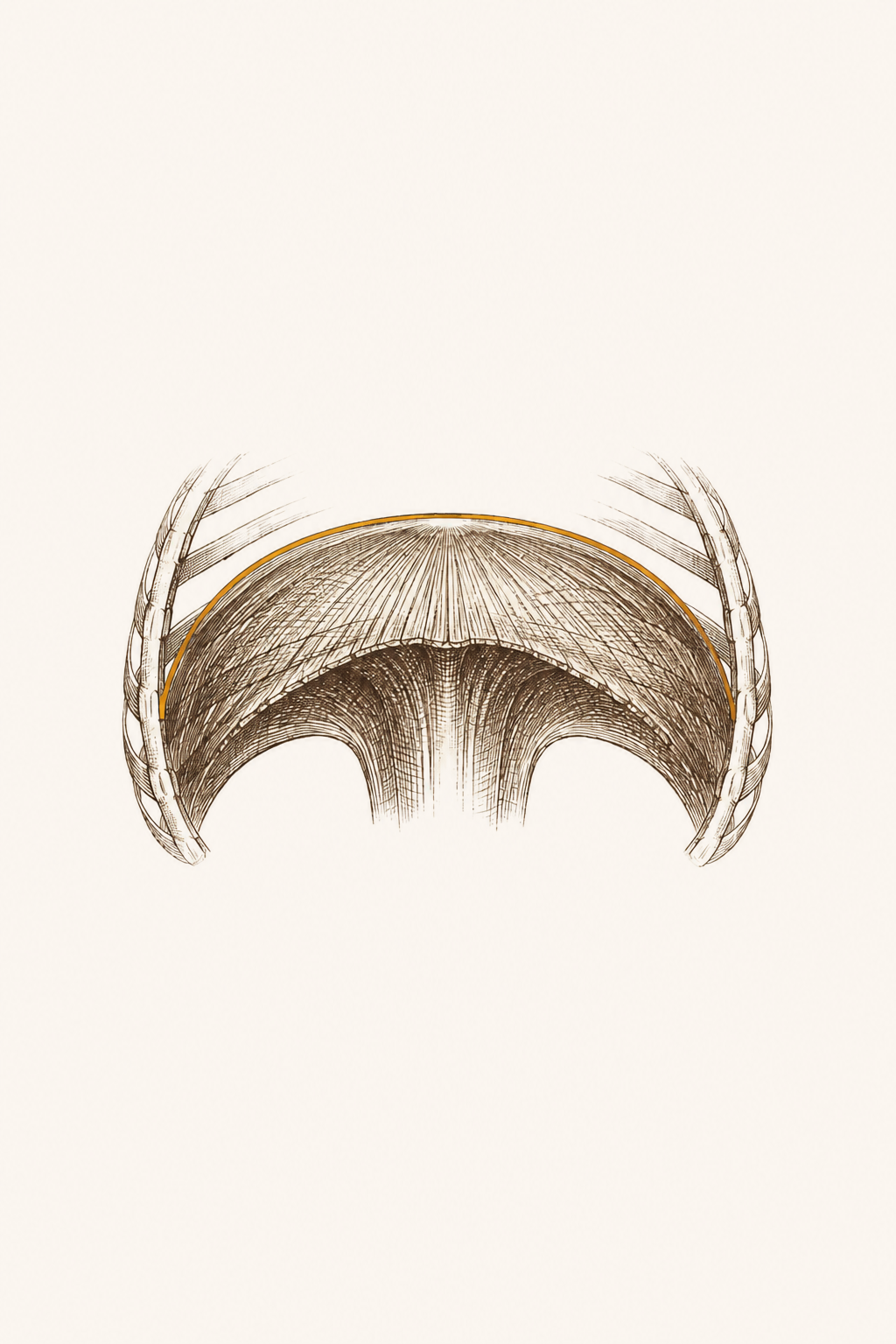
When she stood up after ten minutes, her ribs were moving differently and her trunk was holding itself without the effort it took when she walked in. She noticed. People usually do.
And there’s a second thing happening on the same breath. Slow breathing shifts the vagal side of the nervous system — the branch that governs the recovering state — during the practice and for a stretch afterward.5 So the quiet minutes on the table aren’t just a positioning exercise. They’re a state change. Both things happening at once, through the same muscle, on the same breath.
Next: movement that holds the position under demand
She stood up and started moving. Not lifting — transitioning. Reaching overhead while maintaining a specific position. Shifting her weight from one leg to the other without losing the pattern she’d just restored. Controlling a rotation she would have muscled through an hour ago. The exercises looked simple. She was concentrating harder than she expected.
This phase exists because a position restored in a quiet room has to survive contact with the real world.† Skip it and jump straight to loading, and the system snaps back to its old pattern the moment real demand lands. Integration is the bridge between the treatment table and the barbell.
I see this constantly. Someone does a breathing reset, feels noticeably different, goes right into heavy squats, and by the third set the old pattern is back. The position wasn’t lost because the restore didn’t work. It was lost because it was never tested under demand.
She said afterward that this was the hardest part, which surprised her. The exercises looked like nothing — no weight, no obvious intensity. But holding a new position while your body does something else requires more from the nervous system than most heavy lifts do. It’s a different kind of hard, and it’s the kind that teaches the system to keep what it just gained.
Motor learning research says the same thing from a different angle. In 1979, Shea and Morgan showed that practicing motor skills in a varied, unpredictable sequence — even though it looked worse during acquisition — produced significantly better retention and transfer than drilling one pattern at a time.6 A meta-analysis across sixty-one studies confirmed the principle broadly: varied, challenging practice consolidates a new skill better than blocked repetition.7
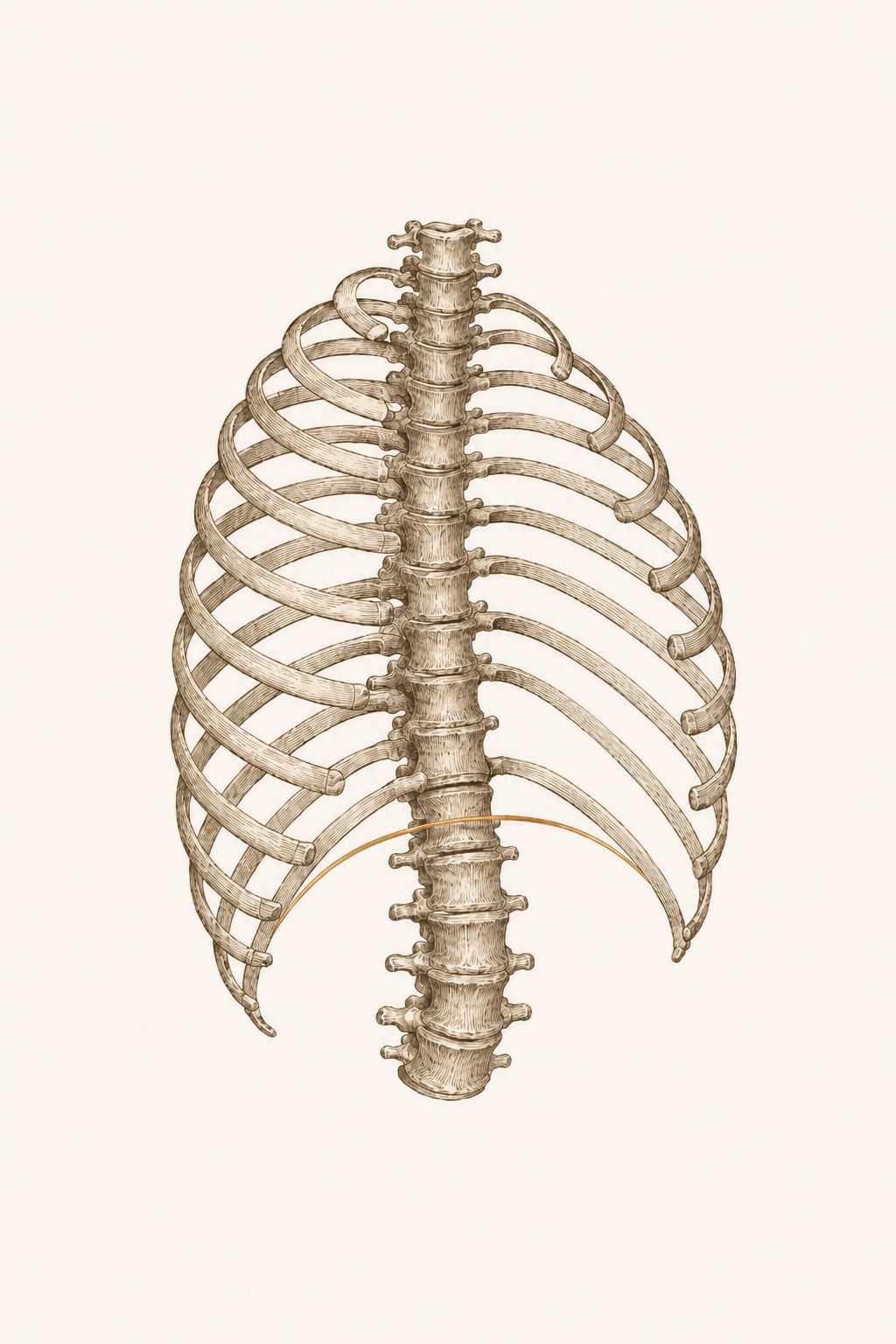
Apply that here and the integration phase makes sense. The restored position gets tested in multiple directions, under different movement demands, precisely because that kind of challenge is what makes it durable. It’s worth being honest about the application: the motor-learning research was done on lab tasks, not on postural-restoration exercises. The principle is well-replicated. Mapping it onto this context is our reasoning, not a tested claim.†
Last: progressive resistance, applied to a system that can receive it
Now she lifts. Same exercises you’d find in any good strength program — squats, hinges, presses, pulls. The movements aren’t exotic. What’s different is what came before them.
The system receiving the load is in a different state than when she walked in. The diaphragm is managing both jobs. The trunk is holding itself without compensating. The nervous system has been read, the position restored, and the position tested under demand. Now you can ask it to adapt.
This is where most programs start. Step four of four. Not because the lifting is less important — it is literally where the adaptation happens. But loading a system that can’t manage its own breath and stability under demand is guessing with extra steps.† The training research backs this up from the recovery side: successful training requires overload, and it also requires that the overload not land on top of inadequate recovery.1 That balance is the whole game, and it’s why the program responds to the state of the system, session by session, instead of running a preset plan that ignores what walked in the door.3
She told me afterward the squat felt different. Same weight she’d moved a hundred times. More grounded. Less effort for the same load. I wouldn’t overstate that — it’s one session, not a transformation. But it’s a system that had its preconditions met before the demand arrived.
The four phases aren’t a warm-up followed by “the real workout.” They’re one continuous session, and the first three phases are the reason the fourth one lands.†
The honest version
If you’re chasing the far edge of what a body can do over a lifetime, this is what the compound interest looks like — a system that can absorb what you give it, year after year, instead of bleeding effort into compensation. And if you’re the person where nothing has worked and nobody can explain why, I want to be careful, because you’ve been sold things before. This isn’t the answer to everything. But it is, more often than not, the question nobody bothered to ask.
Same plain note as the last two letters, because the honesty is the whole point.
The Pneuma protocol is a young method. The Postural Restoration framework underneath it has decades of clinical refinement and a full certification curriculum, and the evidence base it draws on is real — you’ve read it, with every limitation, across three letters. But the integration of that framework into a training protocol — the four phases you just walked through — is my work, and it’s still being developed. I’m building it with a psychologist, setting it down piece by piece, and every claim has to earn its spot or it gets cut — including the ones I liked. What you’d meet in the studio is that method, still being sharpened. I’d rather tell you that now than have you find out later.
If any of this made you think I want to know where my system actually is — that’s what the assessment is for. Book one. Come in. I’ll tell you exactly what I see and what I’d do about it, and you can decide from there.
These three letters are the argument. If it landed, the next step is an hour in the studio. If it didn’t, you’ve still got three letters’ worth of breathing drills and a clearer picture of what your recovery score is actually measuring. Either way, you come out ahead.
Book an assessment at aerboston.com
The fine print
-
Meeusen R, Duclos M, Foster C, et al. Prevention, diagnosis, and treatment of the overtraining syndrome: joint consensus statement of the European College of Sport Science and the American College of Sports Medicine. Med Sci Sports Exerc. 2013;45(1):186–205. Limitation: this is an expert consensus document, not an experiment. The boundaries between functional overreaching, non-functional overreaching, and overtraining syndrome are contested and diagnosed largely by exclusion. Read it as the field’s best current agreement, not as settled fact.
-
Thayer JF, Ahs F, Fredrikson M, Sollers JJ, Wager TD. A meta-analysis of heart rate variability and neuroimaging studies: implications for heart rate variability as a marker of stress and health. Neurosci Biobehav Rev. 2012;36(2):747–756. Limitation: this is a meta-analysis of correlations between HRV and regional brain activity. It shows the association is consistent; it does not show that the brain regions cause the HRV, that raising HRV improves regulation, or that any individual’s HRV number means what a consumer app says it means.
-
Kiviniemi AM, Hautala AJ, Kinnunen H, Tulppo MP. Endurance training guided individually by daily heart rate variability measurements. Eur J Appl Physiol. 2007;101(6):743–751. Limitation: 26 people, all healthy moderately fit men, four weeks. Tiny, short, and not generalisable to women, to older or unfit people, or to strength training. This is the single most favourable study in the area and should be read as a promising signal, not a result you can bank. A subsequent meta-analysis of eight similar studies (Duking et al. 2021, J Sci Med Sport 24(11):1180–1192) found HRV-guided training associated with fewer non-responders, but only a small and non-significant effect on peak performance — the honest ceiling on the single-study result.
-
Hodges PW, Gandevia SC. Activation of the human diaphragm during a repetitive postural task. J Physiol. 2000;522(Pt 1):165–175. Limitation: four subjects. It is an elegant finding, but it is a very small mechanistic lab study using fast arm movements — not a study of barbell training, and not a demonstration that improving diaphragm position improves training outcomes.
-
Laborde S, Allen MS, Borges U, et al. Effects of voluntary slow breathing on heart rate and heart rate variability: a systematic review and a meta-analysis. Neurosci Biobehav Rev. 2022;138:104711. Limitation: the effects are clearest during and around the practice; evidence that it durably lifts your all-day resting baseline is thinner and more mixed. And it supports slow rate, not any particular inhale-to-exhale ratio.
-
Shea JB, Morgan RL. Contextual interference effects on the acquisition, retention, and transfer of a motor skill. J Exp Psychol Hum Learn Mem. 1979;5(2):179–187. doi:10.1037/0278-7393.5.2.179. Limitation: a laboratory motor-skill study (knocking over barriers in different sequences), not a clinical rehabilitation or training study. The principle of contextual interference is well-replicated in motor learning research; applying it to postural-restoration integration is our inference, not a tested claim.
-
Brady F. Contextual interference: a meta-analytic study. Percept Mot Skills. 2004;99(1):116–126. doi:10.2466/pms.99.1.116-126. Limitation: a meta-analysis of sixty-one studies in motor learning. The overall effect size is moderate (0.38), and notably weaker in applied settings (0.19) than in basic research (0.57). Supports the principle broadly; does not test it in the context of respiratory or postural restoration.
The Letter
The writing here is the why. The letter is where the what to do lives — the protocol, the drill, the case behind each piece.
If any of this changed how you think about your own body, an assessment is where that conversation starts.