
Adaptation — Part 1
The variable nobody programs.
Your program probably isn't the problem
Best program you've ever had. Sleep dialed. Food dialed. And you're not getting better. Here's the variable almost nobody plans around.
You’ve got the best program you’ve ever run. Your food is dialed. You’re actually sleeping seven hours. You’re showing up. And you’re not getting better. I hear some version of this constantly, and the first thing I’ll usually tell you is that it probably isn’t the program. Training is a question you ask your body. Whether anything comes back depends on the state your body is in when you ask it.
Everything’s dialed. Nothing’s moving.
Start with the thing everybody skips. A training program doesn’t make you stronger. It’s the stress that asks your body to become stronger. The becoming happens later, when you’re not training, and it only happens if your system has the capacity to do it that week.
That’s not a fringe position, by the way. The joint consensus statement from the European College of Sport Science and the American College of Sports Medicine says it about as plainly as a document like that ever says anything: training has to involve overload, and it also has to avoid overload piled on top of inadequate recovery.1 Cross that line and you don’t get slightly less progress. You get a different outcome. You get worse, and clawing back can take weeks or months.
And here’s the uncomfortable bit from that same document. There is still no single test that reliably tells you which side of the line you’re standing on.1 Not a hormone, not a performance test, not a questionnaire — the authors went through the candidates and concluded none of them meet the bar. So most people guess. Usually by feel, and feel is a famously unreliable narrator when you’re tired.
Try this now — 2 minutes
Before your next set
Don’t do this to relax. Do it to change the state you’re about to train in.
Sit down before you warm up. Breathe out slowly and all the way to the end, then wait a beat before the next breath comes in. Keep the whole cycle slow — somewhere around five or six breaths a minute, which will feel absurdly slow if you’ve never counted. Two minutes. Then go train.
One thing worth being straight about, since the internet is full of magic ratios: it’s the rate doing the work here, not some precise proportion of in to out. Slowing the whole cycle down is what reliably shifts the vagal side of your nervous system, both during the practice and for a stretch afterward.2 A long exhale is just the easiest handle for making the cycle slow. That’s all it is.
Do it once and you’ll feel something. Keep doing it for a couple of months and it starts showing up in things that get measured rather than just things you notice — in one small trial, eight weeks of daily slow breathing moved sustained attention and lowered cortisol.7 Small study. Real direction.
You can run a perfect program on a system that can’t use it. That isn’t training. That’s just wear.
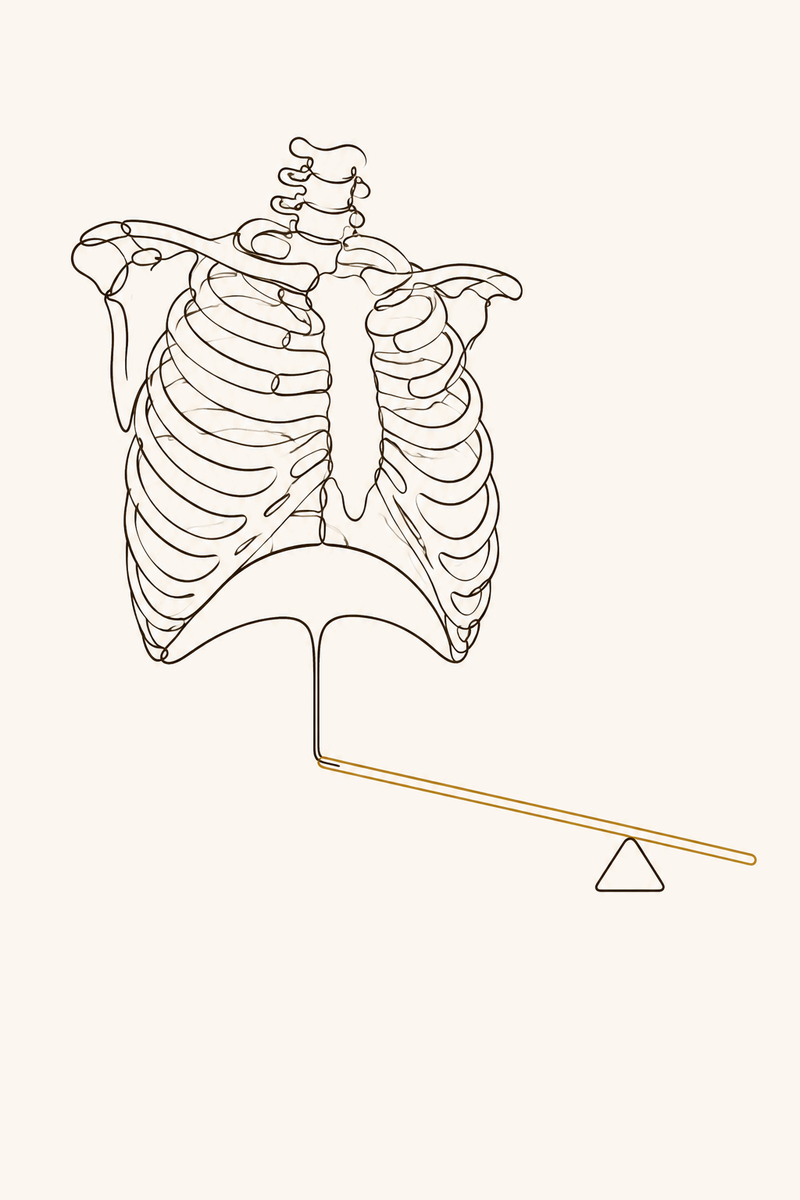
The one handle you can actually reach
If the state of the system is the thing that decides whether training lands, the obvious question is what you can do about it. And most of your autonomic nervous system is genuinely none of your business. You can’t decide to digest. You can’t decide your heart rate.
Breathing is the odd one out. It runs fine without you — you’ve been doing it all day without a single thought — and you can also take it over any time you feel like it. It’s the one place where a system you don’t control has a handle sticking out of it.
And the muscle on the other end of that handle is doing two jobs at once. Your diaphragm is your main breathing muscle, and it’s also part of how your trunk holds itself together under load. That isn’t a metaphor. Researchers put fine wire electrodes into the diaphragm and had people swing their arms fast enough to genuinely disturb their posture, and the diaphragm’s activity showed up at both rhythms at the same time — the breathing rhythm and the movement rhythm.3 No handoff. No taking turns. Both jobs, simultaneously.
This is territory where Postural Restoration has been well ahead of the field for a long time. In PRI, the position of the diaphragm against the inside of your lower ribs — they call it the Zone of Apposition — is the thing you restore first, before almost anything else.† The reasoning is that a diaphragm sitting in a decent position can do both of its jobs, and one that’s flattened out and riding high has to start picking.† When it picks, your body goes and rents your neck and chest muscles to breathe with instead. Which is a miserable way to spend a Tuesday, and it’s also a system with less left over for adapting to your squats.
What happened when someone actually tested this
So how would you even know what state someone’s in? The best window we’ve got is heart-rate variability — the tiny beat-to-beat differences in your heart’s timing. It is not a wellness score, whatever your watch implies. It’s a rough readout of how much regulatory authority your brain currently has over your body. A meta-analysis pulling together the brain-imaging work found HRV tracks activity in exactly the circuits you’d expect: the amygdala and the ventromedial prefrontal cortex, the threat-appraisal and top-down-control machinery.4 More variability, more capacity to modulate. Less, less.
Now the part I actually care about, because it’s what turns an interesting fact into a training variable. A group in Finland took twenty-six moderately fit men and split them up. One group ran a normal, sensibly written four-week program. The other group’s plan was decided fresh every morning by their HRV: holding steady or up, you got a hard session; down, you got an easy day or a rest day. Same four weeks.
The HRV group improved more. Their peak treadmill speed climbed further than the fixed-plan group’s, and their VO₂peak went from 56 to 60 while the fixed-plan group’s didn’t budge.5 Same weeks, same effort, better answer — because one group only asked the hard question on days the body was in shape to answer it.
Before you go buy a chest strap, though, the honest version. That was twenty-six people over four weeks, and it’s the strongest single result in this literature rather than the typical one. When someone pooled eight of these studies — 198 people between them — the picture got a lot more modest: a real, medium-sized benefit on submaximal fitness markers, but only a small and statistically non-significant effect on peak performance and VO₂peak.6 So no, this isn’t a cheat code.
What did show up in that pooled analysis is the finding I’d point at anyway: the groups training by state had fewer non-responders.6 Fewer people doing all the work and getting nothing for it. I’d rather make the small true claim than the big exciting one, so here it is. Paying attention to the state of the system doesn’t raise your ceiling. It makes it a lot less likely you’ll spend a whole training block sitting underneath it for no reason at all.
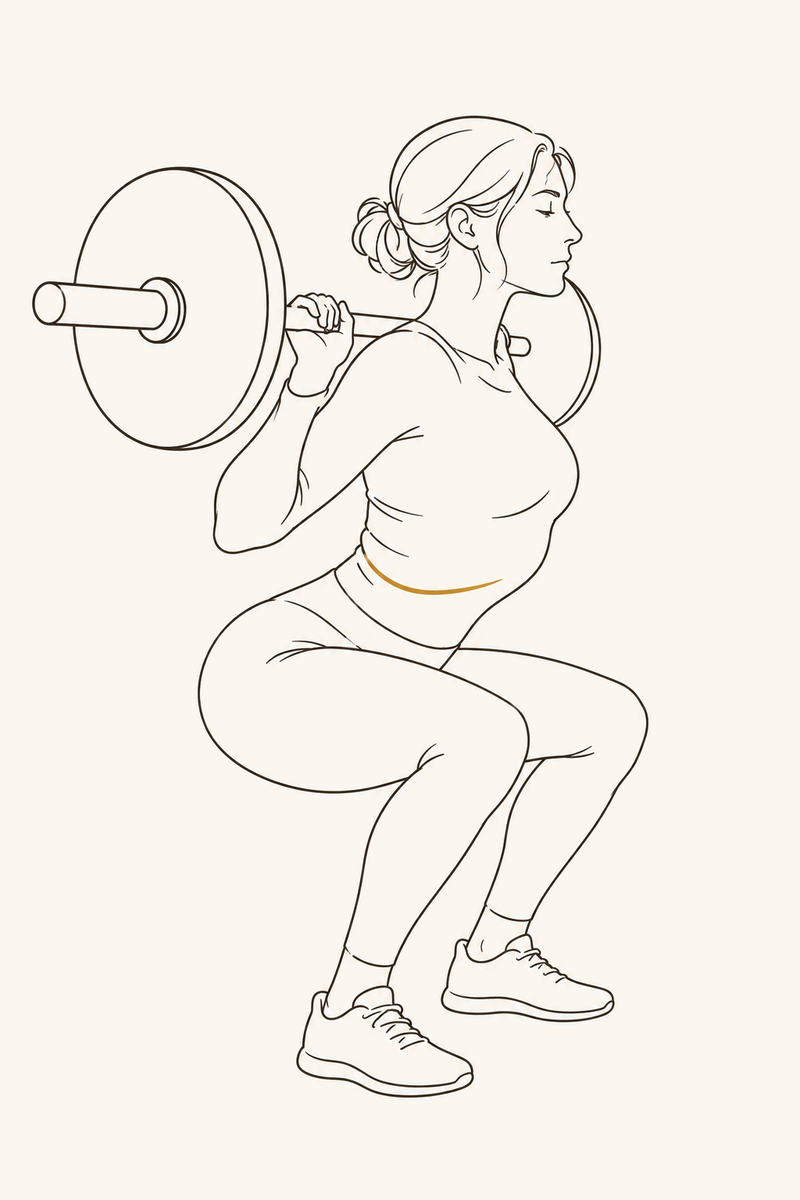
Look at what your program actually tracks
Sets. Reps. Load. Tempo. Rest. Frequency. Every one of those describes the demand you’re putting on the system. Not one of them describes the system. That’s the entire gap, and it’s why two people can run the identical block and only one of them comes out the other side different.
One honest caveat
This is training, not medicine. If you’re not recovering and it’s persistent or getting worse, there’s a real list of things that cause exactly this and that breathing will not touch — thyroid, low iron, sleep apnea, blood-sugar swings, depression, medication, or simply not eating enough for the work you’re doing. Several of those are common and very treatable, and you find them with a workup, not a breathing drill. Breath work sits alongside that. It doesn’t replace it. Nothing here is medical advice.
Where this meets the method
This is the reason an assessment is the first thing that happens here and not the second. Not thoroughness for its own sake. Writing someone a program before you know what state their system is in is just guessing with extra steps.†
Here’s what that looked like with the same person you met in the last two letters, once she stopped just feeling better and decided she wanted to actually get strong.
A case in point — the block that wasn’t landing
She showed up with a program a good coach had written her, and eleven weeks of not much to show for it. The program was fine. I’d have written something close to it.†
What wasn’t fine was everything around it. Four hard sessions a week landing on a system that was already running hot, on top of a job that doesn’t stop. She was doing the work. The work had nowhere to go.
| When | What happened |
|---|---|
| First | We stopped adding and started subtracting. Four hard days went to two, with the other two turned into something genuinely easy. This is the part nobody wants and it’s usually the part that works. She hated it for about ten days. |
| Wk 1–3 | Two minutes before the first set. Same drill that’s in the teal box above, every session, before touching a barbell. Not a warm-up. A way of starting the session from a different place than the one the day had left her in. |
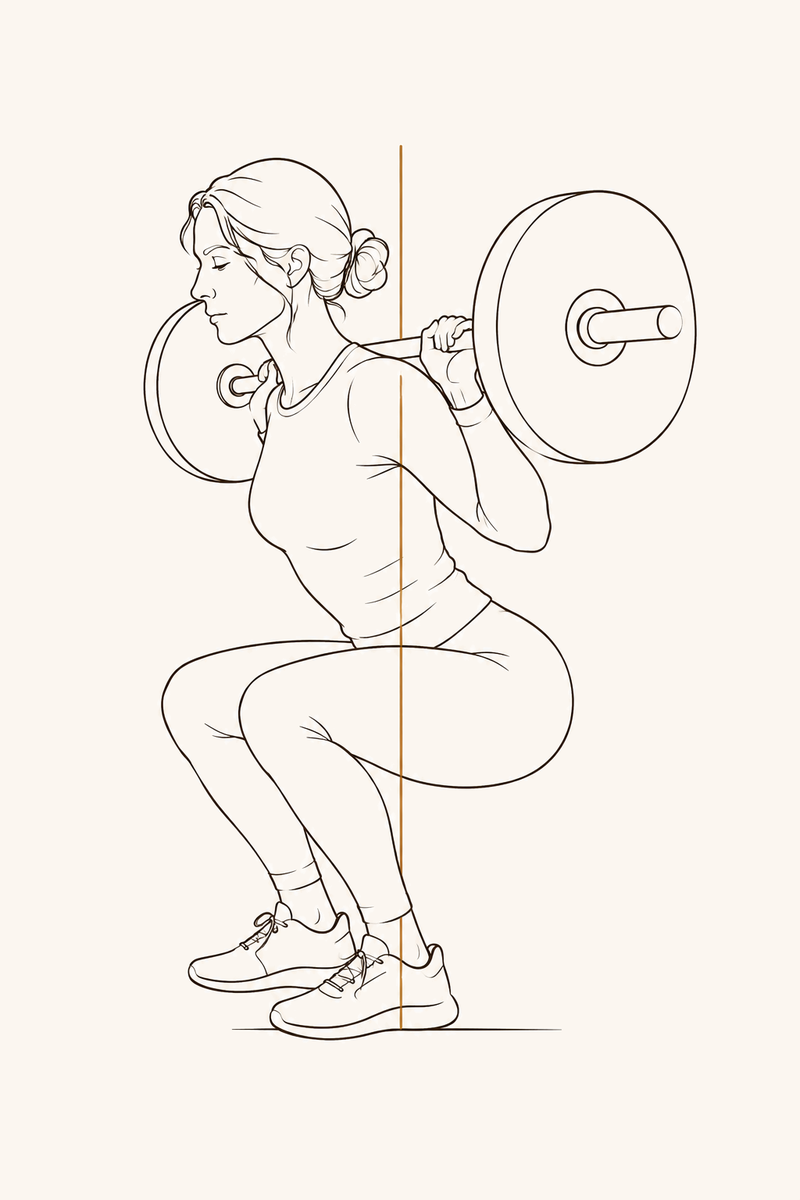
| Wk 4–8 | The ribs stopped flying open under load. Which mattered less as a posture thing and more as a sign the same muscle was managing to breathe and hold her together at once, instead of trading one for the other.† |
| Ongoing | Load it, on the days it’ll land. Hard days are still hard — harder than before, actually. They’re just aimed at days she can use them.† |
She trains less than she used to. She’s stronger than she’s ever been. Those two things are not a coincidence, and they’re not a paradox either.
Why I keep hammering this one
If you’re the sort of person who wants to find out what a body can actually do over thirty years, this is the difference between three decades of training and three decades of training that compounds. Most of the ceiling people hit isn’t a genetic one. It’s years of good work landing on a system that was never in a position to bank it.
And if you’re on the other end of my inbox — the people where nothing has worked and nobody can tell you why, where you’ve been handed a program or a protocol or a diagnosis and none of it moved — I want to be careful here, because you’ve been promised things before. This isn’t the answer to everything. But it is very often the missing question. You weren’t failing to try hard enough. You were asking a system that was already at its limit to please take on some more.
Same plain note as always: the Pneuma protocol underneath all this isn’t finished, and isn’t supposed to be. It’s a living method I’m actively building, right now with a psychologist, setting it down piece by piece so every claim has to earn its spot. What you’d meet in the studio is that method, still being sharpened.
The fine print
-
Meeusen R, Duclos M, Foster C, et al. Prevention, diagnosis, and treatment of the overtraining syndrome: joint consensus statement of the European College of Sport Science and the American College of Sports Medicine. Med Sci Sports Exerc. 2013;45(1):186–205. The statement holds that “successful training not only must involve overload but also must avoid the combination of excessive overload plus inadequate recovery,” and on diagnosis concludes that of the available markers “none of them meet all the criteria to make their use generally accepted.” Limitation: this is an expert consensus document, not an experiment — it synthesises a literature rather than testing a hypothesis. The boundaries between functional overreaching, non-functional overreaching, and overtraining syndrome are contested, hard to measure prospectively, and diagnosed largely by exclusion. Read it as the field’s best current agreement, not as settled fact.
-
Laborde S, Allen MS, Borges U, et al. Effects of voluntary slow breathing on heart rate and heart rate variability: a systematic review and a meta-analysis. Neurosci Biobehav Rev. 2022;138:104711 — slow breathing increased vagally-mediated HRV during the practice, immediately after a single session, and after multi-session interventions. Limitation: the effects are clearest during and around the practice; evidence that it durably lifts your all-day resting baseline is thinner and more mixed (the same limitation flagged in the last letter). Also, and deliberately: this review supports slow rate. It is not evidence for any particular inhale-to-exhale ratio, and we no longer state one — that question is genuinely unsettled, not settled in our favour.
-
Hodges PW, Gandevia SC. Activation of the human diaphragm during a repetitive postural task. J Physiol. 2000;522(Pt 1):165–175 — intramuscular EMG showed costal diaphragm activity modulated at both the respiratory frequency and the much faster limb-movement frequency at once, leading the authors to conclude that phrenic motoneurone activity “contributes to both posture and respiration” in a task that repeatedly challenges trunk posture. Limitation: four subjects. It is an elegant finding, but it is a very small mechanistic lab study using fast arm movements — not a study of barbell training, and not a demonstration that improving diaphragm position improves training outcomes.
-
Thayer JF, Åhs F, Fredrikson M, Sollers JJ, Wager TD. A meta-analysis of heart rate variability and neuroimaging studies: implications for heart rate variability as a marker of stress and health. Neurosci Biobehav Rev. 2012;36(2):747–756 — HRV was associated with activity in the amygdala and ventromedial prefrontal cortex, supporting HRV as an index of top-down regulation. Limitation: this is a meta-analysis of correlations between HRV and regional brain activity. It shows the association is consistent; it does not show that the brain regions cause the HRV, that raising HRV improves regulation, or that any individual’s HRV number means what a consumer app says it means.
-
Kiviniemi AM, Hautala AJ, Kinnunen H, Tulppo MP. Endurance training guided individually by daily heart rate variability measurements. Eur J Appl Physiol. 2007;101(6):743–751 — four weeks, HRV-guided group (n=9) vs. predefined training (n=8) vs. control (n=9). Maximal treadmill speed rose 15.5→16.4 km/h in the HRV group vs. 15.1→15.7 in the predefined group (between-group difference p=0.048); VO₂peak rose 56→60 ml/kg/min in the HRV group (p=0.002) and did not change significantly in the predefined group (54→55, p=0.224). Limitation: 26 people, all healthy moderately fit men, four weeks. Tiny, short, and not generalisable to women, to older or unfit people, or to strength training. This is the single most favourable study in the area and should be read as a promising signal, not a result you can bank.
-
Düking P, Zinner C, Trabelsi K, et al. Monitoring and adapting endurance training on the basis of heart rate variability monitored by wearable technologies: a systematic review with meta-analysis. J Sci Med Sport. 2021;24(11):1180–1192 — 8 studies, 198 participants, 9 interventions. HRV-guided training produced a medium effect on submaximal physiological parameters (g=0.296, 95% CI 0.031–0.562, p=0.028) but “only a small and non-significant influence on performance and V̇O2peak,” while being “associated with fewer non-responders and more positive responders.” Limitation: this is the honest ceiling on the previous citation, and it is why this piece does not promise a performance jump. Small pooled sample, heterogeneous protocols, mostly endurance athletes; the non-responder finding is a secondary observation, not the primary pre-registered outcome.
-
Ma X, Yue ZQ, Gong ZQ, et al. The effect of diaphragmatic breathing on attention, negative affect and stress in healthy adults. Front Psychol. 2017;8:874 — 40 healthy adults, 20 sessions over 8 weeks at roughly 4 breaths/min with a feedback device; the breathing group showed improved sustained attention, reduced negative affect, and lower salivary cortisol, with no equivalent change in controls. Limitation: 40 people, one lab, healthy adults, and a device-assisted protocol most people won’t replicate at home. Cortisol is also a noisy, highly variable measure. Suggestive, not conclusive.
The Letter
The writing here is the why. The letter is where the what to do lives — the protocol, the drill, the case behind each piece.
If any of this changed how you think about your own body, an assessment is where that conversation starts.