
The Asymmetry — Part 6
What an Assessment Actually Finds
Not what's wrong. Where the system committed.
An assessment doesn't tell you what's wrong. It reads where the nervous system committed — position, not pathology — and what changes first.
You stood on one leg last week. You felt it — one side locked into the floor. The other searched.
That was real information. But it was one test reading one dimension of a much larger pattern. This week: what an assessment actually does with that information, what “neutral” really means, and why more data doesn’t help without a framework to read it.
The test doesn’t tell you what’s wrong
This is the first thing to understand about a positional assessment, and the thing most people get backwards.
The tests don’t look for damage. They don’t measure weakness. They don’t grade pathology. They don’t output a diagnosis.†
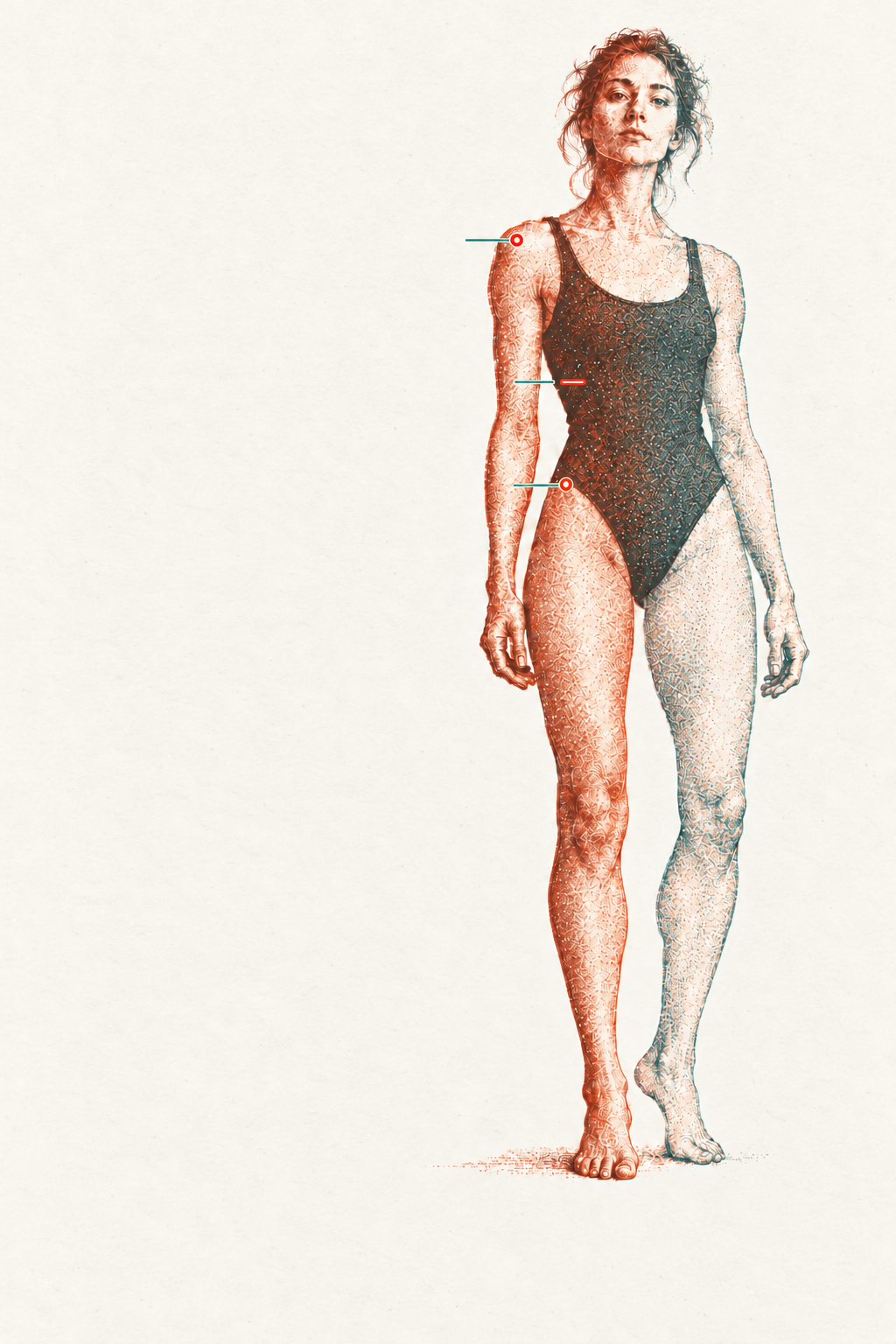
They measure position. Where is the pelvis sitting? Which direction is the ribcage oriented? What can the hip do from where it is? What can’t it do?
That’s a fundamentally different question than “what’s broken?“⁶ It’s: where did the nervous system commit?†
And that distinction changes everything about what happens next.
Position as a decision the system already made
Here’s the mechanism.
Your nervous system is solving a problem every moment you’re upright: how to keep a top-heavy column of bones and tissue balanced over two feet. It does this by choosing positions — committing to specific orientations of the pelvis, ribcage, and spine that create a stable platform.†
In most people, the commitment is asymmetric. One side gets recruited for stability. The other gets inhibited. Not damaged — just not asked to participate. The system found a solution that works well enough, and it stopped searching.⁵†
That’s what the single-leg balance test was reading last week. The side that locked into the floor? That’s the side the system committed to for stance. The side that searched? That’s the side that hasn’t been participating in the same way.†
Not right and wrong. Just where the pattern landed.
What “neutral” actually means
Here’s where it gets interesting.
Most people hear “neutral” and think of a position — a specific alignment where everything is stacked perfectly. Shoulders over hips, hips over ankles, spine in some ideal curve.
That’s not what neutral means in a positional assessment.†
Neutral is the ability to move into a position and move out of it.†
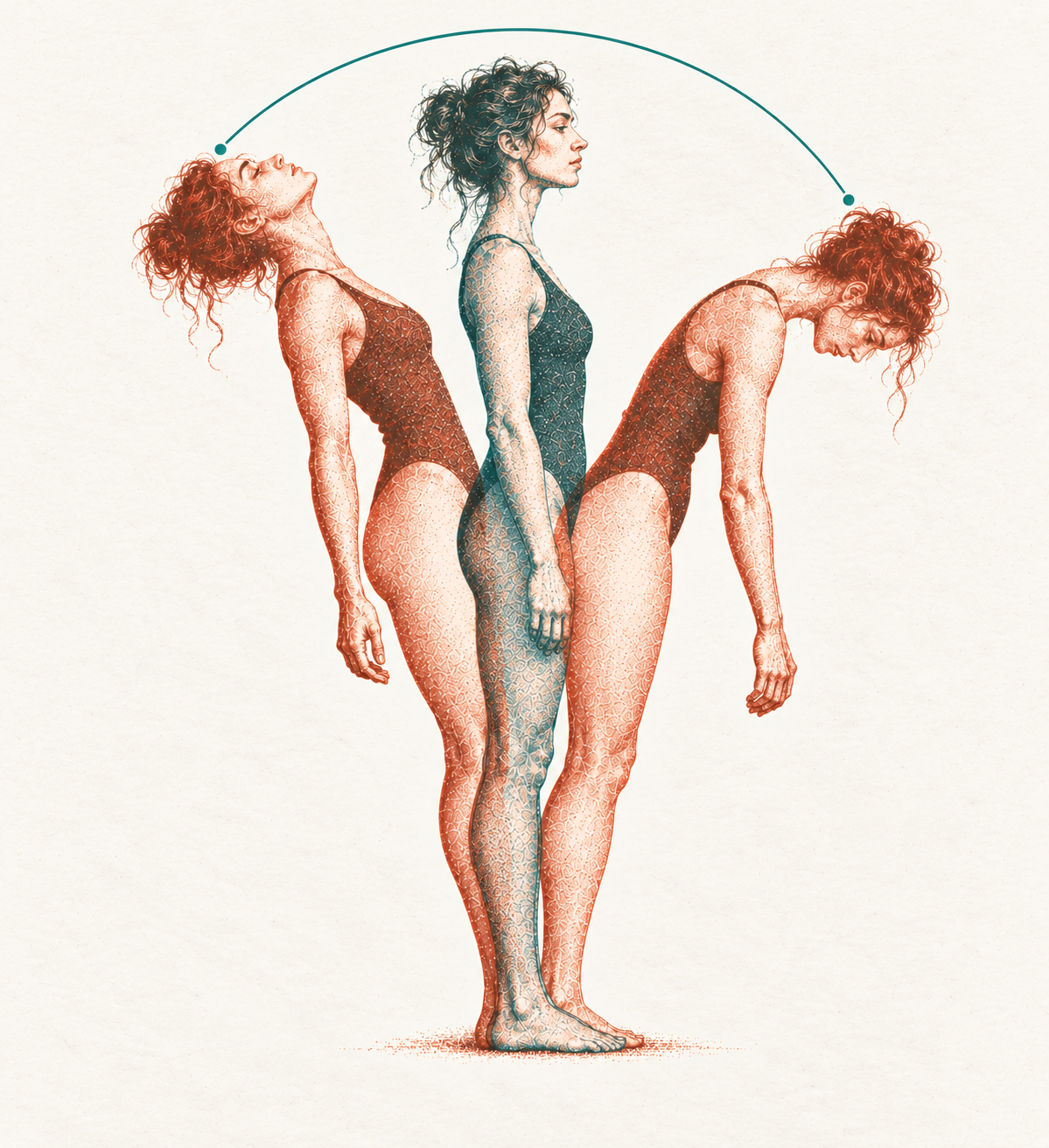
Think about it in terms of movement variability. A healthy system doesn’t park in one position. It cycles — flexion and extension, left rotation and right rotation, inhale and exhale. It can go somewhere and come back. The research on human movement variability supports this idea: optimal movement is characterized not by finding and holding a “correct” position, but by having access to a rich range of movement possibilities.¹
When researchers study pathological movement, they consistently find the same signature: reduced variability. The system gets stuck in a narrower range. It can still move — but it can move into fewer places.¹ ² Low coordinative variability concentrates strain on the same tissues, in the same patterns, at the same joint angles, and reduces the system’s ability to adapt to perturbation.²
That’s what assessment tests are reading. Not whether you’re in the “right” position. Whether you can get to positions and leave them.†
A pelvis that can shift left and right is more neutral than a pelvis that’s perfectly centered but can only shift in one direction. One has options. The other is stuck in a good-looking position.†
The three dimensions: what the self-tests read
In last week’s newsletter, you tried the single-leg balance test. That reads stance commitment — where the pelvis parks under load, and which side the nervous system selected for stability.†
Here are two more. Each reads a different dimension of the same underlying pattern.
Test 2: Seated hip shift
Sit on a firm, flat chair. Feet flat. Hands on your thighs. Without lifting your feet, shift your hips to the left. Return to center. Now shift right.
One direction probably moves easily. The other feels blocked — like the pelvis won’t go there, or like your whole trunk has to come along for the ride.
This reads pelvic rotation — which direction the pelvis can actually move toward without the whole system compensating. If the nervous system committed to one rotational orientation, you’ll feel it: one direction is available, and the other isn’t.†
Test 3: Wall reach
Stand with your back flat to a wall. Heels, butt, upper back touching. Reach both arms straight overhead toward the ceiling, keeping your back flat.
Notice: Does one arm reach higher than the other? Does one side of your ribcage lift away from the wall? Does your low back have to arch off the wall to let your arms up?
This reads rib and thorax position — whether the system can extend overhead without compensating at the spine or ribcage. If the thorax is locked in one orientation, overhead reach requires the low back to overextend, and you’ll feel the wall contact change.†
The pattern across all three
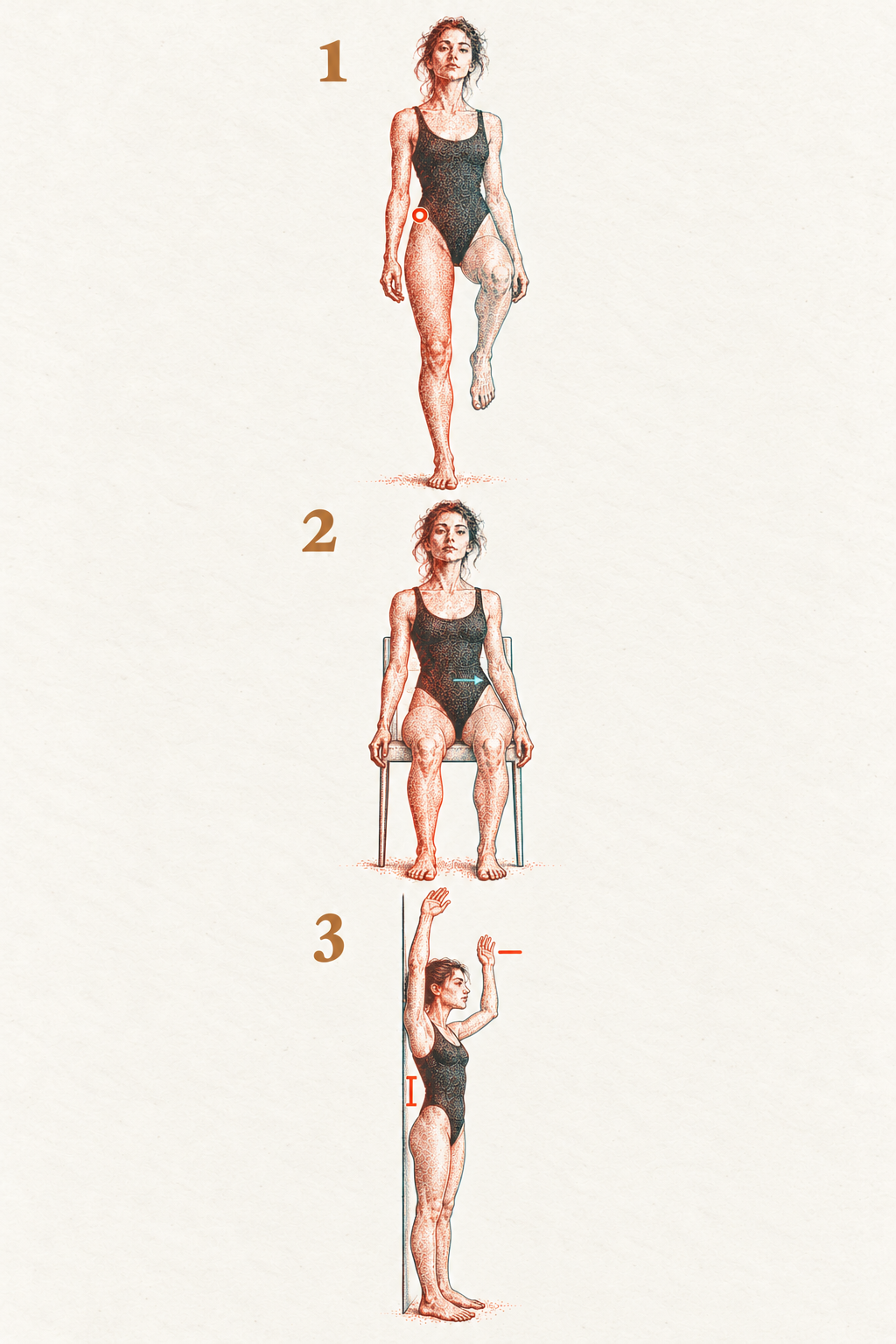
If you noticed asymmetry on all three tests — and most people will — they’re reading the same thing at different levels. The pelvis, the ribcage, and the stance pattern are all part of one system, and the nervous system committed to all of them together.†
An in-person assessment does the same thing with more precision, more positions, and a clinical framework that maps how these dimensions relate to each other. You’re not learning anything an assessment wouldn’t tell you. You’re just getting a preview of the territory.†
Why more data doesn’t help (without a framework)
This is the part that matters for anyone who’s been chasing diagnostics.
You can measure everything. Force plates. Motion capture. Blood panels. HRV. EMG. You can accumulate an enormous amount of data about what the body is doing. And none of it tells you what to do unless you have a framework to interpret it.
A force plate will tell you that your weight distribution is asymmetric. It won’t tell you why the system committed to that distribution, or what the asymmetry means in the context of your pelvis, your ribcage, and your breathing pattern.† An MRI will show you a disc bulge. It won’t tell you whether that bulge is the cause of your pain or just an incidental finding in a system that committed to a position decades ago.
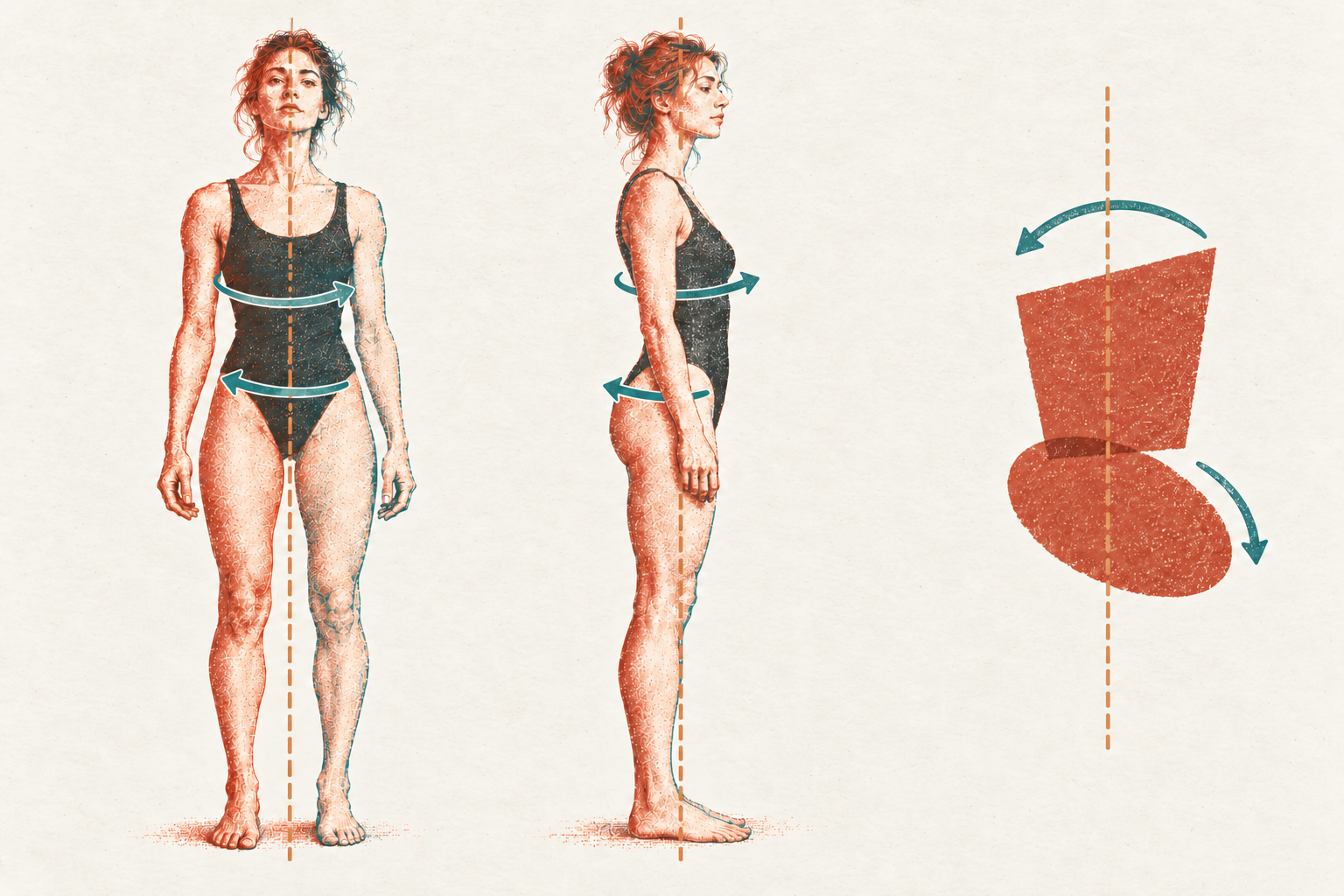
Assessment isn’t about collecting more data points. It’s about reading the pattern that the data points describe.† The framework connects the hip to the ribcage to the breath to the stance — not because those connections are speculative, but because the system committed to all of them as one coordinated solution.†
Here’s what that means in practice: if I know where the pelvis committed, I already have a reasonable expectation for what the ribcage, the breathing pattern, and the stance will look like — before I test them.† That’s the difference between a screen that collects findings and a framework that generates predictions. The screen gives you data. The framework tells you what the data should look like if the pattern is what you think it is — and when the prediction matches, you know what to address first.†
The motor control literature offers a useful parallel here. Scholz and Schöner’s uncontrolled manifold concept demonstrates that the nervous system doesn’t control every joint independently. It stabilizes what matters for the task — the center of mass, the hand position, the gaze direction — and lets everything else vary freely.⁴ Assessment works the same way: you’re looking for what the system stabilized — the positions it locked into — and what it left free. The locked positions tell you where the commitment is. The free positions tell you what options remain.†
What changes first
When an assessment identifies the pattern, the first thing that changes is the position. Not the strength. Not the flexibility. The position.†
This is repositioning — the same principle we covered in Part Five. A specific drill changes where the pelvis sits, or where the ribcage orients, or how the breath moves through the system. It doesn’t strengthen anything. It gives the nervous system a different starting point.†
And then you retest. Same test, different result. That’s the signal that something shifted.†
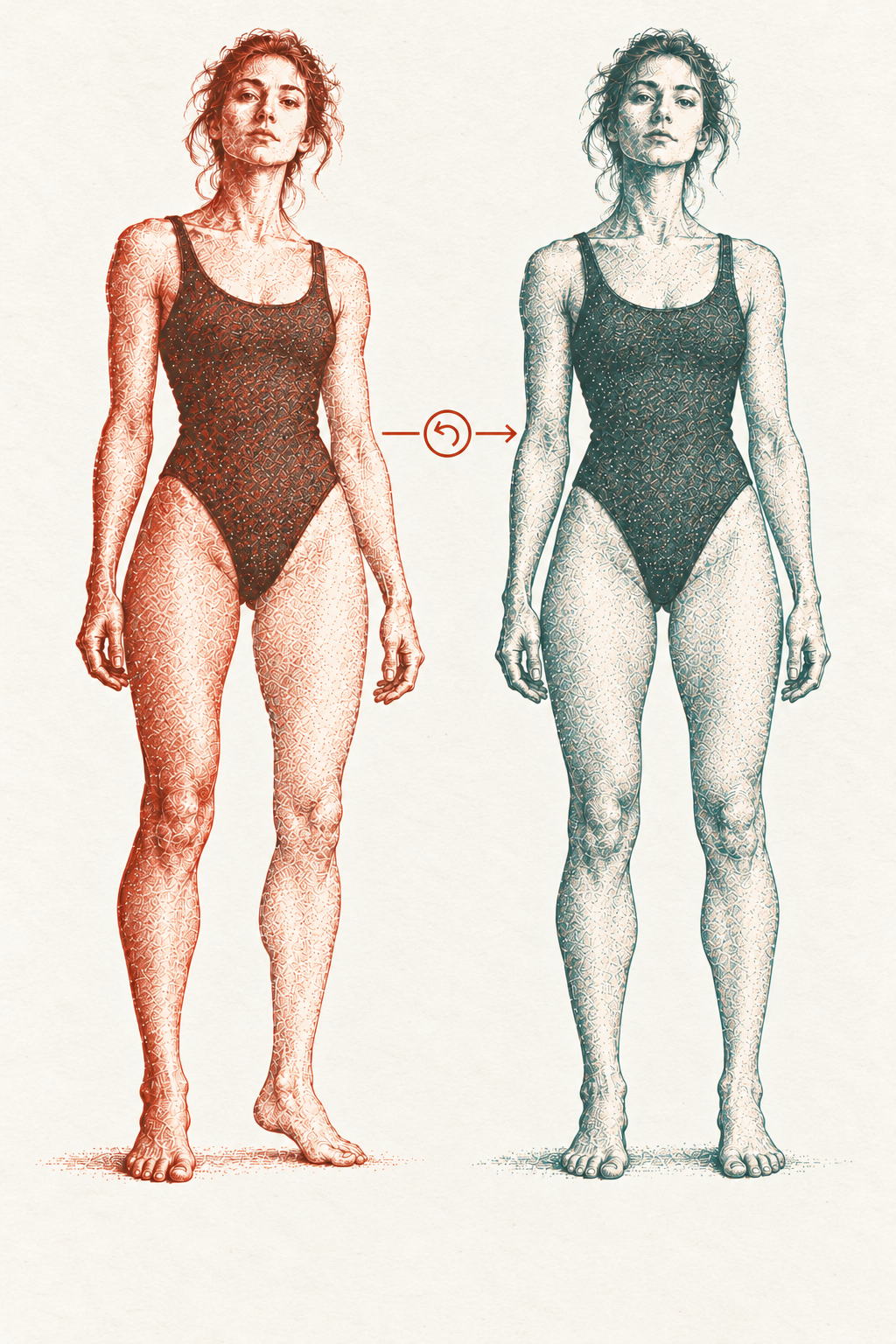
The reason the retest matters is that it closes the loop. You measured a position. You changed it. You measured it again. If the test changes, the system found a new option. If it doesn’t, you’re working at the wrong level.†
That’s what an assessment actually finds. Not what’s wrong. Just where you are — and what changes first.
The fine print
Citations
1 — Stergiou N, Decker LM. Human movement variability, nonlinear dynamics, and pathology: is there a connection? Hum Mov Sci. 2011;30(5):869-888. doi:10.1016/j.humov.2011.06.002. Limitation: review article proposing a theoretical framework (optimal movement variability as a U-shaped curve). The framework is well-cited and influential, but the specific “optimal variability” model has not been validated across all movement domains in controlled trials.
2 — Hamill J, Palmer C, Van Emmerik REA. Coordinative variability and overuse injury. Sports Med Arthrosc Rehabil Ther Technol. 2012;4:45. doi:10.1186/1758-2555-4-45. Limitation: theoretical framework with supporting examples from running and gait analysis. The connection between low variability and overuse injury is proposed and supported with biomechanical evidence, but not tested in a prospective controlled trial.
3 — Harbourne RT, Stergiou N. Movement variability and the use of nonlinear tools: principles to guide physical therapist practice. Phys Ther. 2009;89(3):267-282. doi:10.2522/ptj.20080130. Limitation: conceptual framework applying nonlinear dynamics to PT practice. Proposes that variability analysis should guide clinical decisions; clinical application is proposed, not empirically validated in RCTs.
4 — Scholz JP, Schöner G. The uncontrolled manifold concept: identifying control variables for a functional task. Exp Brain Res. 1999;126(3):289-306. doi:10.1007/s002210050738. Limitation: laboratory study of sit-to-stand in healthy adults (n=7). Foundational motor control theory with strong subsequent empirical support, but the original study is a small-sample proof of concept.
5 — Hodges PW, Richardson CA. Inefficient muscular stabilization of the lumbar spine associated with low back pain: a motor control evaluation of transversus abdominis. Spine. 1996;21(22):2640-2650. PMID 8961451. Limitation: 15 LBP patients vs 15 controls. Foundational motor control study establishing the delayed TrA onset paradigm. Widely replicated but the original sample is small, and the clinical relevance of feed-forward timing delays remains debated — some subsequent work questions whether onset timing is the right variable to measure.
6 — Moseley GL. A pain neuromatrix approach to patients with chronic pain. Man Ther. 2003;8(3):130-140. PMID 12909433. Limitation: narrative review proposing a theoretical framework (the pain neuromatrix model applied to clinical practice). Highly influential and well-cited, but the neuromatrix model itself is a conceptual framework, not a testable hypothesis in its full form.
Framework note
† Marked claims describe the Postural Restoration Institute® clinical model and AER’s applied method — assessment as positional pattern recognition rather than pathology diagnosis, “neutral” as the ability to access multiple positions rather than a single alignment, asymmetric nervous system commitment as the organizing principle of the pattern, and repositioning followed by retesting as the corrective sequence. These are core tenets of a coherent, decades-refined clinical framework. They are not conclusions from peer-reviewed controlled trials on these specific claims.
Self-test disclaimer
The three self-tests described above (single-leg balance, seated hip shift, wall reach) are qualitative self-assessments, not clinical diagnostic tests. What you feel is real information, but it is not a diagnosis. Individual results vary. If any test causes pain, stop. An in-person assessment determines what specifically applies to you. Nothing in this article is medical advice.
Peter Jang, MFA CSCS PRT Certified Postural Restoration Center · Back Bay, Boston aerboston.com
The Letter
The writing here is the why. The letter is where the what to do lives — the protocol, the drill, the case behind each piece.
If any of this changed how you think about your own body, an assessment is where that conversation starts.