
The Asymmetry — Part 5
Why your 'good side' isn't.
The side that does everything can't do anything else.
You have a strong side. The leg you balance on, the arm you carry with. You've been training it more because it performs better. That's the problem. The side you call strong can push and lock and bear load — but it can't do anything else. That's not strength. That's being stuck.
You have a strong side. Everyone does. The leg you balance on, the arm you carry with, the side you push off from.
You’ve been training it more because it performs better.
That’s the problem.
If you’ve been following along since No. 21, you’ve seen this pattern build. The pelvis settles into a predictable orientation.† The ribcage counter-rotates.† The diaphragm loses its dome on one side. The chain runs all the way through the neck, jaw, and eyes.
Four weeks of anatomy. This week is different. This week is about what happens when you load the pattern instead of changing it.
First — the assumption that needs breaking. The side you prefer for motor tasks isn’t necessarily the stronger side. Limb dominance and limb strength are different things. Preference is task-specific, and the direction of asymmetry between limbs reverses between tests in 21–38% of people.1 The side you call your “good side” is the one your nervous system committed to. That’s not the same claim as “strong.”
What “strong” actually means here.
For most people, the right side is the go-to for stability. It’s the stance side. The platform.
In the typical resting pattern, the right side is oriented into extension — the hip stays extended, the pelvis rotates forward on that side.† That makes it the default for weight-bearing. It pushes. It stabilizes. It holds.
Not because it’s stronger. Because it’s stuck there.†
A muscle can generate force. That’s strength. But motor control is the nervous system’s ability to recruit the right muscles, in the right sequence, at the right time. Those are different constructs. In a randomized trial of 149 people with chronic low back pain, person-specific motor skill training produced almost double the functional improvement compared to strength and flexibility exercise — 60% versus 35% improvement, with a 7.9-point greater reduction in disability that held at 12 months.2 More force didn’t help as much as changing the movement pattern.
The side you call strong can push. It can lock. It can bear load. But it can’t flex, can’t swing, can’t yield, can’t alternate.† A system with low movement variability — one that repeats the same coordination pattern every time — concentrates strain on the same tissues and loses its ability to adapt.3 That’s what positional dominance looks like. One option, repeated.
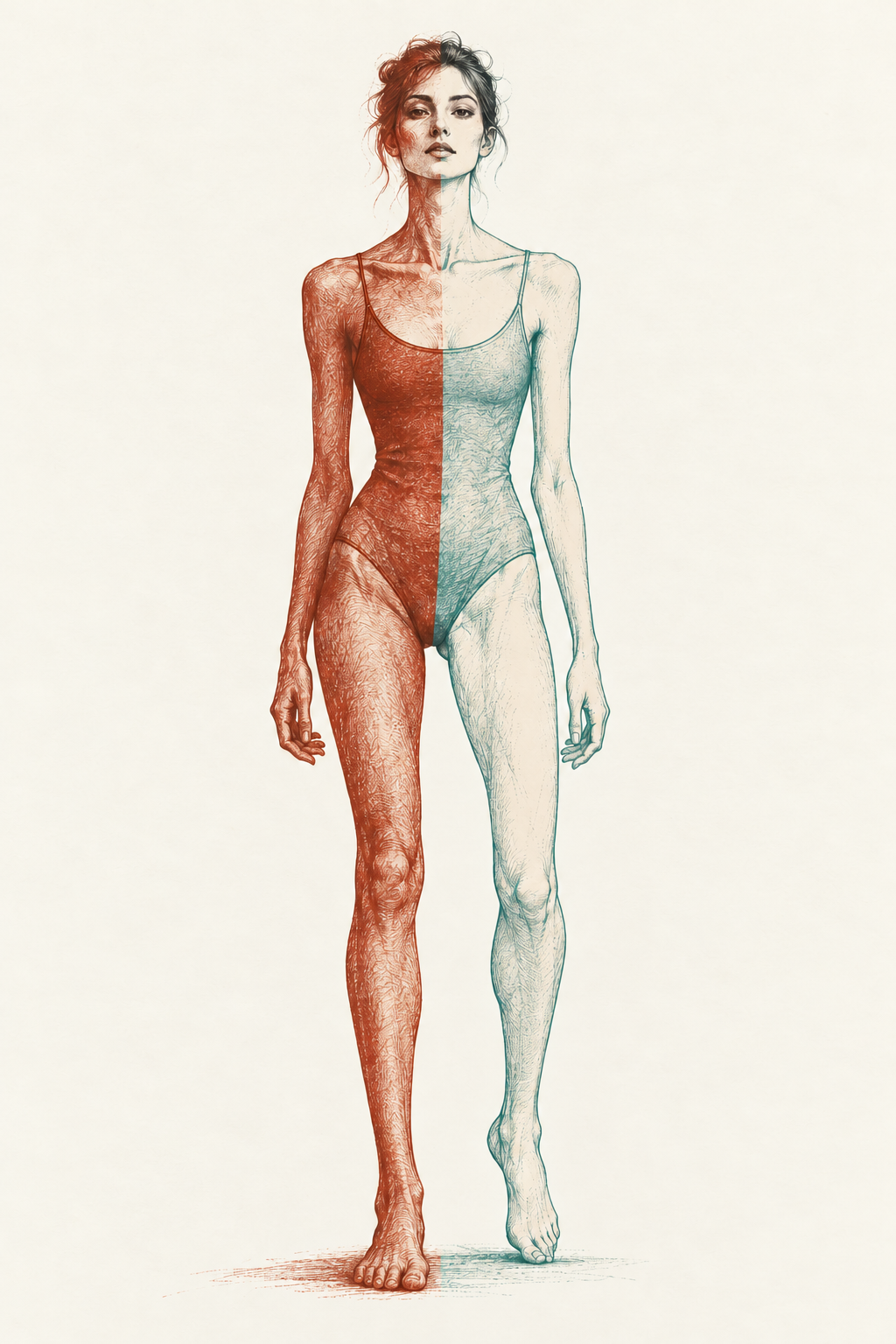
The “weak” side isn’t weak.
The left side tests weaker. It feels shaky on single-leg work. It doesn’t push as hard.
But “tests weaker” and “is weaker” are different things.
Arthrogenic muscle inhibition is a well-documented phenomenon. It’s a neural activation deficit, not a muscle problem. When joint position or afferent input changes, the nervous system reduces its ability to fully activate surrounding musculature — independent of any actual muscle damage or atrophy. A review of 122 articles found that a substantial portion of what looks like “weakness” in clinical testing reflects impaired neural drive, not true contractile loss.4
Reciprocal inhibition works on a similar principle. When one muscle group is tonically active — locked on — its antagonist gets neurally down-regulated. The dominant side isn’t just working harder. It’s suppressing the other side.
The framework interpretation: the left side isn’t weak. The system stopped recruiting it because the right side took over the stability role.† The left side is inhibited, not insufficient.† The nervous system isn’t sending the signal. That’s not the same as the muscle not being able to respond.
What training the “good side” harder does.
Here’s where the training implications land.
When you keep loading the dominant side — more squats biased right, more single-leg work on the “stable” leg, more drive through the stance platform — you reinforce the pattern.† More extension commitment. Less alternation. The system gets deeper into the rut, not out of it.†
The evidence on asymmetry is nuanced. Persistent, rigid asymmetry — the kind that exceeds 10–15% and doesn’t vary by task — is associated with elevated injury risk in sport. But the evidence base is moderate to low quality, those thresholds are somewhat arbitrary, and the association isn’t universal.5 The point isn’t that asymmetry is automatically dangerous. Normal asymmetry is task-specific and variable. The problem is when it becomes fixed — when one side can only do one thing.
There’s also evidence that the nervous system doesn’t perfectly isolate sides. Training one limb produces modest strength gains in the untrained contralateral limb — a phenomenon called cross-education, averaging around 7.8% transfer. It’s neural, not hypertrophic.6 The sides are more connected than we train them. If you load the dominant side harder, you’re not just training that side. You’re reinforcing the entire dominance pattern.†
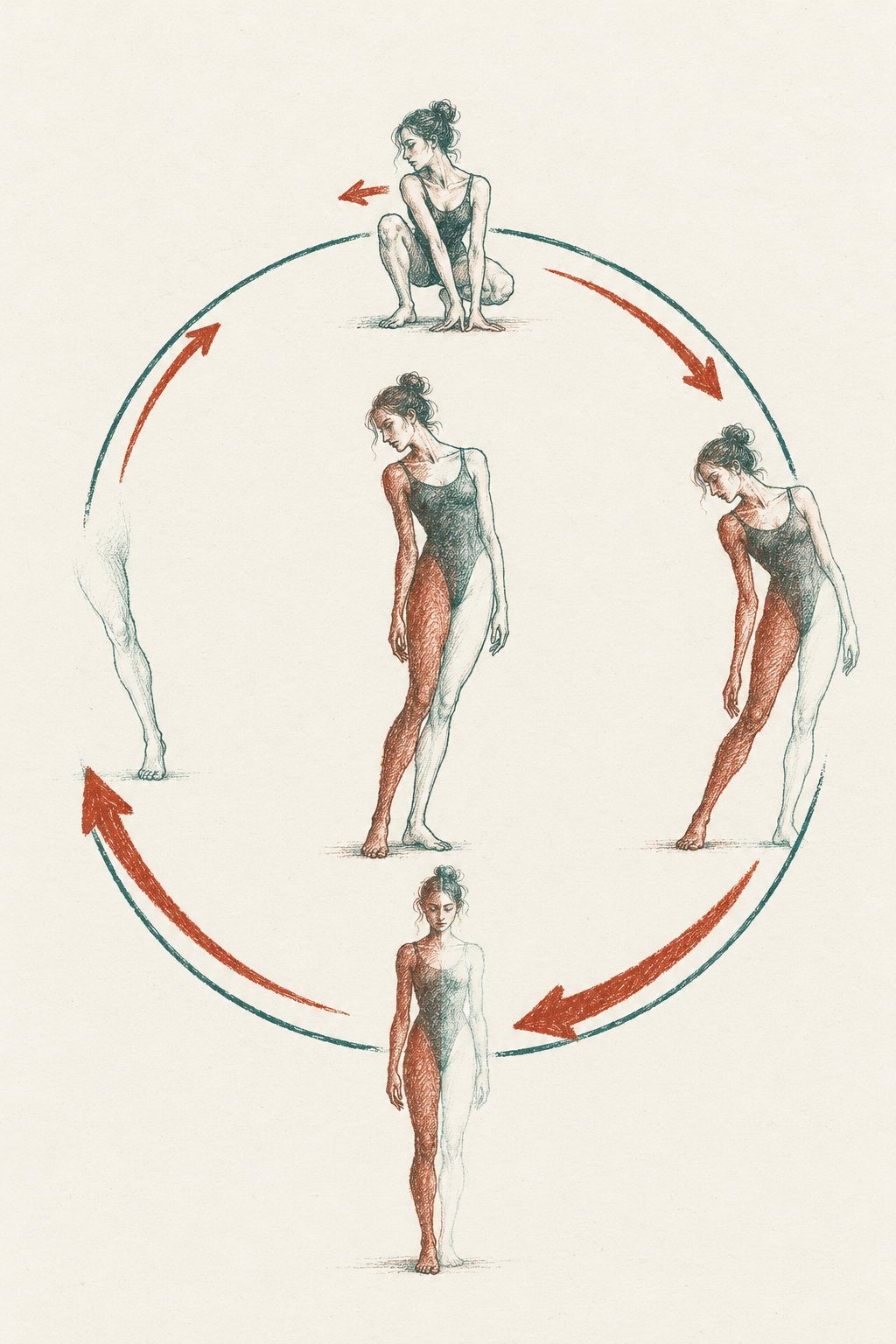
What actually changes the position.
This is the part that’s different from “just strengthen the weak side.”
Repositioning means changing the position first — getting the pelvis back to a place where the left side can participate — and then asking the system to stabilize there.† The sequence matters. Strengthening loads a position the system is already in. Repositioning changes the starting point.†
Same principle from No. 23 and No. 24. Breathing changes the position of the ribcage. The ribcage position changes what the neck has to do. Same logic applied to training: if the system is stuck in a pattern, adding load to that pattern makes it stickier.†
“Just strengthen the weak side” doesn’t work long-term from the same patterned position.† The nervous system will recruit the right side to compensate, even during a “left-side” exercise. Position changes before recruitment changes.
What I’m not claiming.
The motor control vs. strength distinction is well-established at the level of individual joints and specific tasks.2 Applying it to a global postural pattern — the whole body, not one joint — is an extrapolation from that local evidence. I’ve tried to be clear about where that line sits.
Arthrogenic muscle inhibition is documented primarily in post-injury and post-surgical populations, especially around the knee.4 Extending the concept to habitual postural patterns is inference, not direct evidence from those studies.
Low movement variability is associated with overuse injury in a theoretical framework using dynamical systems theory.3 The model is proposed, not empirically tested at the scale I’m applying it. The reasoning is sound. The direct evidence is developing.
The cross-education literature shows real but modest bilateral transfer — a meta-analysis of 17 studies found an average 7.8% contralateral strength gain (95% CI: 4.1–11.6%).6 I’m using it to make the narrow point that the nervous system doesn’t perfectly isolate sides — not to claim that training one side meaningfully strengthens the other.
The PRI framework interpretation — that stance-side dominance is driven by the typical resting pattern and resolved by repositioning — is clinical framework with decades of refinement, not a conclusion from a randomized trial. Flagged throughout with †.
The pattern is real. You can check your shoes. You can feel the breathing difference. You can stand on each leg and notice which one grips and which one searches.
Now what?
Next week: you’ve checked your shoes, felt the breathing difference, and stood on each leg. Now what? No. 26 walks through what an assessment finds — and what the first session looks like.
Book an assessment at aerboston.com →
The fine print.
Every claim marked with a dagger (†) depends on the PRI clinical framework — a system with decades of clinical refinement, but not mainstream consensus biomechanics. PRI claims are presented as interpretive framework, not settled evidence. They’re flagged so you can tell the difference.
-
Virgile A, Bishop C. A Narrative Review of Limb Dominance: Task Specificity and the Importance of Fitness Testing. J Strength Cond Res. 2021;35(3):846-858. PMID 33470600. Limb preference and limb performance dominance are task-specific and frequently discordant. Between-session limb dominance reversed in 21–38% of participants across different tests. Limitation: narrative review, not systematic. Focused on athletic populations. Demonstrates that dominance is task-specific but does not directly test the “strong side is stuck” claim.
-
van Dillen LR, Lanier VM, Steger-May K, et al. Effect of Motor Skill Training in Functional Activities vs Strength and Flexibility Exercise on Function in People With Chronic Low Back Pain: A Randomized Clinical Trial. JAMA Neurol. 2021;78(4):385-395. PMCID PMC7770617. Person-specific motor skill training produced 60% functional improvement vs. 35% for strength/flexibility exercise, with a 7.9-point greater disability reduction that persisted at 6 and 12 months. Limitation: specific to chronic nonspecific low back pain (n=149). Motor skill training was tailored to each participant’s movement patterns, not a standardized protocol. Shows motor control training can outperform strengthening, but does not test global postural retraining.
-
Hamill J, Palmer C, Van Emmerik REA. Coordinative variability and overuse injury. Sports Med Arthrosc Rehabil Ther Technol. 2012;4:45. PMID 23186012. Low movement variability concentrates strain on the same tissues and is associated with overuse injury. Higher variability represents a healthier, more adaptable system. Limitation: theoretical framework paper using dynamical systems theory. Proposes the model rather than testing it empirically. The specific relationship between reduced variability and specific injuries needs more prospective research.
-
Norte GE, Rush JN, Sherman DA. Arthrogenic Muscle Inhibition: Best Evidence, Mechanisms, and Theory for Treating the Unseen in Clinical Rehabilitation. J Sport Rehabil. 2022;31(6):707-720. PMID 34883466. AMI is a neural activation deficit — altered afferent input from the joint reduces the nervous system’s ability to fully activate surrounding musculature. A substantial proportion of clinical “weakness” reflects impaired neural drive rather than true muscle loss. 122 articles reviewed. Limitation: focused on post-injury and post-surgical populations, primarily the knee. The concept applies to joint pathology. Extending it to habitual postural patterns is inference, not direct evidence from these studies.
-
Helme M, Tee J, Emmonds S, Low C. Does lower-limb asymmetry increase injury risk in sport? A systematic review. Phys Ther Sport. 2021;49:204-213. DOI 10.1016/j.ptsp.2021.03.001. Of 31 studies (6,228 participants), asymmetries exceeding 10–15% are associated with elevated injury risk, but these thresholds are “arbitrary” and task/metric-specific. Limitation: moderate to low quality evidence overall. Association only, not causation. No quantitative pooling. Soccer over-represented in the sample. Normal task-specific asymmetry is different from persistent, rigid asymmetry.
-
Munn J, Herbert RD, Gandevia SC. Contralateral effects of unilateral resistance training: a meta-analysis. J Appl Physiol. 2004;96(5):1861-1866. PMID 15075311. Of 17 studies (13 pooled), unilateral resistance training produced a 7.8% increase in contralateral limb strength (95% CI: 4.1–11.6%), roughly 35% of the trained limb’s gains. The effect is neural, not hypertrophic. Limitation: mostly young healthy subjects. Transfer percentage varies widely. Effect is real but modest — used here only to show the sides aren’t neurally isolated, not to claim meaningful cross-limb strengthening.
The Letter
The writing here is the why. The letter is where the what to do lives — the protocol, the drill, the case behind each piece.
If any of this changed how you think about your own body, an assessment is where that conversation starts.